Negative Exponent Rule: Rewrite to Reciprocal Form
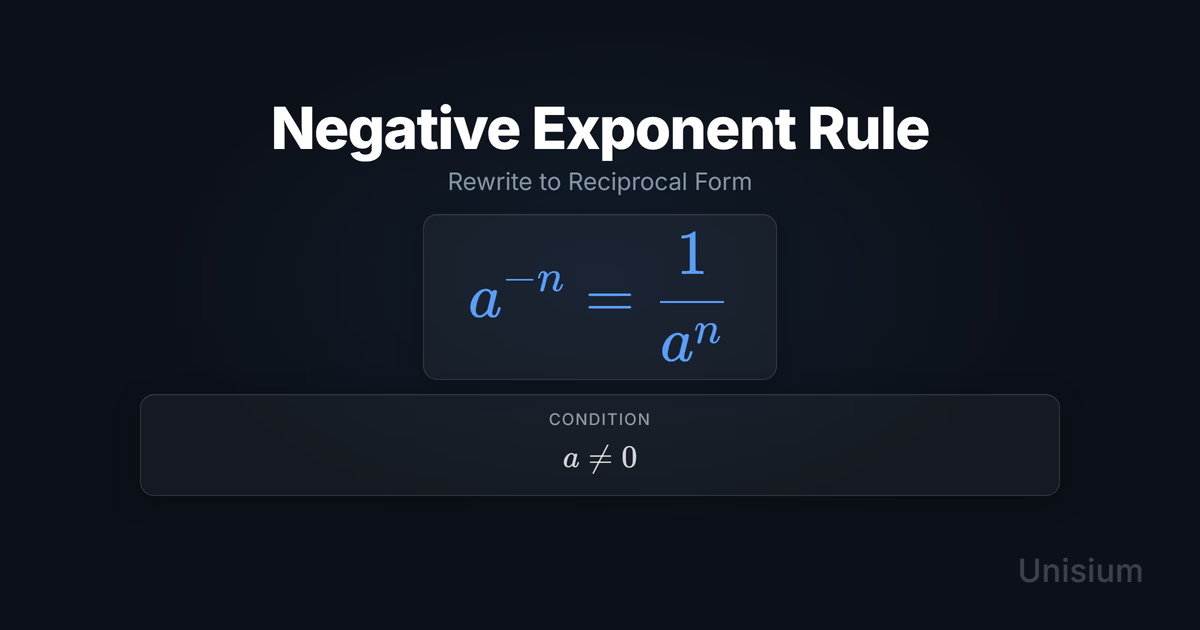
Negative Exponent Rule lets you rewrite as — converting a negative exponent into a positive exponent in the denominator and producing an expression of equal value for every allowed variable assignment. The move requires , since is undefined. Mastering when and how to apply this rewrite is a core exponent fluency skill practiced in the Unisium Study System.
This guide sits inside the Algebra study map, where you can see the neighboring moves, models, and next-step guides that connect this principle to the rest of algebra.
On this page: The Principle | Conditions | Failure Modes | EE Questions | Retrieval Practice | Practice Ground | Solve a Problem | FAQ | How This Fits
The Principle
The move: Rewrite as , or equivalently rewrite as , whenever .
The invariant: This produces an equivalent expression with the same value for every allowed variable assignment (where ). The rule extends uniformly to any base — a number, a variable, or a parenthesized compound expression.
Pattern:
| Legal ✓ | Illegal ✗ |
|---|---|
| (moves the negative to the coefficient) | |
| (splits the compound base) |
The second illegal case is the critical near-miss: the base of the exponent is the entire expression , not just . Rewriting as splits the base and abandons the reciprocal structure — the correct result is the single fraction .
Conditions of Applicability
Condition:
Before applying, check: Is the base zero, or could it equal zero for any value of the variable? If yes, the expression is undefined at that point.
If the condition is violated: requires dividing by , which is undefined — the rewrite step cannot be performed.
- For a variable base like , the rule produces and carries the implicit restriction .
- For a compound base like , the restriction becomes ; the entire parenthesized expression is the base, and the exponent applies to it as a whole.
- The rule can also be used in reverse: (provided ), which is useful when applying the Exponent Product Rule to combine terms with negative exponents.
Want the complete framework behind this guide? Read Masterful Learning.
This move is easiest once the Exponent Product Rule feels automatic. Compare it with Exponent Power of a Power Rule when deciding whether an exponent is negative or nested, and use it next in Exponential Model work where rewriting powers clarifies growth or decay.
Common Failure Modes
Failure mode: write as — treating the negative exponent as a sign on the base → the result has the wrong sign and wrong magnitude (e.g., becomes instead).
Debug: ask “is the negative on the exponent or on the base?” Negative exponent → reciprocal only: , which is positive for a positive base. A negative base requires explicit parentheses, such as .
Elaborative Encoding
Use these questions to build deep understanding. (See Elaborative Encoding for the full method.)
Within the Principle
- Why does the rule require ? What specific operation would break down if ?
- What does “negative exponent” encode about the position of a factor — numerator versus denominator?
For the Principle
- How do you decide whether to apply this rule when the base is a compound expression such as ? What restriction must you record?
- What changes in the procedure when you apply the rule in reverse — writing as ? When is the reverse direction useful?
Between Principles
- How does the Negative Exponent Rule interact with the Exponent Product Rule? For example, how would you simplify in two different ways and verify they agree?
Generate an Example
- Construct an expression with two variables where one has a negative exponent and the other has a positive exponent. Show how to rewrite it with all positive exponents, and state what restrictions are implied.
Retrieval Practice
Answer from memory, then click to reveal and check. (See Retrieval Practice for the full method.)
State the move in one sentence: _____Rewrite a negative exponent as the reciprocal of the same base with a positive exponent: a to the negative n equals 1 over a to the n.
Write the canonical pattern: _____
State the canonical condition: _____
Practice Ground
Use these exercises to build move-selection fluency. (See Self-Explanation for how to use worked examples effectively.)
Procedure Walkthrough
Starting from (), rewrite with positive exponents.
| Step | Expression | Operation |
|---|---|---|
| 0 | — | |
| 1 | Apply the rule to : base ✓ | |
| 2 | Apply the rule to : base ✓ | |
| 3 | Combine into a single fraction |
Drills
Format A — Forward step
Apply the Negative Exponent Rule once.
Reveal
Base is the number , so the rule applies:
Apply the Negative Exponent Rule once. (Assume .)
Reveal
Apply the Negative Exponent Rule once. (Assume .)
Reveal
The entire expression is the base, so the exponent applies to the whole factor:
Reject the invalid rewrite. What is wrong? (Assume .)
Reveal
Not valid. The Negative Exponent Rule converts a negative exponent into a reciprocal — it does not change the sign of the base or produce a negative result:
, which is always positive for .
The expression is always non-positive — a completely different quantity. The error is relocating the negative sign from the exponent position to become a coefficient sign. Negative exponent means reciprocal, not sign flip.
Apply the rule in reverse — write using a negative exponent. (Assume .)
Reveal
Apply the rule in reverse — write using a negative exponent. (Assume .)
Reveal
Only the factor carries the reciprocal; the coefficient is unaffected:
Format E — Canonicalization
Rewrite with positive exponents only. (Assume .)
Reveal
Apply the rule independently to each factor with a negative exponent:
Rewrite with positive exponents only. (Assume .)
Reveal
Apply the rule to the numerator: .
Apply the rule to the denominator: , so dividing by means multiplying by :
A negative exponent in the denominator moves to the numerator as a positive exponent.
Rewrite with positive exponents only and simplify. (Assume .)
Reveal
Multiply, grouping same bases and adding exponents:
Apply the Negative Exponent Rule to each remaining negative exponent:
A student rewrites as . Is this correct? Find the error. (Assume .)
Reveal
Not correct. The student squared the fraction without first taking the reciprocal, giving .
A negative exponent means take the reciprocal of the whole base, then raise to the positive exponent:
The result is — the student’s answer and the correct answer are reciprocals of each other.
Rewrite with positive exponents only and simplify. (Assume .)
Reveal
Only carries a negative exponent; stays in the numerator unchanged:
Rewrite in fully positive-exponent form. (Assume .)
Reveal
Apply the rule to the numerator factor and note that the denominator factor in the denominator moves to the numerator as :
Solve a Problem
Apply what you’ve learned with Problem Solving.
Problem: Starting from (), rewrite with positive exponents only.
Full solution
| Step | Expression | Move |
|---|---|---|
| 0 | — | |
| 1 | Apply : numerator ; denominator | |
| 2 | Dividing by equals multiplying by | |
| 3 | Combine into a single fraction |
FAQ
What is the Negative Exponent Rule?
The Negative Exponent Rule states that for any nonzero base . A negative exponent means “take the reciprocal and use a positive exponent.” It does not make the result negative — for a positive base, both and are positive.
When is the Negative Exponent Rule valid?
The rule is valid whenever . If , the denominator , and division by zero is undefined. When is a variable or compound expression, carry the corresponding restriction (e.g., or for base ).
Does a negative exponent mean the result is negative?
No. equals . For a positive base, the result is positive (e.g., ). The sign of the exponent controls position in a fraction — numerator versus denominator — not the sign of the resulting value.
How do I rewrite using a negative exponent?
Apply the rule in reverse: (provided ). This is useful for combining terms with the same base using the Exponent Product Rule: e.g., .
What if the base is a compound expression like ?
The entire parenthesized expression is the base. , with the restriction . Never distribute the reciprocal over addition: .
How is the Negative Exponent Rule different from the Exponent Product Rule?
The Negative Exponent Rule is a rewrite rule: it changes the form of a single power to without combining it with another factor. The Exponent Product Rule combines two same-base powers into . The two rules are complementary: you often apply the Negative Exponent Rule after the Product Rule to clear any remaining negative exponents.
How This Fits in Unisium
In the Unisium Study System, the Negative Exponent Rule is tracked as a rewrite move in the algebra exponent family, appearing alongside the Exponent Product Rule and the Exponent Power Rule. Sessions combine forward-step drills (apply the rule once, predict the result) with canonicalization exercises (clear all negative exponents from a multi-factor expression), mirroring the Format A and Format E structure used above. The recurring diagnostic focus is the sign error — students who write reveal a misread of the exponent’s role, which Unisium targets with targeted reveal drills before it becomes an ingrained mistake.
Explore further:
- Exponent Product Rule — Combine same-base powers by adding exponents; pairs directly with the Negative Exponent Rule
- Elaborative Encoding — Deepen understanding of why is non-negotiable
- Retrieval Practice — Make the canonical pattern and condition instantly retrievable
Ready to master the Negative Exponent Rule? Check access and join the Unisium waitlist or explore the full learning framework in Masterful Learning.

Masterful Learning
The book behind these guides: a study system for physics, math, & programming built on retrieval, connection, explanation, and problem solving.
Ready to apply this strategy?
Unisium turns these evidence-based techniques into guided study sessions for math and physics. Places are limited during early access. Check current availability to start a trial; joining the mailing list is optional.
See plans and availability Read More GuidesAlready have access? Sign in