Simplify Radicals (Square Factor): Extract Perfect-Square Roots
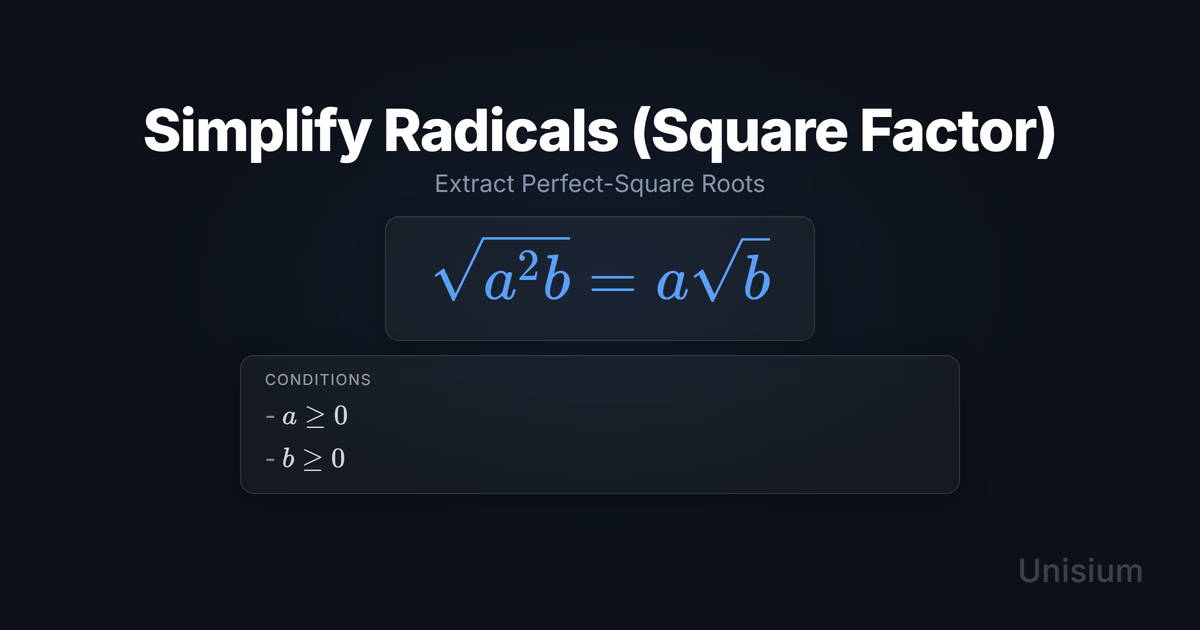
Simplify Radicals (Square Factor) lets you extract a perfect-square factor from under a square root — replacing with — producing an equivalent expression with the same value for every allowed variable assignment. It applies when and ; if could be negative the extraction silently drops the required absolute value and produces the wrong sign. Recognizing which factors are perfect squares and confirming the extracted factor is non-negative before applying the rule is a core algebra fluency skill practiced in the Unisium Study System.
This guide sits inside the Algebra study map, where you can see the neighboring moves, models, and next-step guides that connect this principle to the rest of algebra.
On this page: The Principle | Conditions | Failure Modes | EE Questions | Retrieval Practice | Practice Ground | Solve a Problem | FAQ | How This Fits
The Principle
The move: Extract a perfect-square factor from under a square root: replace with .
The invariant: This produces an equivalent expression with the same value for every allowed variable assignment (when and ).
Pattern:
| Legal ✓ | Illegal ✗ |
|---|---|
Legal: , so for every real and — both conditions hold without any sign restriction. Illegal: the radicand is a sum, not a product of the form ; at the claimed result gives while the true value is .
Conditions of Applicability
Condition: ;
Before applying, check: Factor the radicand completely; confirm that every part you plan to extract as and every remaining part is non-negative under the given variable constraints.
If the condition is violated: When , the correct result is , not — the extraction silently discards the absolute value and introduces a sign error for all inputs where is negative.
- When involves a variable (e.g., ), the assumption must be stated explicitly or guaranteed by the problem context before the move is made.
- When the radicand contains a sum (e.g., ), no factorization of the form exists across the addition, and the move does not apply.
Want the complete framework behind this guide? Read Masterful Learning.
This move starts from the meaning of radicals in Radical Definition. Compare it with Square Root Property when the radical expression is part of an equation solve rather than a simplification task, and use it next in Quadratic Formula work where simplifying the discriminant matters.
Common Failure Modes
Failure mode: extract from without verifying (e.g., if and could be negative, write ) → the rewrite drops the required absolute value, giving the wrong sign for all inputs where .
Debug: ask whether the extracted factor is guaranteed non-negative. If not, the safe form is , not .
Elaborative Encoding
Use these questions to build deep understanding. (See Elaborative Encoding for the full method.)
Within the Principle
- What does it mean for a factor inside a square root to be a “perfect square”? Why must a variable exponent be even for that variable factor to qualify as a perfect-square factor?
- Why is the condition required? What goes wrong numerically if and you still write outside the square root?
For the Principle
- How do you decide which factors to group together as when the radicand has multiple variables with different exponents?
- Why does fail when the radicand is a sum instead of a product ?
Between Principles
- How does Simplify Radicals (Square Factor) rely on the Radical Definition principle — specifically, why does require ?
Generate an Example
- Write a radicand that looks like it contains a perfect-square factor but is instead a sum (a near-miss). Then write a genuinely extractable radicand using the same symbols. Confirm the two give different values at a specific numeric input.
Retrieval Practice
Answer from memory, then click to reveal and check. (See Retrieval Practice for the full method.)
State the move in one sentence: _____Extract a perfect-square factor from under a square root: replace the square root of a-squared times b with a times the square root of b.
Write the canonical pattern: _____
State the canonical condition: _____
Practice Ground
Use these exercises to build move-selection fluency. (See Self-Explanation for how to use worked examples effectively.)
Procedure Walkthrough
Starting from (assuming ; note for all real ), reach simplest radical form.
| Step | Expression | Operation |
|---|---|---|
| 0 | — | |
| 1 | Factor to expose the perfect-square constant factor | |
| 2 | Rewrite: ; identify , | |
| 3 | Apply radicalSimplify: extract from under the root |
Drills
Format A — Forward step
Apply the principle once.
(assuming )
Reveal
Rewrite as ; set , :
Apply the principle once.
(assuming )
Reveal
Set , :
Is it legal to apply radicalSimplify to by writing (assuming )? Explain.
Reveal
No — the move is not legal here. The radicand is a sum, not a product of the form . The near-miss looks plausible because and are each perfect squares, but they are added, not multiplied. RadicalSimplify requires a multiplicative structure.
At : , while the claimed result .
Apply the principle once.
Reveal
Set (since for all real ), :
Apply the principle once.
(assuming )
Reveal
Rewrite as ; set , :
Which of the following expressions can have a perfect-square factor extracted in a single application of radicalSimplify (assuming )? State the result for each eligible case.
(i) — (ii) — (iii)
Reveal
(i) : eligible. ; : result .
(ii) : not eligible. The radicand is a sum — radicalSimplify requires a product. No perfect-square extraction is valid here.
(iii) : eligible. ; (since ): result .
Format E — Canonicalization
Rewrite in simplest radical form.
Reveal
Factor: . Set , :
Rewrite in simplest radical form (assuming ).
Reveal
Factor: . Set , :
Rewrite in simplest radical form (assuming , ).
Reveal
Factor: , so . Set , :
A student rewrites as (assuming , ). Identify the error and provide a numerical counterexample.
Reveal
Error: The radicand is a sum, not a product; radicalSimplify requires a multiplicative structure of the form . The student applied the extraction rule across addition, which is never valid.
Counterexample: At , : ; claimed .
Solve a Problem
Apply what you’ve learned with Problem Solving.
Problem: Starting from (assuming , ), reach simplest radical form using radicalSimplify.
Full solution
| Step | Expression | Move |
|---|---|---|
| 0 | — | |
| 1 | Factor ; surface the perfect-square constant factor | |
| 2 | Rewrite ; constant and -variables now form a perfect square | |
| 3 | Absorb into the square group: ; confirm , | |
| 4 | Apply radicalSimplify: extract from under the root |
Verification: ✓
FAQ
What is Simplify Radicals (Square Factor)?
It is an algebraic rewrite rule that extracts a perfect-square factor from under a square root: , valid when and . The result is an equivalent expression in simplified radical form.
When is valid?
The move is valid exactly when and . Both the extracted factor and the remaining radicand must be non-negative. When involves a variable, you must verify or assume that variable is non-negative before applying the rule.
What goes wrong if ?
When , the correct simplification is , not . Omitting the absolute value produces a negative expression where the principal square root is always non-negative. For example, with and : , not .
Why can’t I split into ?
RadicalSimplify requires the radicand to be a product , not a sum. The expression cannot be written as a perfect square times a factor — it is a sum. A quick numerical check: at , while .
How does this differ from the Radical Definition principle?
The Radical Definition principle defines what means () — it is a representational principle. Simplify Radicals (Square Factor) is a transformational principle: it specifies a concrete legal rewrite move that produces an equivalent simpler form. The definition guarantees the correctness of the result; the simplification rule tells you when and how to legally perform the move.
Does this move apply inside equations, or only to standalone expressions?
Radicals appear inside equations all the time — for example, . The radicalSimplify move rewrites the radical expression to and is completely valid inside an equation, provided and . The move is a purely expression-level rewrite: it transforms one side and leaves the rest of the equation unchanged. Condition checking is identical regardless of context — verify that the extracted factor is non-negative before applying.
How This Fits in Unisium
Radical simplification is a gateway move in algebra: it appears in polynomial operations, solving equations with square roots, and preparing expressions for the quadratic formula. In Unisium, this principle is practiced through short state-transition drills that build both extraction fluency and condition-checking fluency — especially recognizing when a sum blocks the move and when a sign assumption is needed to avoid dropping an absolute value. Use the Masterful Learning framework to connect this principle to its prerequisites and successor moves on the algebra progression map.
Explore further:
- Principle Structures — See how radicalSimplify fits in the algebra principle hierarchy alongside its prerequisite Radical Definition
- Elaborative Encoding — Build deep understanding of why the non-negativity condition is non-negotiable
- Retrieval Practice — Make the condition and canonical pattern instantly accessible under exam pressure
Ready to master radical simplification? Check access and join the Unisium waitlist or explore the full learning framework in Masterful Learning.

Masterful Learning
The book behind these guides: a study system for physics, math, & programming built on retrieval, connection, explanation, and problem solving.
Ready to apply this strategy?
Unisium turns these evidence-based techniques into guided study sessions for math and physics. Places are limited during early access. Check current availability to start a trial; joining the mailing list is optional.
See plans and availability Read More GuidesAlready have access? Sign in