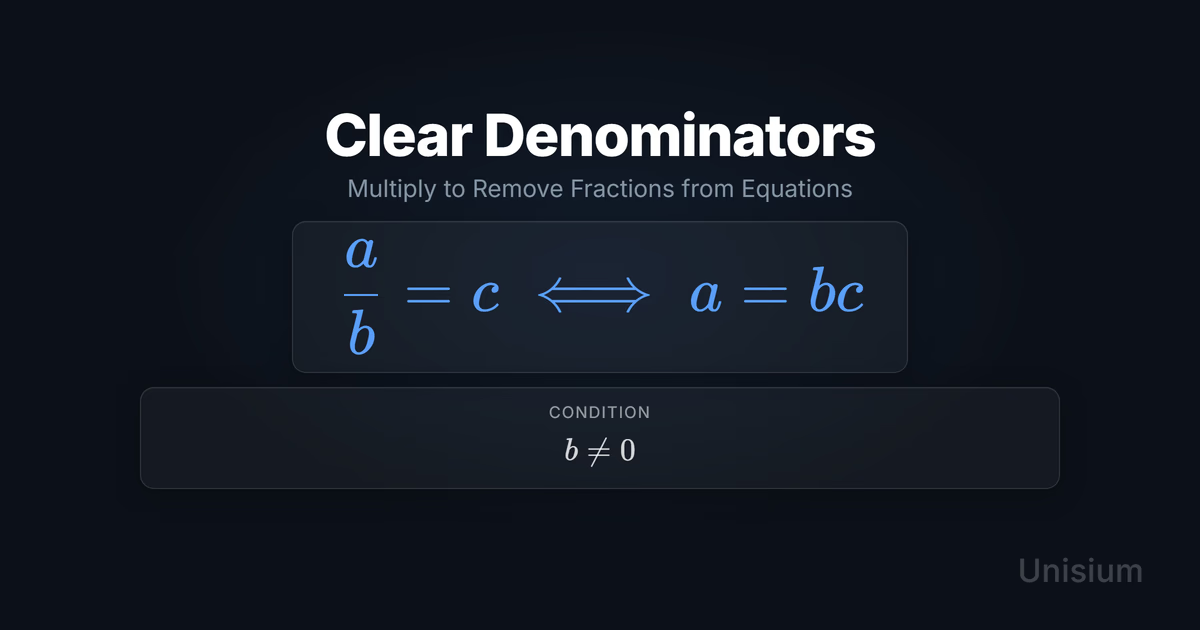
Clear Denominators: Multiply to Remove Fractions from Equations
Clear Denominators lets you multiply both sides of a fractional equation by the LCM of all denominators, producing an equivalent fraction-free equation — provided no denominator equals zero. The condition is non-negotiable: when a denominator is a variable expression, you must record its zero values as excluded from the solution set and discard any derived solution that hits an excluded value. Recognizing when this move is legal and tracking excluded values automatically is a core algebra fluency skill practiced in the Unisium Study System.
This guide sits inside the Algebra study map, where you can see the neighboring moves, models, and next-step guides that connect this principle to the rest of algebra.
On this page: The Principle | Conditions | Failure Modes | EE Questions | Retrieval Practice | Practice Ground | Solve a Problem | FAQ
The Principle
The move: Multiply both sides of a fractional equation by the LCM of all denominators to eliminate every fraction from the equation.
The invariant: This preserves the solution set — the resulting equation is equivalent to the original, provided no denominator is zero. When a denominator is a variable expression, any value making it zero must be excluded and verified after solving.
Pattern:
| Legal ✓ | Illegal ✗ |
|---|---|
Illegal: the denominator was dropped from the left side without multiplying the right side by 4 — the result shows equivalence is broken.
Conditions of Applicability
Condition:
Before applying, check: Identify every denominator in the equation; if any denominator is a variable expression, set it equal to zero and record those values as excluded from the solution set.
If the condition is violated: Multiplying by a zero expression is undefined for fractions, or collapses both sides to 0, destroying the equation’s information. Any derived solution equal to an excluded value is extraneous and must be discarded.
- When all denominators are nonzero constants (e.g., 2, 3, 5), the LCM is a nonzero constant and no exclusions apply — the cleared equation is fully equivalent.
- When a denominator is a variable expression such as , the value is excluded; if the cleared equation yields as a formal root, that root is extraneous and must be discarded, not reported as a solution.
Want the complete framework behind this guide? Read Masterful Learning.
This move depends on Multiplicative Equality because you multiply both sides by the same nonzero quantity. Compare it with Cross Multiplication when the equation is specifically a proportion, and use it next in Linear Model problems that become easier once the fractions disappear.
Common Failure Modes
Failure mode: multiplying only the fractional terms and not every term on both sides → the resulting equation is not equivalent to the original; any non-fractional term not multiplied by the LCM introduces an error.
Debug: Write the multiplication explicitly as before distributing; confirm every individual term — including constant and polynomial terms — was scaled.
Failure mode: forgetting to check excluded values when a denominator is a variable expression → a value that makes the denominator zero may appear as a formal root of the cleared equation; reporting it produces an extraneous answer.
Debug: Before recording the final answer, substitute each candidate solution back into the original fractional equation and reject any that produce a zero denominator.
Elaborative Encoding
Use these questions to build deep understanding. (See Elaborative Encoding for the full method.)
Within the Principle
- What does “preserving the solution set” mean concretely when the denominator is a nonzero constant versus when it is a variable expression containing ?
- Why is the LCM the preferred multiplier rather than any common multiple of all denominators?
For the Principle
- How do you determine the LCM when the denominators are polynomials such as and ?
- Why can a value appear as a formal root after clearing denominators even though it is not a valid solution of the original equation?
Between Principles
- How does Clear Denominators relate to Multiplicative Equality — is every Clear Denominators step also a valid Multiplicative Equality step, or is there a distinction?
Generate an Example
- Write a fractional equation where clearing denominators produces an extraneous solution. State the excluded value, show where it emerges as a formal root, and explain why it must be rejected.
Retrieval Practice
Answer from memory, then click to reveal and check. (See Retrieval Practice for the full method.)
State the move in one sentence: _____Multiply both sides of a fractional equation by the LCM of all denominators to eliminate fractions, provided no denominator is zero.
Write the canonical pattern: _____
State the canonical condition: _____
Practice Ground
Use these exercises to build move-selection fluency. (See Self-Explanation for how to use worked examples effectively.)
Procedure Walkthrough
Starting from , reach .
| Step | Expression | Operation |
|---|---|---|
| 0 | — | |
| 1 | Multiply every term by (Clear Denominators, ) | |
| 2 | Combine like terms | |
| 3 | Divide both sides by 5 (Multiplicative Equality, ) |
Drills
Format D — Goal-directed micro-chain
Micro-chain: Starting from (denominator ), clear the denominator and reach .
Reveal
Multiply both sides by ():
No excluded values — denominator is a nonzero constant.
Micro-chain: Starting from , clear all denominators and isolate .
Reveal
. Multiply every term by ():
No excluded values — denominators are nonzero constants.
Micro-chain: Starting from , clear all denominators and isolate .
Reveal
. Multiply both sides by ():
No excluded values — denominators 3 and 2 are nonzero constants. Check: and ✓.
Micro-chain: Starting from , clear all denominators, state all excluded values, and verify the solution.
Reveal
Denominators: and . Excluded values: and .
Multiply both sides by (valid when and ):
Check: and ✓. The solution is .
Micro-chain (negative): Starting from , clear the denominator, find all formal roots, and decide which are valid solutions.
Reveal
Denominator: . Excluded value: .
Multiply both sides by (valid when ):
Formal roots: and .
is the excluded value — it makes the original denominator zero, so it is extraneous and must be rejected.
Valid solution: only. Check: ✓.
Key lesson: Always test formal roots against excluded values. A root that algebraically satisfies the cleared equation can still be extraneous if it makes the original denominator zero.
Format A — Forward step
Apply Clear Denominators once:
Reveal
Multiply both sides by ():
Apply Clear Denominators once: — state the excluded value before multiplying.
Reveal
Denominator: . Excluded value: .
Multiply both sides by (valid when ):
Apply Clear Denominators once:
Reveal
. Multiply every term by ():
Apply Clear Denominators — identify the error: A student sees and writes by “removing the denominator.” Identify the error and state the correct result.
Reveal
Error: The student dropped the denominator from the left side without multiplying the right side by 3. This breaks equivalence: the original says , not (verification: ).
Correct step: Multiply both sides by (): .
The rule is , not . Every term on both sides must be multiplied.
Identify eligible steps: In which of the following equations can Clear Denominators be usefully applied, and in which can it not? Explain each case.
(a)
(b)
(c)
(d)
Reveal
(a) — No fractions; all denominators are 1 (implicit). Clear Denominators does not apply in a meaningful sense.
(b) — One fraction with constant denominator 5 (); multiply both sides by 5 → . Applies ✓
(c) — No fractions; Clear Denominators does not apply.
(d) — Two fractions with variable denominators; ; excluded values and . Applies ✓ — multiply every term by .
Solve a Problem
Apply what you’ve learned with Problem Solving.
Problem: Starting from , clear all denominators and solve for .
Full solution
| Step | Expression | Move |
|---|---|---|
| 0 | — | |
| 1 | Multiply both sides by (Clear Denominators, ) | |
| 2 | Distribute both sides | |
| 3 | Add 15 to both sides (Additive Equality) | |
| 4 | Subtract from both sides (Additive Equality) |
No excluded values — denominators 5 and 2 are nonzero constants throughout.
Check: and ✓.
FAQ
What is Clear Denominators?
Clear Denominators is the algebraic move of multiplying both sides of a fractional equation by the LCM of all denominators to produce an equivalent equation with no fractions. The canonical form is for .
When is Clear Denominators valid?
The move is valid whenever every denominator in the equation is nonzero. For constant denominators (integers or fractions) this is automatically satisfied. When any denominator is a variable expression, you must record its zero values as excluded from the solution set and verify that no final solution equals an excluded value.
What goes wrong if I skip tracking excluded values?
If a denominator is a variable expression and the value making it zero happens to also satisfy the cleared equation, that value will appear as a formal root — but substituting it back into the original produces division by zero (undefined). It is an extraneous solution and must be discarded. Skipping this check produces an incorrect final answer.
How does Clear Denominators differ from Cross Multiplication?
Cross Multiplication applies specifically to the form (one fraction on each side) and produces directly. Clear Denominators is the general move: it applies to any equation containing fractions, with any number of terms on either side, by multiplying through by the LCM of all denominators. Cross Multiplication is a special case that follows from applying Clear Denominators to the proportion form.
Does Clear Denominators apply to inequalities?
This guide focuses on equations. In inequalities, clearing denominators is more delicate: multiplying by a variable expression of unknown sign may require case splitting to preserve the inequality direction. That is a separate technique and is not covered here.
Can I multiply by a non-LCM common multiple?
Yes — any common multiple of all denominators will clear them. The LCM is preferred because it keeps the resulting coefficients as small as possible, minimising arithmetic and reducing the chance of errors when simplifying.
How This Fits in Unisium
Clear Denominators is a high-leverage transformation move that converts a fractional equation into a fraction-free one, preparing it for subsequent isolation steps. Unisium builds fluency through goal-directed micro-chain drills — reaching a fraction-free form in the minimum number of moves — and forward-step drills that train the automatic habit of stating excluded values before multiplying. The target fluency is seeing a fractional equation and immediately identifying the LCM, noting any variable denominators with their restricted values, and executing the clearing step in one confident move — without losing extraneous-solution awareness.
Explore further:
- Multiplicative Equality — The underlying justification for multiplying both sides of an equation
- Multiplicative Inverse — The companion isolation move used after fractions are cleared
- Elaborative Encoding — Build deep understanding of why excluded values cannot be skipped
- Retrieval Practice — Make the canonical pattern and condition instantly accessible
Ready to master Clear Denominators? Check access and join the Unisium waitlist or explore the full learning framework in Masterful Learning.

Masterful Learning
The book behind these guides: a study system for physics, math, & programming built on retrieval, connection, explanation, and problem solving.
Ready to apply this strategy?
Unisium turns these evidence-based techniques into guided study sessions for math and physics. Places are limited during early access. Check current availability to start a trial; joining the mailing list is optional.
See plans and availability Read More GuidesAlready have access? Sign in