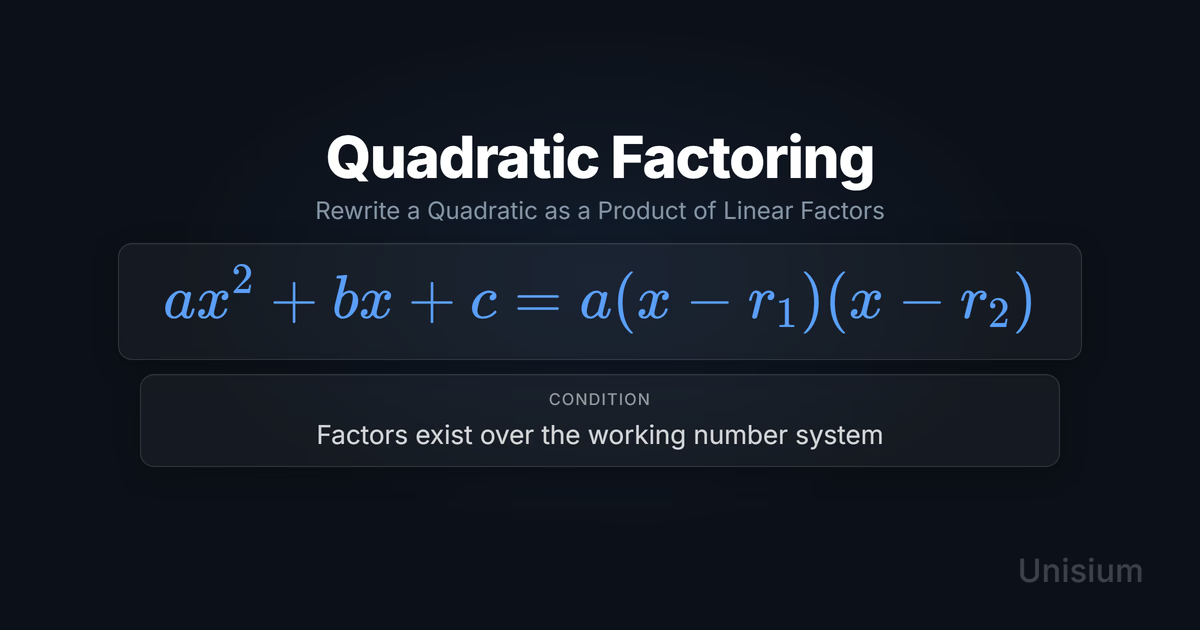
Quadratic Factoring: Rewrite a Quadratic as a Product of Linear Factors
Quadratic Factoring lets you rewrite a quadratic expression as the product , producing an equivalent expression with the same value for every allowed variable assignment. It applies when the quadratic has linear factors over the working number system — a condition you must verify before applying the move. Recognizing when a quadratic is factorable is a core move-selection skill built in the Unisium Study System.
This guide sits inside the Algebra study map, where you can see the neighboring moves, models, and next-step guides that connect this principle to the rest of algebra.
On this page: The Principle | Conditions | Failure Modes | EE Questions | Retrieval Practice | Practice Ground | Solve a Problem | FAQ
The Principle
The move: Rewrite a quadratic expression as , where and are the roots of the quadratic.
The invariant: This produces an equivalent expression with the same value for every allowed variable assignment — the factored and expanded forms evaluate identically everywhere both are defined.
Pattern:
| Legal ✓ | Illegal ✗ |
|---|---|
The right column is an actual invalid attempted move: expands to , not — the proposed rewrite produces a different expression. Over , the negative discriminant confirms no real linear factorization exists: .
Conditions of Applicability
Condition: Factors exist over the working number system
Before applying, check: identify the number system you are working in and verify that linear factors do exist in that system — what “exist” means differs:
- Over (reals): requires . If , no real linear factors exist and the move cannot be applied over .
- Over (rationals): requires additionally that is a perfect square of a rational. For instance, has so it factors over as , but is irreducible over .
- Over (complex numbers): always factorable — every quadratic has two linear factors over .
- If , the quadratic has a repeated root , giving the form — still factorable, but with only one distinct linear factor.
The split-the-middle-term (AC) method used in the walkthrough is suited to finding integer or rational factors. For irrational or complex factors, use the Quadratic Formula first and then write the linear factors from the roots.
Want the complete framework behind this guide? Read Masterful Learning.
This method usually begins with Factor Common Term if the expression shares an obvious factor first. Compare it with Quadratic Formula when deciding whether factoring is the fastest route, and use it next with Zero Product once the quadratic has been split into factors.
Common Failure Modes
Failure mode: attempt to factor a quadratic where over the reals — for instance, writing — and any proposed factored form expands to a different expression than the original.
Debug: check the discriminant before splitting the middle term; if the discriminant is negative over , switch to the Quadratic Formula or conclude the expression is irreducible over .
Elaborative Encoding
Use these questions to build deep understanding. (See Elaborative Encoding for the full method.)
Within the Principle
- What do and represent geometrically on the graph of the quadratic, and how does the factored form make that connection explicit?
- Why does a non-negative discriminant guarantee that real linear factors exist?
For the Principle
- How do you decide in advance whether quadratic factoring will work, before attempting to split the middle term?
- What would you do if the discriminant is negative — what move would you apply instead, and why?
Between Principles
- How does Quadratic Factoring set up the Zero Product Property, and why can’t you apply the Zero Product Property directly to the unexpanded form without factoring first?
Generate an Example
- Describe a quadratic expression that cannot be factored over the reals, explain precisely why the condition fails, and name the alternative move you would use to find the roots.
Retrieval Practice
Answer from memory, then click to reveal and check. (See Retrieval Practice for the full method.)
Write the canonical quadratic factoring pattern: _____
State the Quadratic Factoring move in one sentence: _____Rewrite ax² + bx + c as a(x − r₁)(x − r₂), where r₁ and r₂ are the roots, producing an equivalent expression for every allowed variable value.
State the canonical condition: _____Factors exist over the working number system
Practice Ground
Use these exercises to build move-selection fluency. (See Self-Explanation for how to use worked examples effectively.)
Procedure Walkthrough
Starting from , reach fully factored form via the AC-splitting method (suited to integer and rational factors).
| Step | Expression | Operation |
|---|---|---|
| 0 | — | |
| 1 | Split : need factors of summing to → use and (condition: , real factors exist) | |
| 2 | Factor each pair: extract from first pair, from second | |
| 3 | Extract common binomial factor |
Drills
Format A — Forward step: apply the principle once
Apply quadratic factoring once.
Reveal
Find factors of summing to : use and .
Apply quadratic factoring once.
Reveal
Find factors of summing to : use and .
Apply quadratic factoring once.
Reveal
; factors of summing to : use and .
Splitting:
Is quadratic factoring applicable over ? If not, say why.
Reveal
No. Discriminant: . No real linear factors exist — is irreducible over .
This is a near-miss: the expression looks similar to , but the sign is addition, not subtraction. Any attempted real factorization fails — for instance, .
Apply quadratic factoring once.
Reveal
Find factors of summing to : use and .
Eligibility check: which of the following can be factored using quadratic factoring over ? For those that cannot, explain why.
(a) (b) (c) (d)
Reveal
(a) : discriminant ✓ →
(b) : discriminant ✗ — no real factors; irreducible over .
(c) : discriminant ✓ →
(d) : discriminant ✓ →
Format E — Canonicalization: rewrite in fully factored form
Rewrite in fully factored form.
Reveal
Factors of summing to : use and .
Rewrite in fully factored form.
Reveal
; factors of summing to : use and .
Splitting:
Rewrite in factored form over . If this is not possible, state why.
Reveal
Not possible over . Discriminant: . The expression is irreducible over the reals.
This is a near-miss: resembles factorable trinomials with small coefficients, but the negative discriminant means no real pair of integers (or rationals) works as factors. The condition fails.
Rewrite in fully factored form.
Reveal
; factors of summing to : use and .
Splitting:
Solve a Problem
Apply what you’ve learned with Problem Solving.
Problem: Starting from , reach the form using Quadratic Factoring.
Full solution
| Step | Expression | Move |
|---|---|---|
| 0 | — | |
| 1 | Split : factors of summing to → use and (condition: , real factors exist) | |
| 2 | Factor each pair: extract from first pair, from second | |
| 3 | Extract common binomial factor | |
| 4 | Rewrite in form: factor from , giving and |
FAQ
What is Quadratic Factoring?
Quadratic Factoring is the algebraic move that rewrites as , where and are the zeros of the expression. Both forms are equivalent — they produce the same value for every variable assignment. When suitable integer or rational structure is present, factoring can expose the roots directly. Otherwise, the Quadratic Formula gives the roots first, and those roots determine the factorization.
When is Quadratic Factoring valid?
The move is valid exactly when linear factors exist over the working number system. Over , this requires . Over , it additionally requires a rational-square discriminant. Over , every quadratic factors into linear factors.
What goes wrong if I ignore the condition?
Any proposed factored form expands back to the wrong expression. For example, if you write , expanding gives , which is a different expression. The condition gates legality, not just convenience — ignoring it produces an incorrect identity.
How is Quadratic Factoring different from the Quadratic Formula?
Quadratic Factoring is a rewrite move — it rewrites the expression into factored form but does not directly name the roots. The Quadratic Formula is an isolate move — it produces the root values directly from . In practice: use factoring when obvious integer or rational factors exist; use the formula when they do not, or when you need the root values before you can factor.
Does Quadratic Factoring apply to all quadratic equations?
Only when the condition is met. Over (reals): applies when . Over (rationals): requires additionally that is a perfect rational square — for example, factors over but not over . Over (complex numbers): always applies — every quadratic has two linear factors over . The phrase “working number system” in the condition is precise: factorability depends on which number system you are working in.
How This Fits in Unisium
Quadratic Factoring is the gateway move that connects quadratic expressions to their roots. In the Unisium algebra progression, it sits at the junction where structure meets technique: once you have a factored form, the Zero Product Property finishes solving in one line. Unisium drills condition-checking and eligibility identification alongside execution fluency — so you build the habit of checking factorability before committing to the split — in the real-number setting, that often begins with the discriminant — and you learn to recognize irreducible quadratics as quickly as factorable ones.
Explore further:
- Distributive Property — The inverse move: expanding a factored form back to standard form, and why factoring reverses it
- Zero Product Property — What to apply immediately after factoring when solving a quadratic equation
- Quadratic Formula — The alternative when the factoring condition is not met, and how it produces directly
Ready to build factoring fluency? Check access and join the Unisium waitlist or explore the full learning framework in Masterful Learning.

Masterful Learning
The book behind these guides: a study system for physics, math, & programming built on retrieval, connection, explanation, and problem solving.
Ready to apply this strategy?
Unisium turns these evidence-based techniques into guided study sessions for math and physics. Places are limited during early access. Check current availability to start a trial; joining the mailing list is optional.
See plans and availability Read More GuidesAlready have access? Sign in