Additive Inequality: Same Quantity, Both Sides
Additive Inequality lets you add or subtract the same quantity from both sides of an inequality — preserving the inequality’s direction and solution set. It applies whenever you add or subtract the same quantity on both sides of an inequality, making it one of the most reliable moves in algebra. Building the reflex to apply it symmetrically is a core algebra fluency skill practiced in the Unisium Study System.
This guide sits inside the Algebra study map, where you can see the neighboring moves, models, and next-step guides that connect this principle to the rest of algebra.
On this page: The Principle | Conditions | Failure Modes | EE Questions | Retrieval Practice | Practice Ground | Solve a Problem | FAQ
The Principle
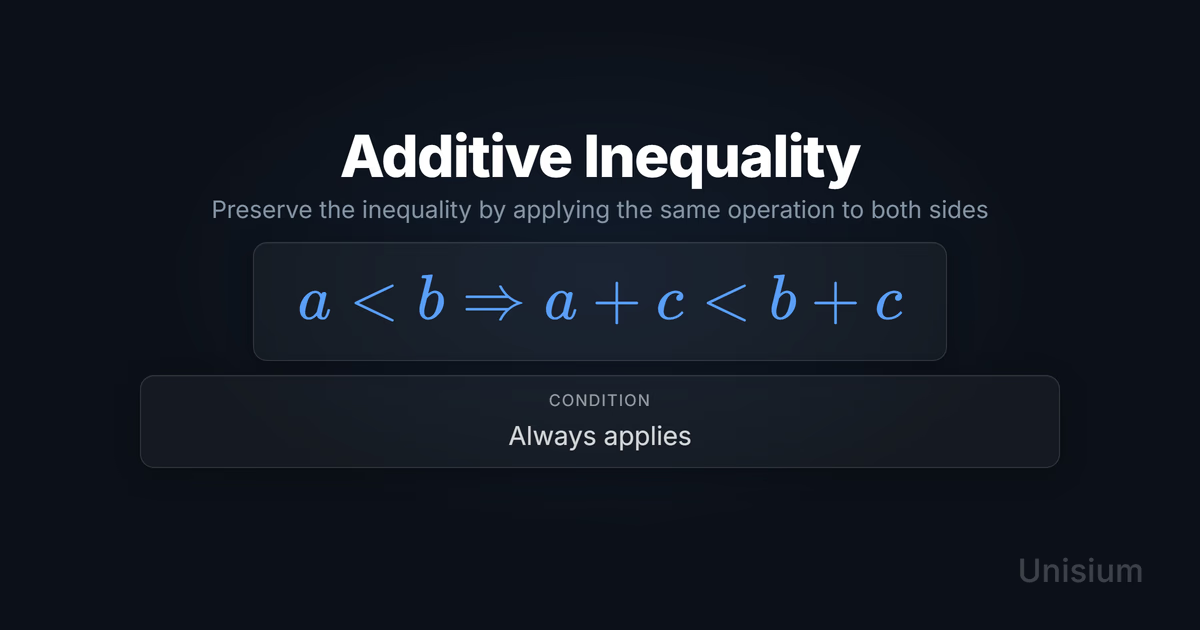
The move: Add or subtract the same quantity from both sides of an inequality.
The invariant: This preserves the inequality’s direction and solution set. If holds, then holds.
Pattern:
| Legal ✓ | Illegal ✗ |
|---|---|
| (subtract 3 from both sides) | (subtract 3 from left only) |
Conditions of Applicability
Condition: Always applies
Before applying, check: Confirm you are adding or subtracting the same value on both sides — not a different value on each side.
- The same additive change must be made on both sides.
- This works for , , , and — direction stays the same.
- Adding a negative number is still an additive move; the direction does not flip.
Want the complete framework behind this guide? Read Masterful Learning.
This move uses the same balance idea as Additive Equality, but now the statement is an inequality rather than an equation. Compare it with Multiplicative Inequality when the step is scaling rather than shifting both sides, and use it next in Absolute Value Cases Equations once a solve has to split into cases.
Common Failure Modes
Failure mode: Treating additive inequality as “move a term across the symbol” — e.g., writing — produces a non-equivalent inequality and a wrong solution set.
Debug: Don’t think “move across.” Think “subtract 5 from both sides.” The operation must appear on both sides explicitly.
Elaborative Encoding
Use these questions to build deep understanding. (See Elaborative Encoding for the full method.)
Within the Principle
- What does “on both sides” mean in the context of an inequality? Why must the same value appear on both sides?
- Why does adding count as the same kind of move as subtracting , and why does neither one change the inequality direction?
For the Principle
- Why does additive inequality preserve direction, while Multiplicative Inequality can reverse it?
- What would change in the inequality if you added a different number to each side?
Between Principles
- How does additive inequality compare to Additive Equality? What is shared and what differs between them?
- Why does Multiplicative Inequality sometimes flip the direction while this principle never does?
Generate an Example
- Describe an inequality problem where applying additive inequality incorrectly (by subtracting a different value from one side) would give an extra or missing solution.
Retrieval Practice
Answer from memory, then click to reveal and check. (See Retrieval Practice for the full method.)
State the move in one sentence: _____Add or subtract the same quantity from both sides of an inequality.
Write the canonical pattern: _____
State the canonical condition: _____Always applies
Practice Ground
Use these exercises to build move-selection fluency. (See Self-Explanation for how to use worked examples effectively.)
Procedure Walkthrough
Starting from , reach .
| Step | Expression | Operation |
|---|---|---|
| 0 | — | |
| 1 | Subtract 1 from both sides (additive inequality; direction preserved) | |
| 2 | Divide both sides by (positive — Multiplicative Inequality; direction stays ) | |
| 3 | Add 3 to both sides (additive inequality; direction preserved) |
Steps 1 and 3 use this principle. Step 2 is multiplicative inequality with a positive divisor — no flip, direction stays.
Drills
Action Label: Identify the operation
What was done between these two steps?
Reveal
Added 4 to both sides (additive inequality; direction preserved).
What was done between these two steps?
Reveal
Subtracted 5 from both sides (additive inequality; direction preserved).
What was done between these two steps?
Reveal
Added 8 to both sides (additive inequality; direction preserved).
What was done between these two steps?
Reveal
Subtracted 10 from both sides (additive inequality; direction preserved).
Transition Identification: Verify or reject
Is this valid? Explain.
Reveal
Invalid. This is the result of subtracting 4 from the left side only. Both sides must receive the same operation: , giving the correct result .
Is this valid? Explain.
Reveal
Valid. Subtracted 2 from both sides (additive inequality; direction preserved).
Is this valid? Explain.
Reveal
Valid. We added 6 to both sides using additive inequality. The direction is preserved, and is the correct solution set.
Is this valid? Explain.
Reveal
Valid. We subtracted 2 from both sides using additive inequality. The direction is preserved. (Note: we still need to divide by if we want to isolate , which flips the symbol.)
Is this valid? Explain.
Reveal
Invalid. Subtracting 5 from the left only gives . Both sides must receive the same operation: , giving .
Is this valid?
Reveal
Valid. We added 3 to both sides using additive inequality. The direction is preserved, and (or ) is correct.
Solve a Problem
Apply what you’ve learned with Problem Solving.
Problem: Starting from , reach the form .
Full solution
| Step | Expression | Move |
|---|---|---|
| 0 | — | |
| 1 | Subtract from both sides (additive inequality; direction preserved) | |
| 2 | Add to both sides (additive inequality; direction preserved) | |
| 3 | Divide both sides by (Multiplicative Inequality with positive divisor; direction preserved) |
FAQ
What is Additive Inequality?
Adding or subtracting the same quantity from both sides of an inequality produces an equivalent inequality. The solution set does not change.
When is Additive Inequality valid?
It is always valid — for all real numbers. There is no sign or nonzero condition to check beforehand. The only requirement is to apply the same additive change on both sides.
Does the inequality symbol ever change with Additive Inequality?
No. The direction (, , , ) is preserved. Only Multiplicative Inequality (multiplying or dividing by a negative) can flip the symbol.
What goes wrong if I forget to add/subtract from both sides?
If you apply the operation to only one side, the resulting inequality is no longer equivalent to the original. The solution set will be wrong.
How is Additive Inequality different from Additive Equality?
The operation is the same: add or subtract the same quantity on both sides. What differs is the object being preserved. Additive Equality preserves an equality relation (). Additive inequality preserves an order relation (, , , ) including its direction. In both cases, additive moves never change the relationship symbol.
Can I add or subtract negative numbers?
Yes. Adding a negative number is the same as subtracting a positive. The move remains valid: means , or equivalently, .
How This Fits in Unisium
Additive inequality is a same-operation-on-both-sides move: the direction is never at risk, but the move must be applied symmetrically. In the Unisium Study System, this principle is drilled through action-label exercises (name the operation across a given transition) and validity checks (catch the asymmetric move). The core reflex to build is: “add or subtract the same value on both sides” — not “move a term across.” Connecting this principle to Multiplicative Inequality sharpens why direction-flipping is specific to sign changes, not additive moves.
Explore further:
- Additive Equality — The companion principle for equations
- Multiplicative Inequality — The next level: when the symbol can flip
- Principle Structures — See how this principle connects to other algebra moves
Ready to master Additive Inequality? Check access and join the Unisium waitlist or explore the full learning framework in Masterful Learning.
Masterful Learning
The book behind these guides: a study system for physics, math, & programming built on retrieval, connection, explanation, and problem solving.
Ready to apply this strategy?
Unisium turns these evidence-based techniques into guided study sessions for math and physics. Places are limited during early access. Check current availability to start a trial; joining the mailing list is optional.
See plans and availability Read More GuidesAlready have access? Sign in