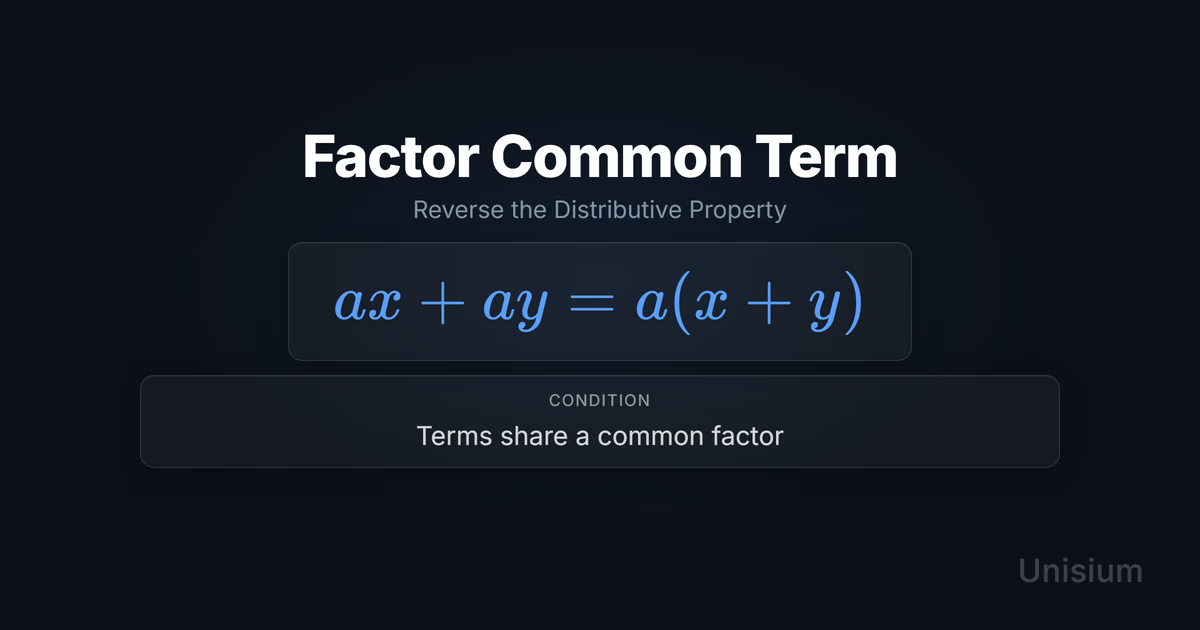
Factor Common Term: Reverse the Distributive Property
Factor Common Term lets you rewrite a sum of terms by pulling out a shared factor — producing an equivalent expression with the same value for every allowed variable assignment. It applies when all terms share a nontrivial common factor, whether that factor is a number, a monomial, or a larger expression. Recognizing which factor to pull out and verifying that every term has it as a factor is a core factoring skill practiced in the Unisium Study System.
This guide sits inside the Algebra study map, where you can see the neighboring moves, models, and next-step guides that connect this principle to the rest of algebra.
On this page: The Principle | Conditions | Failure Modes | EE Questions | Retrieval Practice | Practice Ground | Solve a Problem | FAQ
The Principle
The move: Identify a factor present in every term of a sum, divide each term by it, and write the result as that factor multiplied by a parenthesized sum of the remainders.
The invariant: This produces an equivalent expression with the same value for every allowed variable assignment — factoring out a common term rewrites but does not evaluate or alter the expression.
Pattern:
| Legal ✓ | Illegal ✗ |
|---|---|
In the illegal case the factor was divided out of the first term but not out of the second. The second term inside the parentheses must also be divided by : , giving .
Conditions of Applicability
Condition: Terms share a common factor
Before applying, check: Inspect every term — the candidate factor must appear as a multiplicative factor in each one. For monomials, this means the coefficients divide appropriately and the required variable powers are present in each term. For non-monomial factors (e.g. a binomial like ), the entire expression must appear as a factor in every term. If even one term does not contain the factor, the move is not yet legal.
- : valid — both terms share factor : .
- : only is shared by the first two terms, not by . A factor of cannot be pulled from all three terms; partial factoring or grouping must be used instead.
- : no nontrivial common factor exists, so this move does not simplify the expression.
Want the complete framework behind this guide? Read Masterful Learning.
This move depends on the reverse view of Distributive Property. Compare it with Difference of Squares when a shared factor is not the real structure to exploit, and use it next with Zero Product when factoring turns an equation into separate factors.
Common Failure Modes
Failure mode: dividing the factor out of only some of the terms and leaving the others unchanged → the expression inside the parentheses is wrong and the equality is broken.
Debug: after factoring, verify by redistributing: multiply the factor back through every term inside the parentheses and confirm you recover the original expression exactly.
Elaborative Encoding
Use these questions to build deep understanding. (See Elaborative Encoding for the full method.)
Within the Principle
- What does “common factor” mean for a numeric coefficient versus a variable factor? How do you find the greatest common factor of two monomials?
- Why must the factor be divided out of every term — not just the first — for the rewrite to be valid?
For the Principle
- How do you decide how much to factor out: just the numeric GCF, the full monomial GCF, or something else? What guides that choice?
- What is your check that the factored form is correct before moving to the next step?
Between Principles
- How does Factor Common Term relate to the Distributive Property? When is each the appropriate direction to move?
Generate an Example
- Write a three-term polynomial where the numeric GCF and a variable factor are both present, and factor it completely. Identify what would go wrong if you factored out only the numeric GCF and stopped.
Retrieval Practice
Answer from memory, then click to reveal and check. (See Retrieval Practice for the full method.)
State the move in one sentence: _____Identify a factor shared by every term, divide each term by it, and write the result as that factor times a parenthesized sum of the remainders.
Write the canonical pattern: _____
State the canonical condition: _____Terms share a common factor
Practice Ground
Use these exercises to build move-selection fluency. (See Self-Explanation for how to use worked examples effectively.)
Procedure Walkthrough
Starting from , factor out the greatest common monomial factor.
| Step | Expression | Operation |
|---|---|---|
| 0 | — | |
| 1 | Common monomial GCF identified as : ; minimum variable power is | |
| 2 | Divide each term by : , , |
Check (distribute back): , , ✓
Drills
Format A — Forward step
Apply Factor Common Term once. Pull out the greatest common monomial factor.
Reveal
GCF of 6 and 9 is 3; no variable is shared:
Apply Factor Common Term once.
Reveal
GCF: (numeric GCF 5; lowest variable power ):
Apply Factor Common Term once.
Reveal
GCF of and is ; lowest power of is . Factor out (keep leading sign positive inside):
Equivalently: . Either form is valid; the latter is conventional when all terms have the same sign pattern.
Apply Factor Common Term once.
Reveal
GCF: (both and appear to at least the first power in each term):
Format E — Canonicalization
Rewrite in fully factored form (factor out the greatest common monomial).
Reveal
GCF: ; lowest power of is . GCF = :
Check: , , ✓
Rewrite in fully factored form.
Reveal
GCF: (lowest powers: , ):
Identify which terms are eligible and factor only those. What do you do with the rest?
Reveal
Check for a common factor across all three terms: . is not divisible by , so there is no common numeric factor greater than . No variable appears in the constant term.
This expression cannot be factored by pulling out a common monomial. The move is not legal here. (It may be factorable as a trinomial by inspection or using the quadratic formula, but that is a different principle.)
Reject the invalid rewrite. What is wrong?
Reveal
The factor divides to give and divides to give — not . The corrected factored form is:
The error was dividing the first term by to get but then copying directly rather than also dividing . Always verify by redistributing every term inside the parentheses.
Near-miss: the symbols look similar. Is this a legal Factor Common Term rewrite?
Reveal
- : legal — is a factor of both and .
- : illegal — , so is not a factor of . The two expressions look superficially similar (two two-letter products), but the second term must contain the candidate factor for the move to apply.
Apply Factor Common Term to set up for the Zero Product Property.
Reveal
Both terms on the left share the factor :
This prepares the equation for the Zero Product Property.
Apply Factor Common Term once.
Reveal
GCF: (numeric GCF 7; both and appear to first power or higher in each term):
Apply Factor Common Term once.
Reveal
The expression appears as a factor in both terms:
Reject the invalid rewrite. What is wrong?
Reveal
The constant term does not contain the factor , so cannot be pulled from all three terms — the condition fails for the last term.
A valid greatest common monomial factor is only:
Solve a Problem
Apply what you’ve learned with Problem Solving.
Problem: Starting from , rewrite the expression by factoring out the greatest common monomial factor.
Full solution
| Step | Expression | Move |
|---|---|---|
| 0 | — | |
| 1 | Factor out GCF : , , |
Verify by distributing: , , ✓
The trinomial contains no further common monomial factor, so the target form is reached. To find the zeros of the original expression, the next step would be trinomial factoring followed by the Zero Product Property.
FAQ
What is Factor Common Term?
Factor Common Term is the algebraic move of pulling a shared factor out of every term in a sum, rewriting the sum as that factor multiplied by a parenthesized expression. It is the reverse of the Distributive Property and preserves the value of the expression for every variable assignment.
When is Factor Common Term valid?
The move is valid when every term in the sum contains the candidate factor — meaning the factor appears as a multiplicative factor in every term. For monomial factors, the coefficients must divide appropriately and the required variable powers must be present in each term. For non-monomial factors, the entire expression must appear as a factor in each term. If even one term does not contain the factor, the move cannot be applied globally (though partial factoring by grouping may still be possible).
What goes wrong if I apply it to terms that don’t all share the factor?
You break the equality: the reorganized expression no longer equals the original. The fastest check is to redistribute after factoring — multiply the factor back through every interior term and verify you recover the original.
How is Factor Common Term different from the Distributive Property?
They are inverses: the Distributive Property expands into ; Factor Common Term compresses into . Both preserve value. The distributive direction expands; the factoring direction reveals structure for further steps.
Does Factor Common Term work when the common factor is a variable expression?
Yes. The factor can be any expression — a number, a variable monomial, or a more complex expression — as long as it divides every term without remainder. For example, is a valid factor to pull from , giving .
How This Fits in Unisium
Factor Common Term sits at the gateway to factoring in the algebra progression: it follows the Distributive Property (its logical inverse) and is a prerequisite for the Zero Product Property. Building fluency with common-factor recognition — from numeric and monomial GCFs to larger expression factors — eliminates the most common bottleneck in polynomial solving. In Unisium, this move is practiced through short state-transition drills that train condition recognition: students learn to ask “does every term share this factor?” before applying, and to verify by redistributing afterward.
Explore further:
- Distributive Property — The expansion direction that Factor Common Term reverses
- Zero Product Property — The downstream principle Factor Common Term unlocks
- Elaborative Encoding — Build deep understanding of why the common-factor condition is necessary
- Retrieval Practice — Make the pattern and condition instantly accessible
Ready to master Factor Common Term? Check access and join the Unisium waitlist or explore the full learning framework in Masterful Learning.

Masterful Learning
The book behind these guides: a study system for physics, math, & programming built on retrieval, connection, explanation, and problem solving.
Ready to apply this strategy?
Unisium turns these evidence-based techniques into guided study sessions for math and physics. Places are limited during early access. Check current availability to start a trial; joining the mailing list is optional.
See plans and availability Read More GuidesAlready have access? Sign in