Absolute Value - Definition: The Piecewise Distance Rule
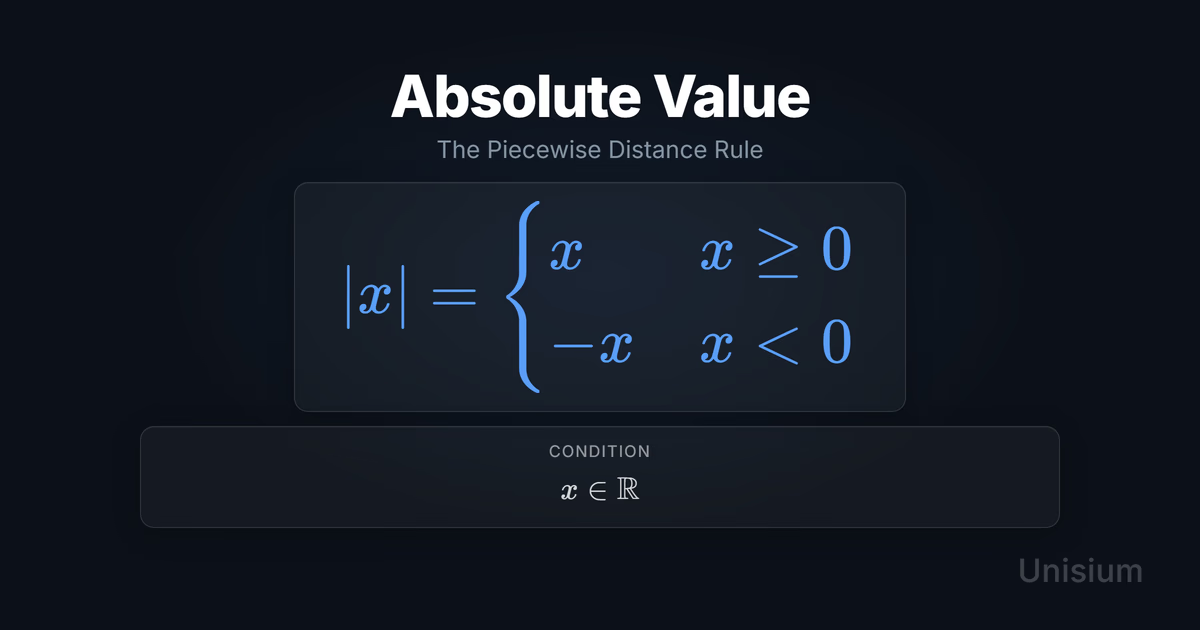
Absolute Value - Definition gives the piecewise rule for : the output is when and when , measuring the distance of from zero on the number line. Because distance is always non-negative, for every real . In the Unisium Study System, understanding both cases of the definition—not just memorizing the symbol—is what makes absolute value reliable in harder problems.
This guide sits inside the Algebra study map, where you can see the neighboring moves, models, and next-step guides that connect this principle to the rest of algebra.
On this page: The Principle · Conditions · Misconceptions · EE Questions · Retrieval Practice · Worked Example · Solve a Problem · FAQ
The Principle
Statement
The absolute value of , written (or ), is the distance between and zero on the number line. Distance is always non-negative, so for every real number , including . For non-negative inputs the output is unchanged; for negative inputs the sign is negated, producing the correct positive distance.
Mathematical Form
Where:
- = any real number (input)
- = distance of from zero; always
The second case, when , does not return a negative result. Because is negative in that branch, is positive — it is the negation of a negative number.
Alternative Form
- Square-root form: — convenient when squaring is easier than case analysis
Conditions of Applicability
Condition:
The piecewise rule is defined for all real numbers. This condition marks the domain: extending to complex inputs requires a different formula (see the modulus below). For any , the correct branch is determined entirely by the sign of .
Practical modeling notes
- Determine where the argument equals zero, then use sign regions on either side of that boundary to choose the branch.
- The two-case structure is essential: collapsing to ” for all ” produces wrong answers for negative inputs.
When It Doesn’t Apply
The piecewise formula above applies only to real numbers.
- Complex numbers : absolute value (modulus) is ; the real-number piecewise formula does not generalize.
- Vectors : the analogous concept is the Euclidean norm .
Want the complete framework behind this guide? Read Masterful Learning.
Compare this with Radical Definition when deciding whether a symbol means distance or principal square root. From there, Absolute Value Cases Equations is the next algebra guide once the definition has to be turned into solvable cases.
Common Misconceptions
Misconception 1: ” in the second case is a negative number”
The truth: The second case activates only when . Negating a negative number gives a positive result: , so .
Why this matters: Students read "" and conclude absolute value can produce a negative output. The notation means “negate ”, not “return a negative value.”
Misconception 2: ""
The truth: for all real . Negating the input does not negate the output because absolute value strips sign information entirely: .
Why this matters: This error surfaces when substituting signed variables — students flip the output sign after applying absolute value, arriving at an incorrect negative answer.
Misconception 3: ""
The truth: The triangle inequality guarantees only . Equality holds when and share the same sign (or one is zero), but not in general: .
Why this matters: Treating absolute value as linear over addition leads to incorrect simplifications when working with expressions like .
Elaborative Encoding
Use these questions to build deep understanding. (See Elaborative Encoding for the full method.)
Within the Principle
- In the second case of the definition, when : if , compute . Why is the result positive even though the formula shows a minus sign?
- What value does produce? Which branch handles it, and why is the boundary condition (rather than )?
For the Principle
- Before applying the piecewise rule to , what must you determine first, and how?
- What goes wrong if you drop the second case and always write ? Construct a numerical example of the resulting error.
Between Principles
- The Absolute Value — Cases rule solves by splitting into or . How does that rule follow directly from this piecewise definition?
Generate an Example
- Construct a real number such that applying the first branch () gives the correct answer, and a different where only the second branch gives the correct answer. What property of determines which branch applies?
Retrieval Practice
Answer from memory, then click to reveal and check. (See Retrieval Practice for the full method.)
State the absolute value definition in words: _____The absolute value of x is x when x is non-negative, and the negation of x when x is negative. It equals the distance from zero on the number line.
Write the canonical equation: _____
State the canonical condition: _____
Worked Example
Use this worked example to practice Self-Explanation.
Problem
Write as a piecewise function of .
Step 1: Verbal Decoding
Target: piecewise form of
Given:
Constraints: ; apply the piecewise definition to the argument
Step 2: Visual Decoding
Draw a number line for . Mark (where ), with to the right and to the left.
(So: first branch for , second branch for .)
Step 3: Mathematical Modeling
Step 4: Mathematical Procedures
Step 5: Reflection
- Verification: at (first branch): ✓; at (second branch): ✓
- Graphical meaning: the result is a V-shaped graph with vertex at , rising linearly on both sides.
Before moving on: self-explain the model
Explain Step 3 in your own words: why is the argument substituted for ? How does setting determine the branch boundary?
Mathematical model with explanation
Principle: Absolute Value — Definition applied to the composite argument .
Conditions: ; the argument is real for every real .
Relevance: Setting at identifies the sign boundary. Below the argument is negative; at and above it is non-negative.
Description: Substituting for in the definition and resolving the branch inequalities in terms of eliminates the absolute value bars. The two output expressions, and , are linear and equal each other at .
Goal: Express without absolute value bars by writing the explicit linear formula in each sign region of the argument.
Solve a Problem
Apply what you’ve learned with Problem Solving.
Problem
Solve .
Hint (if needed): Use the piecewise definition to write separate equations for each branch, then solve each.
Show Solution
Step 1: Verbal Decoding
Target: all real satisfying
Given:
Constraints: ; apply the piecewise definition to the argument
Step 2: Visual Decoding
Draw a number line. Mark (where ). For the argument is non-negative (first branch); for it is negative (second branch).
(So: two cases, one on each side of .)
Step 3: Mathematical Modeling
Step 4: Mathematical Procedures
Step 5: Reflection
- Verification: ✓ and ✓ — both solutions satisfy the original equation.
- Interpretation: the two solutions are symmetric about ; absolute value equations with always yield two solutions equidistant from .
Related Principles
| Principle | Relationship to Absolute Value — Definition |
|---|---|
| Absolute Value — Cases for Equations | Splits into or ; derived directly from this definition |
| Triangle Inequality | Bounds ; built on the distance interpretation |
| Pythagorean Theorem | Distance in 2D via ; absolute value is its 1D special case |
See Principle Structures for how to organize these relationships visually.
FAQ
What is the absolute value of a number?
The absolute value of a real number , written , is its distance from zero on the number line. It equals when and (flipping the sign) when . The result is always .
Why is absolute value defined in two cases?
Distance must be non-negative. For positive inputs the number itself already represents the distance. For negative inputs, the formula negates the sign to produce a positive distance. A single-branch formula cannot handle both situations correctly.
Is equal to ?
No. Since , the second branch applies: . Absolute value always returns a non-negative result.
What is ?
. Zero satisfies the first branch condition (), so directly. This is consistent with the distance interpretation: zero is zero units from itself.
How does absolute value differ from negation?
Negation flips the sign of (positive becomes negative and vice versa). Absolute value always returns a non-negative result, regardless of the sign of . For the two operations agree (both yield which is positive), but for they differ: is negative while is positive.
Where does absolute value appear outside of basic algebra?
Absolute value measures distance in geometry ( is the distance between and ), speed vs. velocity in physics ( is speed), error magnitude in statistics, and modulus of complex numbers. Each context generalizes the distance-from-zero idea in this definition.
Related Guides
- Principle Structures — Organize absolute value in a hierarchy of algebra definitions and rules
- Self-Explanation — Use the worked example above to practice explaining each step
- Retrieval Practice — Make the piecewise rule immediately accessible under exam pressure
- Problem Solving — Apply the Five-Step Strategy systematically to absolute value problems
How This Fits in Unisium
Unisium pairs each principle—including this definition—with elaborative-encoding questions, retrieval cloze prompts, and graded problem sets so you build both recall and flexible application. Linking the piecewise rule to the distance interpretation, then immediately applying it in problems, shortens the path from “I’ve seen this” to “I can use it reliably.”
Ready to master absolute value? Check access and join the Unisium waitlist or explore the full learning framework in Masterful Learning.
Masterful Learning
The book behind these guides: a study system for physics, math, & programming built on retrieval, connection, explanation, and problem solving.
Ready to apply this strategy?
Unisium turns these evidence-based techniques into guided study sessions for math and physics. Places are limited during early access. Check current availability to start a trial; joining the mailing list is optional.
See plans and availability Read More GuidesAlready have access? Sign in