Substitution Property: Replace Any Expression with an Equal One
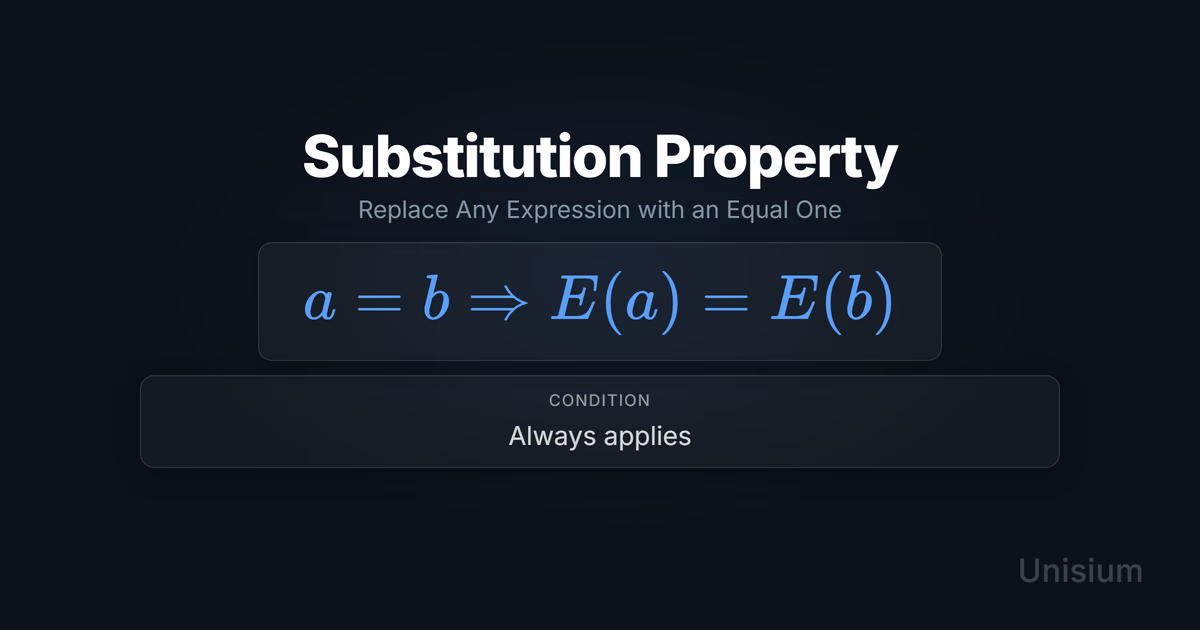
The Substitution Property states that if , any occurrence of may be replaced by — or by — inside any expression, equation, or inequality, producing an equal result. The move is unconditionally valid: no sign check, no domain restriction. The two practical guards worth training are confirming the equality was established, and carrying parentheses when the substituted expression contains multiple terms. Both are drilled in the Unisium Study System.
This guide sits inside the Algebra study map, where you can see the neighboring moves, models, and next-step guides that connect this principle to the rest of algebra.
On this page: The Principle | Conditions | Failure Modes | EE Questions | Retrieval Practice | Practice Ground | Solve a Problem | FAQ
The Principle
The move: If two expressions are equal, replace one with the other inside any larger expression or equation.
The invariant: Replacing any chosen occurrence(s) of with in an expression produces a result equal to the original at that assignment — the substituted form is algebraically licensed by the equality . Replacing all occurrences is often the goal (full evaluation or elimination), but replacing one or some is still a valid application of the property.
Pattern:
| Legal ✓ | Illegal ✗ |
|---|---|
| — the substituted expression has two terms; dropping the parentheses changes the result from to , which is wrong |
The parentheses error is the most common invalid substitution: when the substituted expression is a sum or difference, it must be bracketed in whatever context was occupying.
Conditions of Applicability
Condition: Always applies
Before applying, check: Confirm that the two expressions are genuinely equal (established by a prior equation, definition, or given), then identify which occurrence(s) you intend to replace and preserve structure when substituting multi-term expressions.
- The direction is symmetric: licenses replacing with or with .
- You may replace any one occurrence, some occurrences, or all occurrences — each replacement is individually valid. Replacing all is typically the goal when eliminating a variable or evaluating fully.
- When the substituted expression contains multiple terms (e.g., ), always wrap it in parentheses to match the role was playing in .
- The replacement context can be any algebraic expression, equation, or inequality.
Want the complete framework behind this guide? Read Masterful Learning.
Compare this with Additive Equality when deciding whether to replace an equal quantity or transform both sides directly. It often carries next into Linear Model work when a known relationship has to be substituted into a larger equation.
Common Failure Modes
Failure mode: dropping parentheses when substituting a multi-term expression — e.g., from , rewriting as instead of → the result differs numerically from the correct substitution ( in general).
Debug: when the substituted expression is a sum, difference, or any multi-term form, write it inside parentheses first; strip them only if the surrounding context makes it safe (e.g., where gives , and the outer plus is safe to drop the inner parentheses after).
Elaborative Encoding
Use these questions to build deep understanding. (See Elaborative Encoding for the full method.)
Within the Principle
- What does the notation represent, and why does replacing even one occurrence of with (when ) produce a result that is algebraically valid?
- Why must a multi-term expression be wrapped in parentheses when substituted — what specific numerical error arises when you write instead of after substituting ?
For the Principle
- What is the difference between a valid partial substitution (replacing one occurrence of a variable) and an incomplete evaluation (not yet reached the goal form)? Why does the distinction matter?
- Given that the condition is “Always applies,” what is the typical source of error in a substitution step, and how does it differ from errors in condition-critical moves like Multiplicative Equality?
Between Principles
- How does the Substitution Property support Additive Equality when you add the same expression to both sides — what role does the idea of “equal expressions are interchangeable” play in justifying that result?
Generate an Example
- Construct an equation containing a multi-term expression on one side (e.g., with ). Substitute incorrectly by dropping the parentheses, compute the wrong result, and then show the correct parenthesized substitution and result.
Retrieval Practice
Answer from memory, then click to reveal and check. (See Retrieval Practice for the full method.)
State the move in one sentence: _____If two expressions are equal, one can be substituted for the other in any context.
Write the canonical pattern: _____
State the canonical condition: _____Always applies
Practice Ground
Use these exercises to build move-selection fluency. (See Self-Explanation for how to use worked examples effectively.)
Procedure Walkthrough
Starting from the system and , convert to a single-variable equation by substitution.
| Step | Expression | Operation |
|---|---|---|
| 0 | — | |
| 1 | Substitution Property: replace with in (valid — ) | |
| 2 | Combine like terms | |
| 3 | Divide both sides by |
Drills
Format B — Action label
What was done between these two steps?
Reveal
Substitution Property — replaced with throughout this expression, valid because .
What was done between these two steps?
Reveal
Substitution Property — replaced with in the right-hand side expression , valid because .
Is this step a valid application of the Substitution Property? If not, identify the error.
From , rewriting as:
Reveal
Invalid — dropped parentheses. We know , so . The step wrote instead of , treating the substituted expression as if the multiplication by 3 applied only to the first term. The parentheses are required because was a single factor being multiplied; substituting a sum in its place requires bracketing the sum. The error changes the constant term from to .
What was done between these two steps?
Reveal
Substitution Property — replaced with in the equation , valid because . The variable appears only on the right and was not replaced (no equation equates to something else here).
What was done between these two steps?
Reveal
Substitution Property — replaced with everywhere needed for the target form, valid because . Each substitution is independently licensed by the property; together they complete the full evaluation.
Is this step a valid application of the Substitution Property? If not, identify the error.
From and the expression , someone writes:
Reveal
Invalid. We know , which licenses replacing with to obtain . But is a separate variable without an established equality to . Replacing with requires a separate equation , which is not given. The correct result of this substitution is , not .
Format C — Transition identification
Which step(s) use the Substitution Property?
Reveal
- Step 1 → 2: Substitution Property — replaced with and with in , valid because and .
- Step 2 → 3: Arithmetic — not the Substitution Property.
Which step(s) use the Substitution Property?
- and
Reveal
- Step 1 → 2: Substitution Property — replaced with in , valid because .
- Step 2 → 3: Additive Equality — added to both sides.
- Step 3 → 4: Square root principle — not the Substitution Property.
None, one, or multiple transitions below use the Substitution Property. Identify which.
Reveal
None. Step 1 → 2 is Multiplicative Equality (both sides multiplied by ). Step 2 → 3 is the Distributive Property in reverse (factoring from the left side). Neither step replaces an expression with a known-equal one in a larger context — that is the signature of the Substitution Property. Both steps instead transform the equation by operating on both sides or rearranging within a side.
Which transition uses the Substitution Property?
Reveal
- Step 2 → 3: Substitution Property — replaced with in , valid because equation 1 establishes .
- Steps 3 → 4, 4 → 5 use Combine Like Terms, Additive Equality, and Multiplicative Equality—not the Substitution Property.
Format D — Micro-chain
Given , use the Substitution Property to evaluate .
Reveal
| Step | Expression | Move |
|---|---|---|
| 0 | — | |
| 1 | Substitution Property: replaced with to complete the evaluation | |
| 2 | Arithmetic |
Given , rewrite the equation as a single-variable equation in .
Reveal
Replace with in (Substitution Property — valid because ):
Solve a Problem
Apply what you’ve learned with Problem Solving.
Problem: Given and , substitute to write a single-variable equation in , then solve for .
Full solution
| Step | Expression | Move |
|---|---|---|
| 0 | — | |
| 1 | Substitution Property: replace with | |
| 2 | Distributive Property | |
| 3 | Combine Like Terms | |
| 4 | Additive Equality: add to both sides | |
| 5 | Multiplicative Equality: divide both sides by |
FAQ
What is the Substitution Property?
The Substitution Property is the algebraic rule that if , then equal expressions are interchangeable in context: one may replace with wherever that occurrence appears in a larger expression or equation. The canonical form is .
When is the Substitution Property valid?
Always — the condition is “Always applies.” The only requirement is that the two expressions being swapped are genuinely equal (established by a prior equation, definition, or given). Unlike condition-critical moves such as Multiplicative Equality, no sign check or domain restriction is needed.
What goes wrong if I drop parentheses when substituting?
When the substituted expression contains more than one term (like ), it must be wrapped in parentheses to match the role the original variable was playing. Writing instead of after substituting into misapplies the distributive property — the multiplication by 3 distributes over only the first term. The result is off by a constant and the error is easy to miss.
How is the Substitution Property different from Additive or Multiplicative Equality?
Additive Equality and Multiplicative Equality are equation-balancing moves — they transform both sides of an equation simultaneously. The Substitution Property is an equivalence move — it replaces an expression with a known-equal one inside a larger context. No balancing of two sides is required; the justification is purely that the two expressions name the same value.
Does the Substitution Property apply to inequalities?
Yes. The property is not restricted to equations. If , then and can be exchanged wherever the expressions appear — including inside inequalities, function definitions, or multi-equation systems.
How This Fits in Unisium
The Substitution Property is the algebraic move that connects isolated equalities into coordinated chains. Unisium builds fluency through action-label drills — naming the exact equality used and checking that the substituted expression was bracketed correctly — and transition-identification drills — spotting which step in a multi-step chain applies the Substitution Property versus principles like Combine Like Terms or Additive Equality. The two diagnostic questions trained are: “Was that equality established?” and “Did I bracket the substituted expression?”
Explore further:
- Principle Structures — Locate the Substitution Property in the algebra principle hierarchy
- Elaborative Encoding — Build deep understanding of what makes a substitution valid
- Retrieval Practice — Make the canonical pattern and condition instantly accessible
Ready to master the Substitution Property? Check access and join the Unisium waitlist or explore the full learning framework in Masterful Learning.
Masterful Learning
The book behind these guides: a study system for physics, math, & programming built on retrieval, connection, explanation, and problem solving.
Ready to apply this strategy?
Unisium turns these evidence-based techniques into guided study sessions for math and physics. Places are limited during early access. Check current availability to start a trial; joining the mailing list is optional.
See plans and availability Read More GuidesAlready have access? Sign in