Zero Product Property: From Factored Form to Solutions
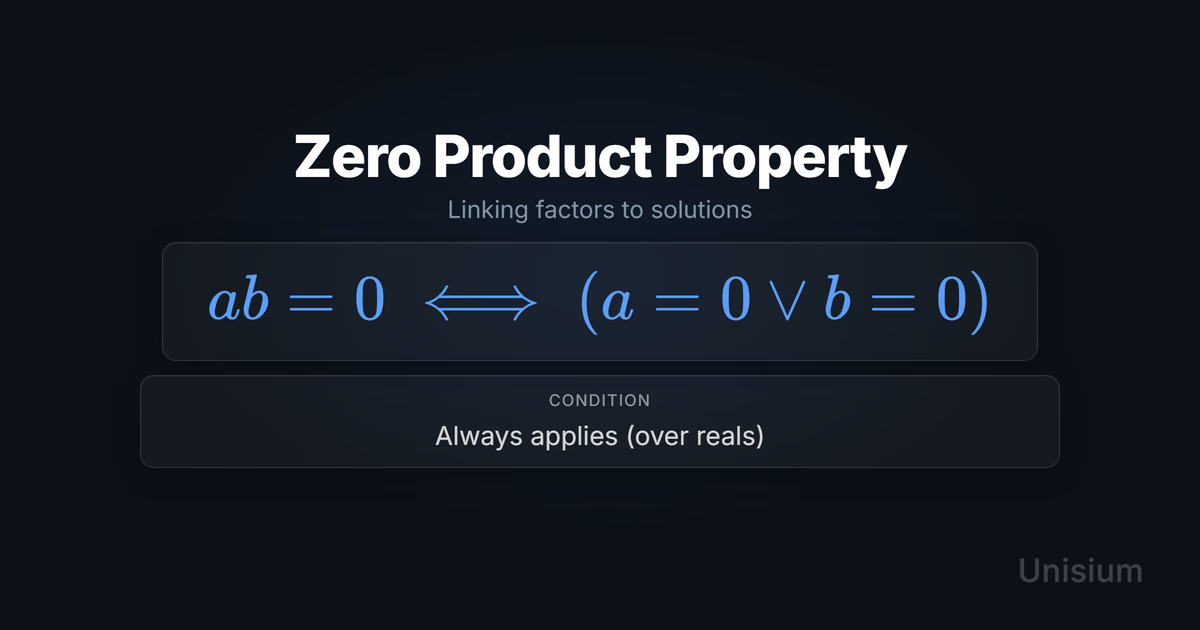
Zero Product Property lets you convert a factored equation—where the product is zero—into isolated factor equations you can solve one at a time. Over the reals, the property itself always applies; in equation solving, you typically use it after rewriting the equation into product-equals-zero form. Recognizing when a product is zero and identifying which factors must equal zero is a core algebra fluency skill practiced in the Unisium Study System.
This guide sits inside the Algebra study map, where you can see the neighboring moves, models, and next-step guides that connect this principle to the rest of algebra.
On this page: The Principle | Conditions | Failure Modes | EE Questions | Retrieval Practice | Practice Ground | Solve a Problem | FAQ
The Principle
The move: If a product of two or more factors equals zero, then at least one of those factors must equal zero.
The invariant: This preserves the solution set. Every solution of the factored equation is a solution of one of the factor equations, and vice versa.
Pattern:
| Legal ✓ | Illegal ✗ |
|---|---|
Conditions of Applicability
Condition: Always applies (over reals)
Before applying, check: Is the equation in product-equals-zero form?
- The product must equal zero, not a nonzero constant. If the right side is nonzero, splitting into factor equations changes the problem.
- The relevant structure is a product of factors; further factoring is often useful, but the move is already legal once the product structure is visible.
Want the complete framework behind this guide? Read Masterful Learning.
This move usually matters after Factor Common Term or another factoring step has exposed separate factors. Compare it with Difference of Squares when deciding which pattern produced those factors, and use it next in Quadratic Factoring solves where the factorized form is the whole point.
Common Failure Modes
Failure mode: Apply the Zero Product Property to an unfactored equation or when the product is not zero (e.g., writing “if , then or ”) → the factorization is incomplete or misapplied, leading to spurious or lost solutions.
Debug: Identify whether the left side is in product-of-factors form, and confirm the right side is exactly 0.
Elaborative Encoding
Use these questions to build deep understanding. (See Elaborative Encoding for the full method.)
Within the Principle
- What does it mean for a product to be zero, and why must at least one factor be zero?
- Why is it true that solving is the same as solving or separately?
For the Principle
- When would you choose to apply the Zero Product Property instead of using the quadratic formula?
- How would the solution process change if the product were equal to a non-zero constant?
Between Principles
- How does the Zero Product Property relate to the Distributive Property? One expands a product; the other uses an already-factored product. When does each direction apply?
Generate an Example
- Describe a quadratic equation that you would solve using the Zero Product Property, and explain why factoring is the right first step for that equation.
Retrieval Practice
Answer from memory, then click to reveal and check. (See Retrieval Practice for the full method.)
State the move in one sentence.: _____If a product of factors equals zero, then at least one of those factors must equal zero.
Write the canonical pattern.: _____
State the canonical condition: _____Always applies (over reals)
Practice Ground
Use these exercises to build move-selection fluency. (See Self-Explanation for how to use worked examples effectively.)
Procedure Walkthrough
Starting from , find all real solutions.
| Step | Expression | Operation |
|---|---|---|
| 0 | — | |
| 1 | or | Apply Zero Product Property (two factors, product is zero) |
| 2 | or | Solve first factor |
| 3 | or | Factor (difference of squares) |
| 4 | or or | Apply Zero Product Property to |
| 5 | Solve each linear factor |
Drills
Goal-directed micro-chain
Micro-chain: Starting from , identify all solutions.
Reveal
Apply Zero Product Property: or (note: the factor 2 is never zero, so it doesn’t contribute a solution).
Solutions: or
Micro-chain: Starting from , isolate the two linear equations.
Reveal
Apply Zero Product Property: or
Then solve: or
Negative drill: Can you apply the Zero Product Property to this equation? Why or why not?
Reveal
No — the product equals 6, not zero. The Zero Product Property requires the right side to be zero. Move 6 to the left first and factor the resulting quadratic, or use the quadratic formula.
Micro-chain: Starting from , reach all solutions (factor completely).
Reveal
First factor further: (using difference of squares on ).
Apply Zero Product Property: or or
Solutions:
Micro-chain: Starting from , identify which values make the product zero.
Reveal
Apply Zero Product Property: each factor can be zero independently.
Solutions:
Forward step
Apply the principle once.
Reveal
Apply Zero Product Property (product is zero):
or
Apply the principle once.
Reveal
Apply Zero Product Property:
or
(The constant 3 does not contribute a solution since .)
Apply the principle once.
Reveal
Apply Zero Product Property:
or or
Note: is always positive (never zero) for real , so it contributes no real solution.
Apply the principle once.
Reveal
Apply Zero Product Property:
or
This gives (a repeated root) or
Negative drill: Can you apply the Zero Product Property to this expression? Why or why not?
Reveal
The expression is not an equation—there is no “equals zero” condition. The Zero Product Property requires the product to be set equal to zero. This expression alone tells you nothing about what must be.
See: The Principle — the condition requires the product to equal zero.
Solve a Problem
Apply what you’ve learned with Problem Solving.
Problem: Starting from , find all solutions using the Zero Product Property.
Full solution
| Step | Expression | Move |
|---|---|---|
| 0 | — | |
| 1 | Subtract from both sides | |
| 2 | Factor the trinomial (product , sum ) | |
| 3 | or | Apply Zero Product Property (product is zero) |
| 4 | or | Solve each linear factor |
FAQ
What is the Zero Product Property?
If a product of two or more factors equals zero, then at least one of those factors must equal zero. It is the key principle for solving factored equations.
When can I use the Zero Product Property?
Only when the product is exactly equal to zero. If the product equals a non-zero constant, you must use a different method.
What goes wrong if I forget to check that the product is zero?
You may apply the principle to an equation like and incorrectly conclude that or ; these are not solutions to the original equation.
How is the Zero Product Property different from factoring?
Factoring techniques like the Distributive Property work by breaking an expression into factors. The Zero Product Property tells you that if those factors equal zero, you can solve each factor separately. Factoring is the tool; the Zero Product Property is the theorem that justifies splitting into simpler equations.
Can the Zero Product Property apply to inequalities or only equations?
The Zero Product Property applies only to equations where the product equals zero. For inequalities like , you use a sign-chart analysis method instead.
How This Fits in Unisium
In the Unisium Study System, the Zero Product Property is a cornerstone move for solving quadratic and higher-degree polynomial equations efficiently. Recognizing when a product is zero and confidently splitting it into separate factor equations is a core algebra fluency skill. This guide trains both the condition check (“Is the product zero?”) and the move execution (“Which factors are zero?”), preparing you to anchor your problem-solving strategy on factoring whenever the problem structure allows it.
Explore further:
- Distributive Property — Understand how to expand and factor expressions
- Elaborative Encoding — Build deep understanding of why one factor being zero makes the whole product zero
- Retrieval Practice — Make the condition and pattern instantly accessible
Ready to master the Zero Product Property? Check access and join the Unisium waitlist or explore the full learning framework in Masterful Learning.
Masterful Learning
The book behind these guides: a study system for physics, math, & programming built on retrieval, connection, explanation, and problem solving.
Ready to apply this strategy?
Unisium turns these evidence-based techniques into guided study sessions for math and physics. Places are limited during early access. Check current availability to start a trial; joining the mailing list is optional.
See plans and availability Read More GuidesAlready have access? Sign in