Multiplicative Inequality: Flipping When the Multiplier Is Negative
Multiplicative Inequality lets you scale an inequality by multiplying or dividing both sides by the same nonzero number — but if that number is negative, the inequality direction flips. Recognizing when the multiplier is negative and automatically flipping the direction is a critical algebra fluency skill practiced in the Unisium Study System.
This guide sits inside the Algebra study map, where you can see the neighboring moves, models, and next-step guides that connect this principle to the rest of algebra.
On this page: The Principle | Conditions | Failure Modes | EE Questions | Retrieval Practice | Practice Ground | Solve a Problem | FAQ
The Principle
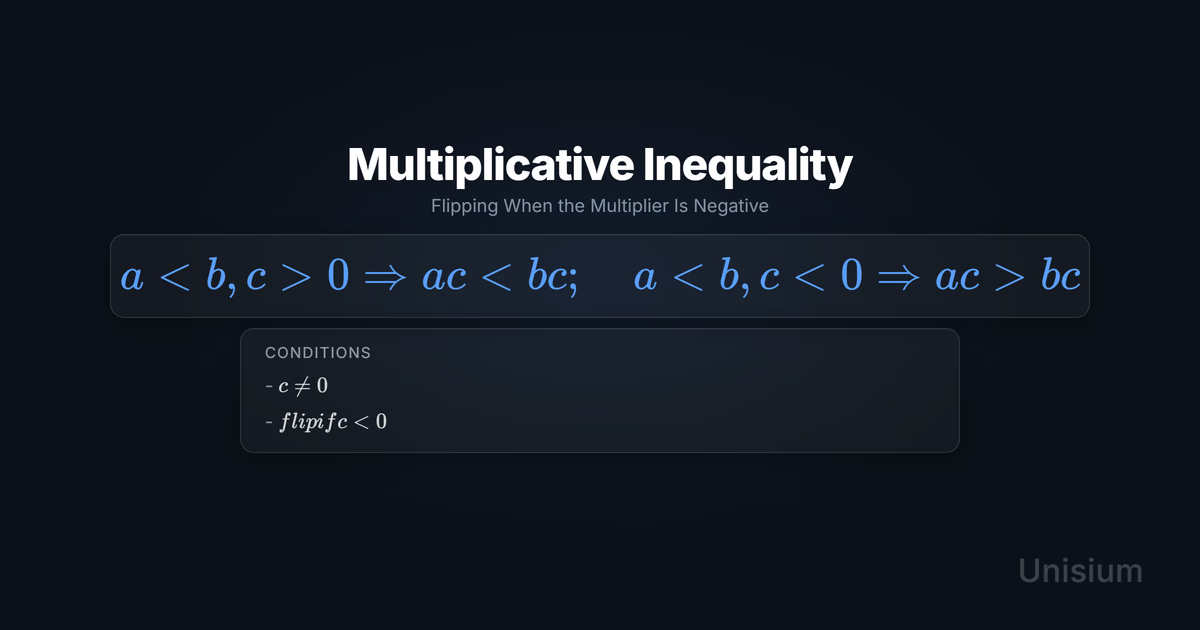
The move: When you multiply or divide both sides of an inequality by the same nonzero number, the inequality direction is preserved if the number is positive, and flipped if the number is negative.
The invariant: This preserves the solution set when the multiplier or divisor is nonzero and the sign is tracked correctly.
Pattern:
| Legal ✓ | Illegal ✗ |
|---|---|
| (wrong: forgot to flip) |
Conditions of Applicability
Condition: ;
Before applying, check: Is the multiplier/divisor nonzero, and is it positive or negative?
If the condition is violated: Division by zero is undefined. Multiplying by zero is defined but collapses both sides to zero, destroying the order relation — the move is not valid for preserving the solution set. If you forget to flip when the multiplier is negative, the resulting inequality points in the wrong direction and the solution set will be wrong.
- Division by zero: Dividing by (equivalently, multiplying by ) requires . Verify the divisor is not zero at each step.
- Sign mismatch: If the multiplier is negative and you don’t flip the direction, the new inequality is not equivalent to the original and gives the wrong solution set. For example, if and you multiply by without flipping, you get , which is not equivalent to .
Want the complete framework behind this guide? Read Masterful Learning.
This move usually follows Additive Inequality in multi-step inequality solves. Compare it with Multiplicative Equality when deciding whether a sign reversal matters, and use it next in Absolute Value Cases Equations when the resulting cases must be solved carefully.
Common Failure Modes
Failure mode: Multiply an inequality by a negative number without flipping the direction → the solution set lands on the wrong side of the boundary.
Debug: Before you multiply or divide, ask explicitly: “Is this multiplier positive or negative?” If negative, you must flip to (or to ).
Failure mode: Forget that the sign of an expression like depends on the value of ; multiply by it as if it were a constant → introduce or lose solutions depending on the range of .
Debug: If you multiply by an expression containing a variable, you cannot treat it as a fixed constant. Either split into cases (if vs ) or use a different move.
Elaborative Encoding
Use these questions to build deep understanding. (See Elaborative Encoding for the full method.)
Within the Principle
- What does “flipping the inequality direction” mean in terms of which solution values satisfy the inequality?
- Why does the sign of the multiplier matter, but not its magnitude? (I.e., why is treated the same as in terms of flipping?)
For the Principle
- How do you decide whether to flip the inequality before you perform the multiplication?
- When you divide both sides of by , which step comes first: divide, or flip?
Between Principles
- How does this principle relate to Additive Inequality, which also preserves truth of an inequality?
- If you know Multiplicative Equality applies to equations with a nonzero divisor, why does the multiplicative inequality need an extra condition about sign?
Generate an Example
- Describe a multi-line procedure where you multiply an inequality by a negative expression and forget to flip; then explain why the solution you get is the wrong set and how to find the correct one.
Retrieval Practice
Answer from memory, then click to reveal and check. (See Retrieval Practice for the full method.)
State the move (what the principle does): _____When you multiply or divide both sides of an inequality by the same nonzero number, the inequality direction is preserved if the number is positive, and flipped if the number is negative.
Write the canonical pattern: _____
State the canonical condition: _____
Practice Ground
Use these exercises to build move-selection fluency. (See Self-Explanation for how to use worked examples effectively.)
Procedure Walkthrough
Starting from , reach the form .
| Step | Expression | Operation |
|---|---|---|
| 0 | — | |
| 1 | Divide both sides by (negative, so flip to ) | |
| 2 | Add to both sides (Additive Inequality) |
Drills
Format B: Action Label
What was done between these two steps? (Assume .)
Reveal
Multiplied both sides by (negative, so the inequality direction flipped from to ).
Is this move correct? If not, what went wrong?
Proposed: (no flip).
Reveal
Incorrect. Multiplying both sides by (negative) requires flipping the direction. The correct result is . The proposed step keeps the same direction, which produces the wrong solution set.
What operation was performed? (Assume .)
Reveal
Divided both sides by (negative, so the inequality direction flipped from to ).
What was done between these states?
Reveal
Divided both sides by (positive, so the inequality direction stayed ).
Format C: Transition Identification
In which steps was this principle used? (Remember: check the sign of each multiplier.)
Reveal
- Step 1 → 2: Added to both sides (not this principle — Additive Inequality).
- Step 2 → 3: Divided both sides by (positive, so this principle applies; direction stays ).
Identify which transitions used the multiplicative inequality principle.
Reveal
- Step 1 → 2: Divided both sides by (negative multiplier; this principle applies, direction flips from to ).
- Step 2 → 3: Added to both sides (not this principle — Additive Inequality).
Which steps involved this principle?
Reveal
- Step 1 → 2: Multiplied both sides by (negative, so this principle applies; direction flips from to ).
- Step 2 → 3: Subtracted from both sides (not this principle — Additive Inequality).
Format D: Goal-Directed Micro-Chain (optional)
Isolate the variable using this principle.
Starting from , reach .
Reveal
Divide both sides by (negative, so the direction flips from to ):
Forward Application
Apply the principle once. Check the sign before you move.
Reveal
Multiply both sides by (negative, so flip to ):
Isolate the variable using this principle.
Starting from , reach .
Reveal
Divide both sides by (negative, so flip to ):
Negative Drills (Non-Eligible Cases)
Is this move legal? Why or why not?
Multiply the inequality by .
Reveal
Not legal. The condition requires . Multiplying both sides by is defined, but it collapses both sides to the same value and does not preserve the original order relation or solution set.
Spot the error.
Starting from , one student writes:
Is this correct? If not, what is the right result?
Reveal
Incorrect. The student multiplied by (negative) but forgot to flip the direction. The direction should flip from to : the correct result is , which is true (since ). The student’s result () is false.
Solve a Problem
Apply what you’ve learned with Problem Solving.
Problem: Starting from , isolate (reach ) using the multiplicative inequality principle where needed.
Full solution
| Step | Expression | Move |
|---|---|---|
| 0 | — | |
| 1 | Distributed (not this principle, but sets up the next step) | |
| 2 | Added to both sides (Additive Inequality) | |
| 3 | Divided both sides by (negative, so direction flips from to ) — this is the multiplicative inequality principle |
FAQ
What is the Multiplicative Inequality principle?
It’s the rule that when you multiply or divide both sides of an inequality by the same nonzero number, the direction stays the same for a positive number and flips for a negative number. This preserves the solution set when the sign is handled correctly.
When is it valid to multiply an inequality by a number?
It is valid when the number is nonzero and its sign is known or tracked correctly. Dividing by zero is undefined; multiplying by zero is defined but collapses both sides and destroys the order relation — neither is a valid inequality-preserving move. A positive number preserves the direction; a negative number flips it.
What goes wrong if I forget to flip?
If you multiply by a negative number and forget to flip, the resulting inequality is false (it points in the wrong direction). For instance, if and you multiply by without flipping, you get , which is false. You end up with the wrong solution set.
How is this different from the Additive Inequality principle?
The Additive Inequality principle says you can add or subtract the same quantity on both sides without changing the inequality direction—it always stays the same. The Multiplicative Inequality principle requires you to check the sign: positive multiplier → direction stays; negative multiplier → direction flips. The two principles work together to solve multi-step inequalities.
Does this principle apply to all types of inequalities?
Yes—to , , , and . When you multiply by a negative, flip the direction accordingly: becomes , becomes , and vice versa.
Can I multiply or divide by an expression involving ?
If an expression contains the variable, you cannot treat it as a fixed constant. Its sign depends on the value of . For multi-step inequalities, you would need to split into cases (e.g., “if …” and “if …”). For most algebra courses, avoid multiplying or dividing by expressions with unknown sign unless you split into cases. Prefer equivalent rearrangements that avoid that move.
How This Fits in Unisium
The Multiplicative Inequality principle is a condition-critical move — it preserves truth only when the sign is tracked. In the Unisium Study System, mastering this principle means building automatic condition checking: before you multiply by a number in an inequality, you develop the reflex to ask “Is it positive or negative?” and act accordingly. This fluency prevents the most common error in algebra (forgetting to flip), and drilling it repeatedly with Elaborative Encoding and Retrieval Practice builds deep, automatic recognition. Understanding the connection to Additive Inequality and Multiplicative Equality helps you see the broader pattern of operation-preserving moves.
Explore further:
- Principle Structures — Organize this move in the algebra principle hierarchy
- Elaborative Encoding — Build deep understanding of why the sign matters
- Retrieval Practice — Make the condition check instant
Ready to master Multiplicative Inequality? Check access and join the Unisium waitlist or explore the full learning framework in Masterful Learning.

Masterful Learning
The book behind these guides: a study system for physics, math, & programming built on retrieval, connection, explanation, and problem solving.
Ready to apply this strategy?
Unisium turns these evidence-based techniques into guided study sessions for math and physics. Places are limited during early access. Check current availability to start a trial; joining the mailing list is optional.
See plans and availability Read More GuidesAlready have access? Sign in