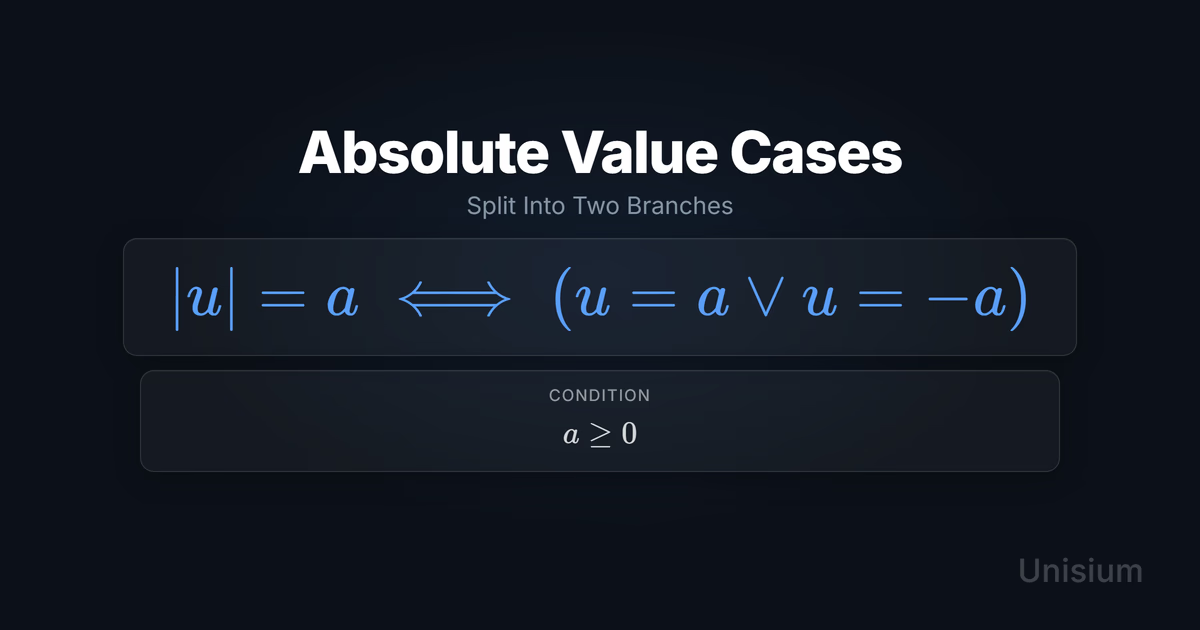
Absolute Value Cases: Split Into Two Branches
Absolute Value Cases lets you replace the equation with two equation branches, and , preserving the solution set exactly. It applies only when ; if the original equation has no solution and the case-split must not be performed. Recognizing when this move is legal — and automatically checking the sign of before splitting — is a core algebra fluency skill practiced in the Unisium Study System.
This guide sits inside the Algebra study map, where you can see the neighboring moves, models, and next-step guides that connect this principle to the rest of algebra.
On this page: The Principle | Conditions | Failure Modes | EE Questions | Retrieval Practice | Practice Ground | Solve a Problem | FAQ
The Principle
The move: Replace an absolute value equation with two branches: or .
The invariant: When , the solution set of equals the union of the solution sets of and .
Pattern:
| Legal ✓ | Illegal ✗ |
|---|---|
The illegal column is the critical near-miss: the expression looks syntactically ready for a case-split, but fails the condition. An absolute value can never equal a negative number, so has no real solution — the correct answer is “no solution,” not two extraneous roots.
Conditions of Applicability
Condition:
Before applying, check: Is the right-hand side of the absolute value equation non-negative? If there is an expression on the right (e.g. ), verify or assume before splitting.
If the condition is violated: Splitting when produces two equations that have solutions, but those solutions are extraneous — none of them satisfy the original equation because an absolute value can never equal a negative number.
- Negative RHS: If , stop immediately and write “no solution.” Do not perform the case-split.
- Expression on the RHS: If is a variable expression (e.g. ), you must either restrict to values where or handle the two sub-cases separately: one where and one where yields no solution from the absolute value branch.
Want the complete framework behind this guide? Read Masterful Learning.
This move starts from the meaning established in Absolute Value Definition. Compare it with Square Root Property when two algebraic branches appear for a different reason, and use it next with Multiplicative Inequality when solving the resulting cases requires inequality steps.
Common Failure Modes
Failure mode: Split without checking the sign of ; if , the two resulting equations are solved and the extraneous roots are reported as valid → incorrect solution set.
Debug: Before splitting, glance at the right side: is it a literal negative number, or an expression that could evaluate negatively? If either, the split is blocked.
Failure mode: Write only one branch () instead of both ( and ) → miss the second solution.
Debug: A case-split always produces exactly two branches when ; when the two branches coincide, so the solution set has exactly one value (). Count branches before moving on.
Elaborative Encoding
Use these questions to build deep understanding. (See Elaborative Encoding for the full method.)
Within the Principle
- Where do the two cases and come from in terms of the absolute value definition?
- If , does the split still produce two distinct solutions? What is the solution set?
For the Principle
- How do you verify, after solving both cases, that neither solution is extraneous?
- If the right-hand side involves a variable (e.g. ), how does the condition change your procedure?
Between Principles
- How does Absolute Value Cases relate to the Absolute Value Definition, which defines as a piecewise function?
- Compare this move to Zero Product Property: both split a single equation into two simpler ones. What is the structural difference?
Generate an Example
- Write an equation of the form where is a variable expression. Then describe a situation where a student could perform the case-split and obtain a false solution because they did not check .
Retrieval Practice
Answer from memory, then click to reveal and check. (See Retrieval Practice for the full method.)
State the move in one sentence: _____Replace |u| = a with the two cases u = a or u = −a, valid only when a ≥ 0.
Write the canonical equivalence: _____
State the canonical condition: _____
Practice Ground
Use these exercises to build move-selection fluency. (See Self-Explanation for how to use worked examples effectively.)
Procedure Walkthrough
Starting from , reach the two solution values for . (Note: , so the split is valid.)
| Step | Expression | Operation |
|---|---|---|
| 0 | — | |
| 1 | Apply Absolute Value Cases () | |
| 2 | Add 1 to both sides of each equation (Additive Equality) | |
| 3 | Divide both sides of each equation by 2 (Multiplicative Equality) |
Both solutions check out in the original: and .
Drills
Format D: Goal-Directed Micro-Chain
Micro-chain: Starting from , reach the solution set for . (.)
Reveal
Apply Absolute Value Cases:
Subtract 4 from each branch:
Solution set: .
Micro-chain: Starting from , reach the solution set for . (.)
Reveal
Apply Absolute Value Cases:
Divide each branch by 3:
Micro-chain: Starting from , solve for . (.)
Reveal
Apply Absolute Value Cases:
Add 5 to both sides of each branch:
Divide by 2:
Micro-chain: Starting from , isolate the absolute value and then apply the case-split.
Reveal
Divide both sides by 3 first:
Apply Absolute Value Cases:
Subtract 2:
Negative drill — eligibility check: Can you apply Absolute Value Cases to ? Explain.
Reveal
No. The right-hand side violates the condition . An absolute value is always non-negative, so has no real solution. Performing the split would yield and , giving and — both extraneous.
Negative drill — identify the legal step: In this three-step chain, which step correctly applies Absolute Value Cases and which one is illegal?
- (proposed)
Reveal
- Step 1 → 2 is legal. , so the split is valid. Both branches are identical (), giving the single solution .
- Step 3 is illegal. violates the condition. The split must not be performed; the correct conclusion is “no solution” for that equation.
Micro-chain (variable RHS): Starting from , find all solutions for . The RHS is an expression — check whether is satisfied at each candidate solution.
Reveal
The RHS is , which must be for the split to be valid; any solution found must satisfy .
Apply Absolute Value Cases:
Branch 1: . Check condition: ✓. Verify: ✓.
Branch 2: . Check condition: ✓. Verify: ✓.
Solution set: .
Format A: Forward Step
Apply the principle once. ( confirmed.) Write the two-branch result.
Reveal
, so apply Absolute Value Cases:
Apply the principle once. ( confirmed.)
Reveal
, so apply Absolute Value Cases:
Both branches are identical. There is exactly one solution: .
Apply the principle once. ( confirmed.)
Reveal
, so apply Absolute Value Cases:
Is this application correct? Explain.
Reveal
Incorrect. The right-hand side fails the condition . The equation has no real solution — the case-split must not be performed.
Apply the principle once. The RHS is an expression — confirm it is non-negative before splitting. Given that :
Reveal
Substitute : .
✓, so apply Absolute Value Cases:
Solve a Problem
Apply what you’ve learned with Problem Solving.
Problem: Starting from , reach both solution values for using Absolute Value Cases.
Full solution
| Step | Expression | Move |
|---|---|---|
| 0 | — | |
| 1 | Add 4 to both sides (Additive Equality) | |
| 2 | Divide both sides by 2 (Multiplicative Equality, ); confirmed | |
| 3 | Apply Absolute Value Cases | |
| 4 | Add 6 to both sides of each branch (Additive Equality) | |
| 5 | Divide by 3 (Multiplicative Equality) |
Check: ✓ and ✓.
FAQ
What is Absolute Value Cases?
Absolute Value Cases is the algebraic move that replaces with the disjunction or . It works because the definition of absolute value forces to land on one of two symmetric positions on the number line whenever the distance is non-negative.
When is Absolute Value Cases valid?
The move is valid whenever the right-hand side satisfies . If is a literal number, simply check its sign. If is an expression, you must verify or assume that expression is non-negative before splitting.
What goes wrong if I forget the condition?
If , the two resulting equations will have numeric solutions, but those solutions are extraneous — substituting them back into the original equation shows equals a positive number, not . You will report solutions that do not exist.
Why does produce only one solution?
When , both branches collapse to — the two branches coincide, so the solution set contains exactly one value. This is not a sign of error — it is the degenerate case of the move.
How does Absolute Value Cases differ from the Absolute Value Definition?
The Absolute Value Definition describes what absolute value is (piecewise: for , for ). Absolute Value Cases is an operation: a legal move for solving equations. The definition is the theoretical foundation; this move is what you apply when you see and want to remove the bars.
Does Absolute Value Cases apply to absolute value inequalities?
No. This guide covers equations of the form . Absolute value inequalities such as or use a different case structure and should be treated as a separate topic.
How This Fits in Unisium
In the Unisium Study System, Absolute Value Cases appears as a key isolate-type move in the algebra principle map. The system drills condition recognition — not just the mechanical split — so you build the reflex to check before every case-split, not as an afterthought. The spaced repetition scheduler prioritizes this condition check because skipping it is the single most common source of extraneous solutions in absolute value problems.
Explore further:
- Absolute Value Definition — The representational foundation this move is built on
- Elaborative Encoding — Build deep understanding of why matters
- Retrieval Practice — Make the condition and canonical pattern instantly accessible
Ready to master Absolute Value Cases? Check access and join the Unisium waitlist or explore the full learning framework in Masterful Learning.
Masterful Learning
The book behind these guides: a study system for physics, math, & programming built on retrieval, connection, explanation, and problem solving.
Ready to apply this strategy?
Unisium turns these evidence-based techniques into guided study sessions for math and physics. Places are limited during early access. Check current availability to start a trial; joining the mailing list is optional.
See plans and availability Read More GuidesAlready have access? Sign in