Cross Multiplication: Solving Proportions by Cross Products
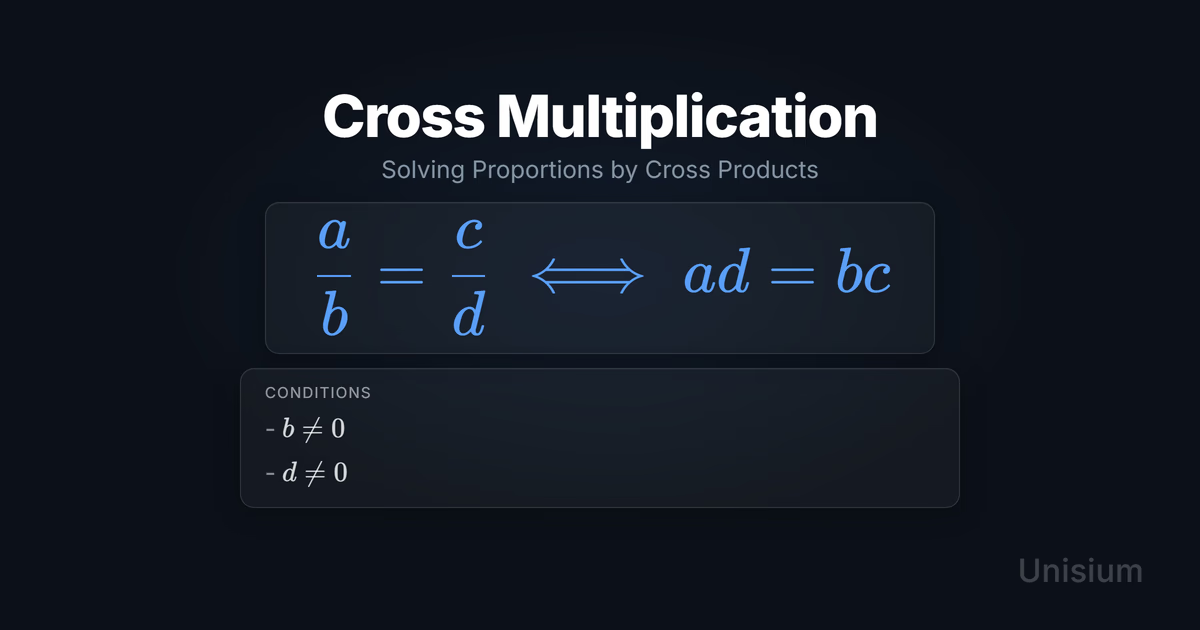
Cross Multiplication converts a proportion into the equivalent product equation , preserving the solution set in a single denominator-clearing step. The move is legal only when both denominators are nonzero — a zero denominator makes the original fraction undefined, so no valid proportion exists to transform. Checking and before applying is a core condition-recognition habit built in the Unisium Study System.
This guide sits inside the Algebra study map, where you can see the neighboring moves, models, and next-step guides that connect this principle to the rest of algebra.
On this page: The Principle | Conditions | Failure Modes | EE Questions | Retrieval Practice | Practice Ground | Solve a Problem | FAQ
The Principle
The move: Replace the proportion with the product equation .
The invariant: This preserves the solution set, provided and .
Pattern:
The result is a direct consequence of Multiplicative Equality: multiplying both sides of the proportion by gives , which simplifies to .
| Legal ✓ | Illegal ✗ |
|---|---|
| → → ✓ — cross product pairs with and with | → → ✗ — same-row pairing: pairs numerator with numerator and denominator with denominator ; this does not follow from the proportion rule |
Conditions of Applicability
Condition: ;
Before applying, check: identify both denominators and confirm neither is zero — for numeric denominators this is immediate; for denominators containing a variable such as , note the excluded value(s) before proceeding, and verify that any solution you find does not equal an excluded value.
If the condition is violated: if or , the corresponding fraction is undefined and the original proportion is a meaningless expression. Any product equation derived from an undefined proportion has no validity, and a “solution” obtained from it is equally meaningless.
- A denominator equal to a nonzero constant is always safe — no further check needed.
- When a denominator is a variable expression, exclude its zero-values from the domain, and test any solution against those excluded values before accepting it.
Want the complete framework behind this guide? Read Masterful Learning.
This move is safest after you recognize the underlying Proportional Model. Compare it with Clear Denominators when deciding whether you are solving a true proportion or a more general fractional equation, and use it next in Linear Model contexts where the ratio relation turns into an explicit solve.
Common Failure Modes
Failure mode: pairing numerator with numerator and denominator with denominator instead of taking cross products — writing (same-row pairing) instead of (numerator of each to denominator of the other) → the equation is algebraically wrong and solving it produces an incorrect value.
Debug: draw an ×-shape over the proportion ; the two products are (top-left to bottom-right) and (bottom-left to top-right). If your products connect same-row entries, you have the wrong diagonal.
Failure mode: solve the cross-multiplied equation and accept a root that makes a variable denominator zero — e.g., finding as a formal solution of the product equation when the original had denominator , which is zero at → that value is an excluded value; the original proportion was undefined there, so it is not a valid solution.
Debug: write down all excluded values before solving (e.g., ""), then test every root against that list and discard any match.
Elaborative Encoding
Use these questions to build deep understanding. (See Elaborative Encoding for the full method.)
Within the Principle
- What does “equivalent equation” mean concretely: if satisfies , does it also satisfy ? Verify by substitution.
- Why does multiplying both sides of by produce exactly — what happens to each side in that step?
For the Principle
- How do you confirm and when the denominators are numbers? When they contain a variable like ?
- After cross-multiplying a proportion with a variable denominator, what extra verification step must follow solving the resulting equation?
Between Principles
- How does Cross Multiplication relate to Proportional Model: one is a representational tool (setting up ) and the other is an operational move — which is which, and when does the representational step precede the operational one in a proportion problem?
Generate an Example
- Write a proportion where one denominator is a variable expression. Apply Cross Multiplication, state the excluded value, solve for , and confirm the solution is not an excluded value.
Retrieval Practice
Answer from memory, then click to reveal and check. (See Retrieval Practice for the full method.)
State the move in one sentence: _____In a proportion, multiply each numerator by the opposite denominator: the product of a and d equals the product of b and c.
Write the canonical pattern: _____
State the canonical condition: _____
Practice Ground
Use these exercises to build move-selection fluency. (See Self-Explanation for how to use worked examples effectively.)
Procedure Walkthrough
Starting from , reach .
| Step | Expression | Operation |
|---|---|---|
| 0 | — | |
| 1 | Cross Multiplication (, ) | |
| 2 | Distributive Property | |
| 3 | Subtract 12 from both sides (Additive Equality) | |
| 4 | Divide both sides by 6 (Multiplicative Equality, ) |
Diagnostic: A near-miss at Step 1 is to write , i.e., — this pairs numerator with numerator and denominator with denominator (same-row pairing), not the cross products. The correct cross pairing is .
Drills
Format D — Goal micro-chain
Reach the target form. Starting from , find .
Reveal
Cross-multiply (, ):
Reach the product form. Starting from , state the product equation and solve for .
Reveal
Cross-multiply (, ):
Identify eligibility. A student writes down .
Before applying Cross Multiplication, what values of must be excluded, and why?
Reveal
Denominator when ; denominator when . Both are excluded by the conditions and .
Cross-multiplying: .
Check: and — solution is valid.
Negative drill — condition violated. A student sees and applies Cross Multiplication to get , i.e., , concluding “no solution.” Is this a valid application? Why or why not?
Reveal
Invalid. The denominator violates the condition . The fraction is undefined — the proportion does not exist as a mathematical statement. Cross Multiplication cannot be applied, and any equation derived from an undefined expression has no meaning. The expression is not a valid proportion.
Reach the target form with condition check. Starting from , solve for .
Reveal
The original requires (denominator of the left fraction). Cross-multiply ():
Check: — condition satisfied; solution is valid.
Reach the product form. Starting from , state the product equation and solve.
Reveal
Cross-multiply (, ):
Format A — Forward step
Apply Cross Multiplication once.
Reveal
Cross products (, ):
Negative drill — not a proportion. A student sees and applies Cross Multiplication to just , ignoring the term: ”, so .” Is this valid? What is the error?
Reveal
Invalid. The equation is not a proportion — it is not in the form with a single fraction on each side. The left side contains a sum of fractions; you cannot apply Cross Multiplication by ignoring part of the left side.
Correct approach: evaluate the left side first — — then cross-multiply: .
Apply Cross Multiplication once.
Reveal
Cross products (, ):
Apply Cross Multiplication once. State the product equation and identify the excluded values.
Reveal
Excluded values: (makes ) and (makes ).
Cross products (, ):
(The next steps — distributing, combining, and solving — continue from here, subject to rejecting any solution equal to 2 or .)
Apply Cross Multiplication once.
Reveal
Cross products (, ):
Solve a Problem
Apply what you’ve learned with Problem Solving.
Problem: Starting from , solve for using Cross Multiplication.
Full solution
| Step | Expression | Move |
|---|---|---|
| 0 | — | |
| 1 | Cross Multiplication (, ) | |
| 2 | Distributive Property | |
| 3 | Subtract from both sides (Additive Equality) | |
| 4 | Add to both sides (Additive Equality) | |
| 5 | Divide both sides by (Multiplicative Equality, ) |
FAQ
What is Cross Multiplication?
Cross Multiplication is the algebraic rule that replaces a proportion (with and ) with the equivalent product equation . It eliminates all denominators from the proportion in a single step.
When is Cross Multiplication valid?
The move is valid when the equation is a proportion — a single fraction equal to a single fraction — and both denominators are nonzero. For constant denominators, confirmation is immediate. For variable denominators, identify and exclude the zero-values before proceeding.
What goes wrong if I forget the condition?
If a denominator is zero, the original fraction is undefined — the proportion does not exist. Any product equation derived from it is meaningless. For variable denominators, omitting the zero-check can allow an extraneous value to slip through as a “solution” that must be rejected on inspection.
How is Cross Multiplication different from just multiplying both sides by both denominators?
They are equivalent operations. Cross Multiplication is the shorthand result of applying Multiplicative Equality with the common nonzero factor : multiplying both sides by yields , which simplifies to . Cross Multiplication names that single denominator-clearing step.
Does Cross Multiplication apply to equations, inequalities, or both?
This principle applies to proportional equations — a single fraction equal to a single fraction. For a proportion inequality such as , cross-multiplying is not a free move: the direction of the inequality depends on the signs of and , and multiplying by a negative value reverses the inequality. Because the sign of a variable denominator may be unknown, Cross Multiplication as stated here is limited to equations where only the nonzero condition (not the sign) matters.
Does Cross Multiplication apply to adding fractions?
No. Adding fractions — — is not a proportion. Cross Multiplication applies only when a single fraction equals a single fraction. Reduce the left side to a single fraction first, then cross-multiply if needed.
Can I use Cross Multiplication on a three-part proportion like ?
The standard rule applies to a pair of equal fractions. For a three-part continued proportion, isolate any two fractions, cross-multiply those, and work through the remaining pair separately.
How This Fits in Unisium
Cross Multiplication sits at the boundary between proportional reasoning and equation-solving in the algebra sequence — it consumes the Proportional Model setup and converts it into a linear equation ready for isolation. Unisium builds fluency through goal-directed micro-chain drills (given a proportion, reach the product equation as efficiently as possible while stating both condition checks) and forward-step drills that isolate the single cross-multiplication move. The target is immediate pattern recognition: seeing , writing , and confirming and without interrupting the solution flow.
Explore further:
- Principle Structures — Locate Cross Multiplication in the algebra principle hierarchy
- Elaborative Encoding — Understand why the cross-product diagonal matters, not just the rule
- Retrieval Practice — Make the canonical pattern and condition instantly accessible
Ready to master Cross Multiplication? Check access and join the Unisium waitlist or explore the full learning framework in Masterful Learning.
Masterful Learning
The book behind these guides: a study system for physics, math, & programming built on retrieval, connection, explanation, and problem solving.
Ready to apply this strategy?
Unisium turns these evidence-based techniques into guided study sessions for math and physics. Places are limited during early access. Check current availability to start a trial; joining the mailing list is optional.
See plans and availability Read More GuidesAlready have access? Sign in