Radical Definition: The Principal Nonnegative Root Rule
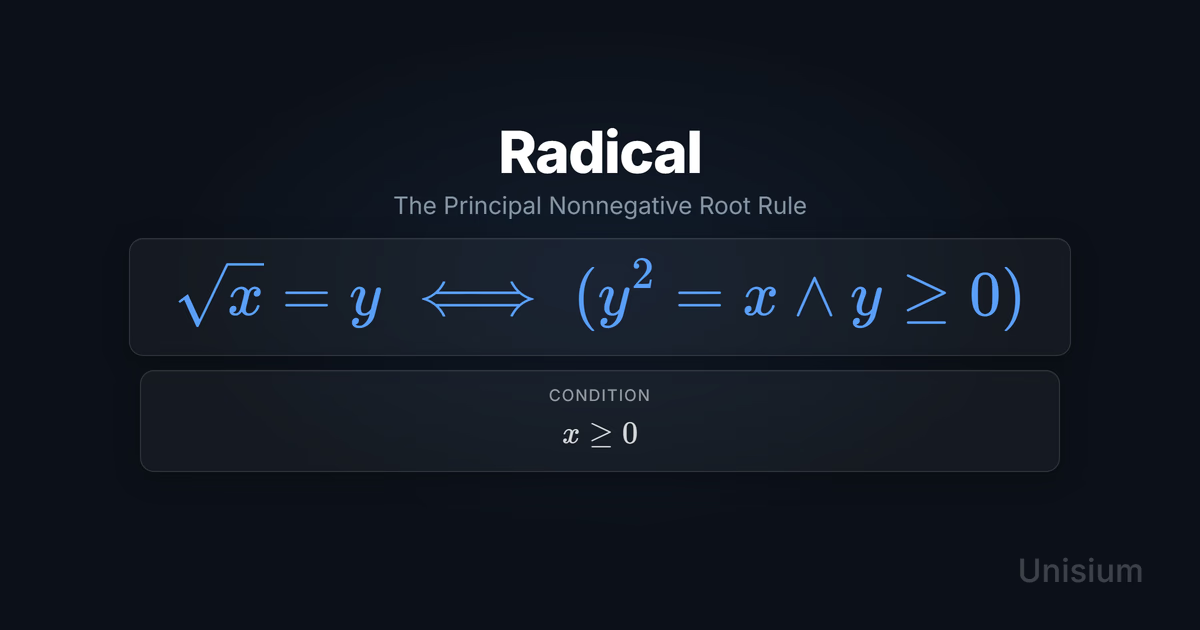
Radical Definition identifies as the unique nonnegative number satisfying , valid only when . The nonnegative requirement is not a convenience — it makes the square root a true function with exactly one output per input. Mastering it through elaborative encoding, retrieval practice, self-explanation, and problem solving is part of the Unisium Study System.
This guide sits inside the Algebra study map, where you can see the neighboring moves, models, and next-step guides that connect this principle to the rest of algebra.
On this page: The Principle · Conditions · Misconceptions · EE Questions · Retrieval Practice · Worked Example · Solve a Problem · FAQ
The Principle
Statement
The square root of , written , is the unique nonnegative number such that . The nonnegative requirement distinguishes the principal root from the full solution set of , which has two elements ( and ) whenever . Because only one output is named by , the expression is a single-valued function.
Mathematical Form
Where:
- = radicand; must satisfy for the square root to be a real number
- = principal square root; always
- = biconditional: both and must hold simultaneously
Alternative Forms
In different contexts, this appears as:
- Fractional exponent: — convenient when combining with exponent rules
Conditions of Applicability
Condition:
The radicand must be nonnegative so that a real number exists satisfying . If , no real number squares to , and is undefined in the real number system.
Practical modeling notes
- Check the radicand before writing a square root: if a variable radicand could be negative, impose and carry the domain constraint (e.g., ) through your work.
- The condition applies to the radicand, not to the variable you are solving for. After solving, verify that the candidate solution satisfies any derived domain constraints.
When It Doesn’t Apply
- Negative radicand (): is not a real number. In complex-number contexts, extends the definition via the imaginary unit, but the real-number principal-root convention no longer applies.
- Complex radicands: For complex inputs, the principal value of the square root requires halving the argument of the complex number; the real-variable definition above does not generalize without a separate convention.
Want the complete framework behind this guide? Read Masterful Learning.
Compare this with Square Root Property when deciding whether you are defining what a radical means or solving an equation with roots. The next algebra step is often Simplify Radicals by Extracting a Square Factor when the radical needs rewriting.
Common Misconceptions
Misconception 1: ""
The truth: only. The definition requires , so is excluded even though . Writing is appropriate when listing all solutions to , but alone names only the principal root.
Why this matters: Misreading as introduces phantom negative outputs into simplification steps, producing incorrect signs in final answers.
Misconception 2: ” for all ”
The truth: , not . If , then and , not . The absolute value arises directly from the nonnegative requirement in the radical definition.
Why this matters: Omitting the absolute value when simplifying produces errors in any problem where could be negative — a frequent source of lost points in equation solving.
Misconception 3: “Squaring both sides always introduces an extraneous solution”
The truth: For equations of the form , squaring is equivalent to the original equation exactly when . The radical definition guarantees the left side is nonnegative, so a negative right side cannot match it in the real numbers.
Why this matters: Students who miss this condition either over-check harmless cases or fail to see why with has no real solution before any algebra begins.
Elaborative Encoding
Use these questions to build deep understanding. (See Elaborative Encoding for the full method.)
Within the Principle
- In , the clause is listed separately from . What additional root does alone permit, and why does the definition exclude it?
- Evaluate using the definition. Which value of satisfies both and ? Is there any ambiguity?
For the Principle
- Before evaluating in an algebraic expression, what must you check about ? What constraint do you impose when you cannot confirm the sign of ?
- The equation can be solved by squaring both sides to get . What condition on ensures this step is safe, and how does the radical definition explain it?
Between Principles
- The identity links the radical definition to the absolute value definition. For a given real , trace through both definitions to show why is the correct output rather than .
Generate an Example
- Write a radical equation with and explain, using the definition, why it has no real solution regardless of the choice of .
Retrieval Practice
Answer from memory, then click to reveal and check. (See Retrieval Practice for the full method.)
State the radical definition in words: _____The square root of x is the unique nonnegative number y such that y squared equals x, defined only when x is nonnegative.
Write the canonical equation: _____
State the canonical condition: _____
Worked Example
Use this worked example to practice Self-Explanation.
Problem
Solve .
Step 1: Verbal Decoding
Target:
Given: —
Constraints: radicand nonnegative, right side nonnegative
Step 2: Visual Decoding
Draw a number line for . Mark and shade the region .
(So any valid solution must lie in the shaded region.)
Step 3: Mathematical Modeling
Step 4: Mathematical Procedures
Step 5: Reflection
- Verification: ✓ — the solution satisfies the original equation.
- Domain check: , so falls within the valid domain of .
- Connection to concept: Because , the principal-root definition ensures squaring produces no extraneous solutions; the solution is unique.
Before moving on: self-explain the model
Explain Step 3 in your own words: why does directly imply ? How does the clause of the definition justify squaring without introducing an extraneous solution?
Mathematical model with explanation
Principle: Radical Definition, instantiated as with .
Conditions: ; verified at since ✓.
Relevance: The right side is positive, satisfying the definition’s output constraint, so squaring converts the radical equation to a linear equation without sign ambiguity.
Description: Substituting into the biconditional yields , eliminating the radical. Two linear operations then isolate .
Goal: Remove the radical using the definition, solve the resulting linear equation, and verify the domain.
Solve a Problem
Apply what you’ve learned with Problem Solving.
Problem
Solve .
Hint (if needed): Apply the radical definition to remove the radical, then solve the resulting equation and check the domain constraint.
Show Solution
Step 1: Verbal Decoding
Target:
Given: —
Constraints: radicand nonnegative, right side nonnegative
Step 2: Visual Decoding
Draw a number line for . Mark and shade the region .
(So any valid solution must lie in the shaded region.)
Step 3: Mathematical Modeling
Step 4: Mathematical Procedures
Step 5: Reflection
- Verification: ✓
- Domain check: , so ✓
- Connection to concept: ensures the biconditional applies cleanly; the principal-root guarantee yields exactly one solution.
Related Principles
| Principle | Relationship to Radical Definition |
|---|---|
| Simplify Radicals (Square Factor) | Applies this definition to extract perfect-square factors: for |
| Absolute Value — Definition | The identity bridges both definitions; the nonneg output of the radical matches absolute value |
| Exponent Rule — Fractional Exponents | ; the exponent rule generalizes the radical to any rational power |
See Principle Structures for how to organize these relationships visually.
FAQ
What is the radical definition in math?
The radical definition states that is the unique nonnegative number satisfying , for . The word “principal” refers to this nonneg root specifically, making a single-valued function rather than a two-valued relation.
Why is equal to 3 and not ?
The definition requires , so is excluded even though . Both and solve the equation , but only is the principal root. Writing is appropriate when listing all solutions to , not when evaluating .
What is the domain of the square root function?
The domain of is in the real number system. For , no real number squares to , so the output is undefined over the reals.
What does “principal root” mean?
“Principal root” refers to the nonnegative square root, selected by the clause in the definition. It distinguishes — one specific value — from the full solution set of , which contains two values when .
What is the difference between and ?
They name the same value: the principal (nonneg) square root of for . The notation connects the radical to exponent rules, while is standard in arithmetic and algebra. Both carry the implicit constraint for real outputs.
Can you take the square root of a negative number?
Not in the real number system — no real number squares to a negative value. In complex arithmetic, extends the definition using the imaginary unit , but that requires a separate complex-number convention. In real algebra, with is undefined.
Related Guides
- Principle Structures — Organize the radical definition in a hierarchy of algebra definitions and rules
- Self-Explanation — Use the worked example above to practice explaining each step
- Retrieval Practice — Make the biconditional definition immediately accessible under exam pressure
- Problem Solving — Apply the Five-Step Strategy to radical equations systematically
How This Fits in Unisium
Unisium pairs each principle — including this definition — with elaborative-encoding questions, retrieval cloze prompts, and graded problem sets so you build both recall and flexible application. Linking the biconditional form to the principal-root interpretation, then applying it in worked and solo problems, shortens the path from “I’ve seen this” to “I can use it reliably under exam pressure.”
Ready to master Radical Definition? Check access and join the Unisium waitlist or explore the full learning framework in Masterful Learning.

Masterful Learning
The book behind these guides: a study system for physics, math, & programming built on retrieval, connection, explanation, and problem solving.
Ready to apply this strategy?
Unisium turns these evidence-based techniques into guided study sessions for math and physics. Places are limited during early access. Check current availability to start a trial; joining the mailing list is optional.
See plans and availability Read More GuidesAlready have access? Sign in