Additive Inverse: Canceling an Offset with Its Opposite
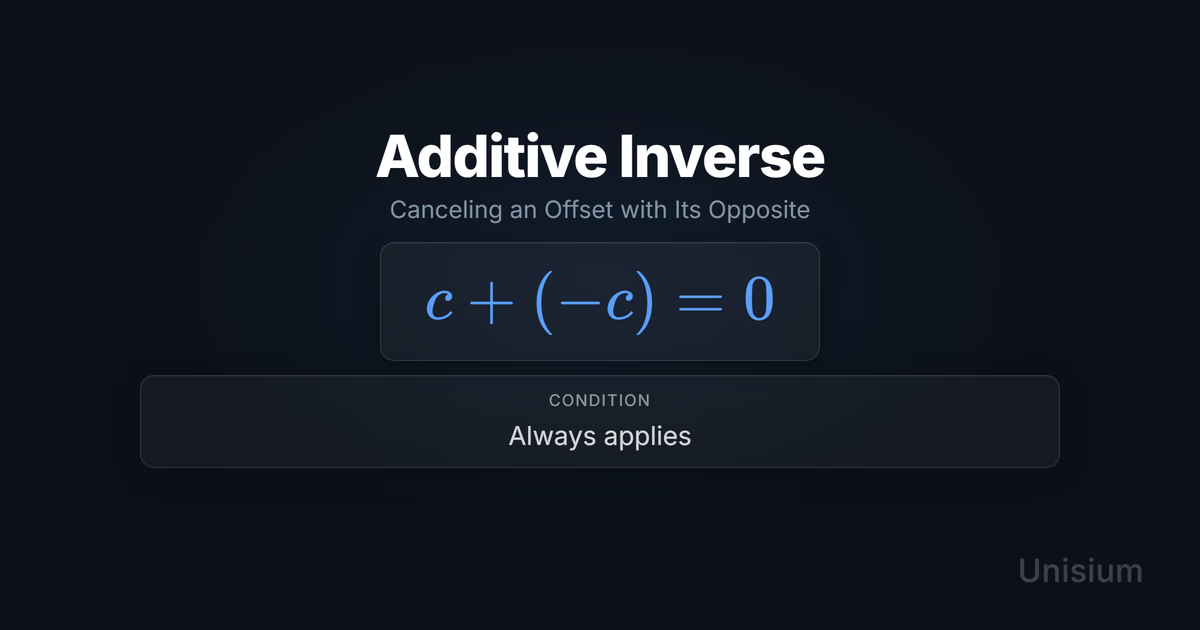
Additive Inverse is the local cancellation principle that a quantity and its opposite add to zero: . In algebra, this is what makes an offset disappear. In equation solving, it is usually combined with Additive Equality, which licenses applying the same opposite quantity to both sides; building the structural reflex to distinguish these two layers is a foundational algebra fluency skill practiced throughout the Unisium Study System.
This guide sits inside the Algebra study map, where you can see the neighboring moves, models, and next-step guides that connect this principle to the rest of algebra.
On this page: The Principle | Conditions | Failure Modes | EE Questions | Retrieval Practice | Practice Ground | Solve a Problem | FAQ
The Principle
The move: Add the opposite of an offset so the offset cancels to 0.
The local invariant: The cancellation is valid because a quantity and its opposite sum to zero.
Canonical pattern:
Common algebra forms:
This principle is local: it explains why an offset disappears inside an expression. It is not the general rule that justifies adding the same quantity to both sides of an equation. That justification belongs to Additive Equality.
In equation solving, Additive Inverse and Additive Equality work together:
| Local cancellation ✓ | Not a valid cancellation ✗ |
|---|---|
| (sign changed without applying the opposite to the whole equation) | |
| (offset moved across with the same sign) |
The right column fails because additive cancellation requires adding the actual opposite quantity — it is not a sign flip or a term teleportation.
Conditions of Applicability
Condition: Always applies
Every real quantity has an additive opposite, so there is no restriction. The key task is identifying the full offset and its true opposite — if the offset is , its opposite is ; if the offset is , its opposite is .
Want the complete framework behind this guide? Read Masterful Learning.
This move relies on Additive Equality: you are still changing both sides by the same quantity. Compare it with Multiplicative Inverse when the cancellation move is division instead of subtraction, and use it next inside Linear Model setups where isolating a variable is part of the solve.
Common Failure Modes
Failure mode: treating the offset removal as “move it across and flip the sign” without adding the actual opposite — e.g., . Here the offset was not canceled by its opposite ; instead, landed on the right side unchanged.
Debug: Name the opposite explicitly: “the opposite of is .” Then check: did the offset cancel locally (), and did both sides receive the same change?
Elaborative Encoding
Use these questions to build deep understanding. (See Elaborative Encoding for the full method.)
- Why does explain the disappearance of an offset?
- How do you identify the full additive offset in an expression?
- How does Additive Equality license applying the same opposite quantity to both sides, and how does Additive Inverse explain the local cancellation that follows?
- Write one equation where adding the opposite cleanly removes an offset, and one student step where the sign is changed informally instead of applying the actual opposite.
Retrieval Practice
Answer from memory, then click to reveal and check. (See Retrieval Practice for the full method.)
State the Additive Inverse principle in one sentence: _____A quantity cancels with its opposite because c + (-c) = 0.
Write the canonical pattern: _____
State the canonical condition: _____Always applies
Practice Ground
Use these exercises to build move-selection fluency. (See Self-Explanation for how to use worked examples effectively.)
Procedure Walkthrough
Starting from , isolate . Each offset-removal step has two layers: Additive Equality licenses applying the same opposite to both sides, and Additive Inverse explains why the offset cancels locally.
| Step | Expression | Operation |
|---|---|---|
| 0 | — | |
| 1 | Apply to both sides (Additive Equality). | |
| 2 | Right side: , so the variable offset cancels (Additive Inverse); left side simplifies . | |
| 3 | Apply to both sides (Additive Equality). | |
| 4 | Left side: , so the constant offset cancels (Additive Inverse). |
Drills
Local cancellation
Simplify:
Reveal
The offset cancels with its opposite : .
Is this a valid cancellation? Why or why not?
Reveal
Invalid. The sign was changed informally. To remove the offset, add to the whole expression: . Changing the sign to produces a different expression.
Equation use
Starting from , reach .
Reveal
Add to both sides (Additive Equality). On the left, , so the offset cancels (Additive Inverse):
Apply one additive-cancellation step to isolate the term. What is the next state?
Reveal
Add to both sides (Additive Equality). On the left, , so the constant offset cancels (Additive Inverse):
(Negative) A student has the equation and writes the next line as . Identify the error and state the correct result.
Reveal
Invalid. The offset is ; its opposite is , since . Adding to both sides (Additive Equality) cancels the offset locally (Additive Inverse): . The student subtracted from the right instead of adding.
Solve a Problem
Apply what you’ve learned with Problem Solving.
Problem: Starting from , isolate .
Full solution
| Step | Expression | Move |
|---|---|---|
| 0 | — | |
| 1 | Distribute on both sides (Distributive Property) | |
| 2 | Combine like terms on both sides | |
| 3 | Add to both sides (Additive Equality); on the left, , so the variable offset cancels (Additive Inverse). | |
| 4 | Add to both sides (Additive Equality); on the right, , so the constant offset cancels (Additive Inverse). |
Check: and ✓
FAQ
What is the Additive Inverse principle?
Additive Inverse is the principle that a quantity cancels with its opposite: In algebra, this is what removes an offset from an expression.
Why does this always apply?
Because every real quantity has an additive opposite. Unlike multiplicative inverse, there is no nonzero restriction — the opposite of any real number always exists.
How is Additive Inverse different from Additive Equality?
Additive Equality is the general equation rule: add the same quantity to both sides and equality is preserved. Additive Inverse is the local cancellation principle: a quantity and its opposite sum to zero, so the offset disappears. Additive Equality answers “why can I do this to both sides?”; Additive Inverse answers “why does the offset vanish?”
Why is “move it across and change the sign” risky?
Because it hides the actual algebraic step. The real move is not a term teleportation: it is adding the opposite quantity so that the offset cancels locally. Phrasing it as “moving” makes it easy to apply the wrong sign or forget to apply the same change to both sides.
How This Fits in Unisium
Additive Inverse gives the local mechanism of offset removal: an additive term disappears because its opposite turns it into 0. In equation solving, this works together with Additive Equality, which licenses applying that opposite to both sides. Unisium trains these as two distinct recognitions: first, “what opposite cancels this offset?” and second, “is it legal to apply that same change to both sides?” The goal is structural fluency — seeing exactly why the offset vanishes and what makes that cancellation valid.
Explore further:
- Additive Equality — The bilateral equation rule that licenses applying an opposite to both sides
- Multiplicative Inverse — The multiplicative counterpart: a nonzero factor cancels with its reciprocal
- Elaborative Encoding — Build deep understanding of why the opposite is the right tool
- Retrieval Practice — Make the canonical pattern and condition instantly accessible
Ready to master Additive Inverse? Check access and join the Unisium waitlist or explore the full learning framework in Masterful Learning.

Masterful Learning
The book behind these guides: a study system for physics, math, & programming built on retrieval, connection, explanation, and problem solving.
Ready to apply this strategy?
Unisium turns these evidence-based techniques into guided study sessions for math and physics. Places are limited during early access. Check current availability to start a trial; joining the mailing list is optional.
See plans and availability Read More GuidesAlready have access? Sign in