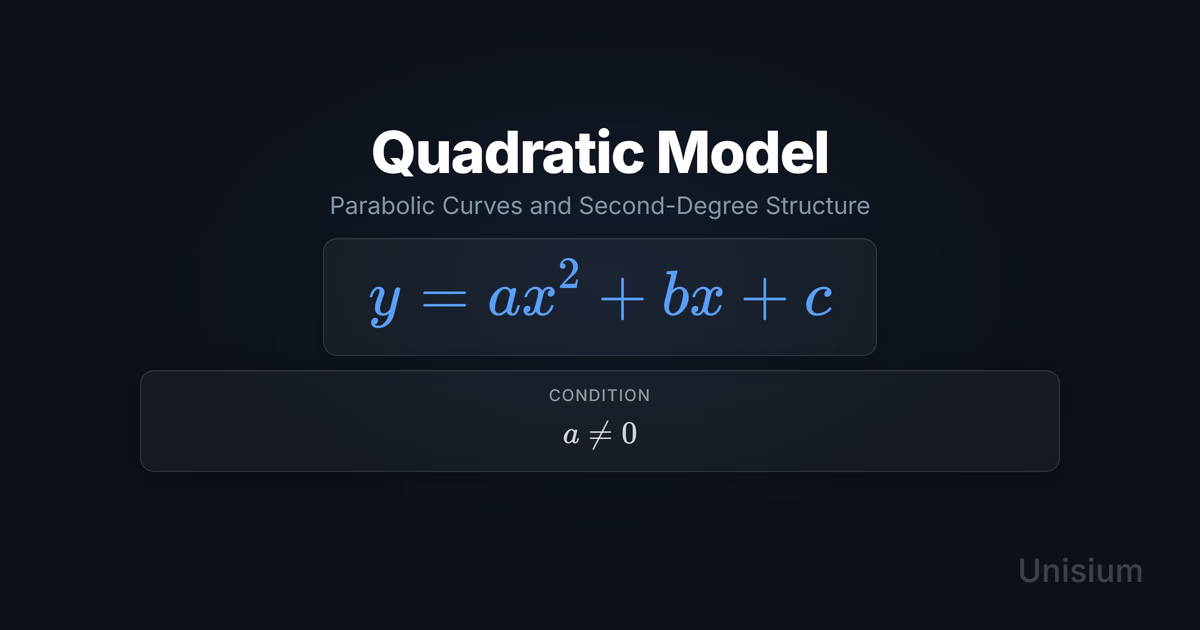
Quadratic Model: Parabolic Curves and Second-Degree Structure
The Quadratic Model is the second-degree polynomial , where . It describes relationships that are well modeled by a second-degree polynomial in one variable—height of a launched object, profit as a function of price, area as a function of side length—producing a parabolic graph.
This guide sits inside the Algebra study map, where you can see the neighboring moves, models, and next-step guides that connect this principle to the rest of algebra.
On this page: The Principle | Conditions | Misconceptions | EE Questions | Retrieval Practice | Worked Example | Solve a Problem | FAQ
The Principle
Statement
The Quadratic Model is a second-degree polynomial in one variable. It states that is determined by three additive contributions from : a quadratic term , a linear term , and a constant term . The graph of this relationship is always a parabola—symmetric about a vertical axis—and the coefficient governs both its direction and its width.
Mathematical Form
Where:
- = dependent variable (output)
- = independent variable (input)
- = leading (quadratic) coefficient; controls direction and width of the parabola;
- = linear coefficient; together with , determines the horizontal location of the axis of symmetry and vertex
- = constant term; equals the -intercept (the value of when )
Alternative Forms
In different contexts, this appears as:
- Vertex form: , where is the vertex
- Factored form: , where and are the real roots
Conditions of Applicability
Condition:
Practical modeling notes
- All three coefficients , , and may be any real numbers, subject to .
- The axis of symmetry is the vertical line ; the vertex lies on this line.
- When the parabola opens upward (minimum at vertex); when it opens downward (maximum at vertex).
When It Doesn’t Apply
- : Standard form collapses to , which is the Linear Model—a first-degree polynomial.
- Variable degree higher than 2: Use a higher-degree polynomial model or a different archetype entirely.
- Two-variable degree-2 relationships (e.g., circles, ellipses): These are conic sections, not single-variable quadratic models.
Want the complete framework behind this guide? Read Masterful Learning.
This model makes more sense once Linear Model feels familiar as the constant-slope case. Compare it with Exponential Model when deciding what kind of curvature the situation shows, and use it next with Completing the Square when vertex form clarifies the structure.
Common Misconceptions
Misconception 1: ” only controls the steepness of the curve”
The truth: controls two separate things: the sign of determines whether the vertex is a minimum () or maximum (), and the magnitude controls the width of the parabola (larger = narrower).
Why this matters: Confusing these leads students to sketch the wrong shape or miss that flips the parabola—a critical step when finding maximum values.
Misconception 2: ” is just a constant that shifts the parabola up or down”
The truth: In standard form, is the -intercept—the value of when . In vertex form , it is that represents the vertical position of the vertex. Mixing those two roles is a common source of confusion.
Why this matters: A student who treats as “vertical shift” will misplace the vertex and get wrong answers when converting between forms.
Misconception 3: “Any equation with is a Quadratic Model”
The truth: The equation must be in one variable and the coefficient on must be non-zero. Multi-variable degree-2 expressions (like ) are not quadratic models in a single variable.
Elaborative Encoding
Use these questions to build deep understanding. (See Elaborative Encoding for the full method.)
Within the Principle
- What does each coefficient tell you about the parabola before you plot a single point? Work out how changing only , then only , then only each affect the graph shape and position.
- The equation has three terms with different powers of . What happens to each term as grows without bound? Which term dominates, and why?
For the Principle
- A set of data could be modeled as linear, quadratic, or exponential. What features in the data—or in the situation’s structure—would lead you to choose a quadratic model over the others?
- Suppose is accidentally used. What breaks, mathematically and graphically? What is the replacement model, and when does it apply?
Between Principles
- The Quadratic Formula finds the roots of . How does it relate to the Quadratic Model? Is the Formula a representation or a transformation, and what is the Quadratic Model?
Generate an Example
- Describe a physical or economic situation—other than projectile motion or revenue—where the relationship between two quantities is naturally modeled by with . Justify why must be negative in your scenario.
Retrieval Practice
Answer from memory, then click to reveal and check. (See Retrieval Practice for the full method.)
State the Quadratic Model in words: _____A quadratic model is a second-degree polynomial in one variable of the form y = ax^2 + bx + c, with a nonzero quadratic coefficient, that produces a parabolic graph.
Write the canonical equation: _____
State the canonical condition: _____
Worked Example
Use this worked example to practice Self-Explanation.
Problem
A ball is launched straight up from a platform. Its height (in meters) at time seconds is modeled by . Find the time at which the ball reaches its maximum height, and state the maximum height.
Step 1: Verbal Decoding
Target: time at maximum height; maximum height
Given: ,
Constraints: quadratic model with ; so the vertex is a maximum;
Step 2: Visual Decoding
Draw a vertical -axis (meters) and horizontal -axis (seconds). The parabola opens downward (). Label on the -axis; the vertex is the highest point.
Step 3: Mathematical Modeling
Step 4: Mathematical Procedures
Step 5: Reflection
- Verification: At : ✓
- Graphical meaning: Vertex form makes the vertex explicit; the squared term is zero at , maximizing .
- Domain check: , consistent with a physical time after launch.
Before moving on: self-explain the model
Try explaining Step 3 out loud (or in writing): why the Quadratic Model applies, what implies about the vertex, and how Step 4 rewrites the model into vertex form without using the quadratic formula.
Mathematical model with explanation (what “good” sounds like)
Principle: The Quadratic Model with .
Conditions: ✓ The standard form applies.
Relevance: The height is a second-degree polynomial in , fitting the standard form exactly. Since , the vertex is a maximum—precisely what “maximum height” asks for.
Description: Factoring from the quadratic and linear terms isolates the completing-the-square target. Expanding and distributing yields vertex form, from which the time and height at the maximum are read off directly—no memorized vertex formula needed.
Goal: We want and . Vertex form makes both explicit: the vertex is at and by inspection of .
Solve a Problem
Apply what you’ve learned with Problem Solving.
Problem
A manufacturer’s monthly profit (in hundreds of dollars) is modeled by , where is the number of units produced (in thousands). Find the production level that maximizes profit and state the maximum profit.
Hint (if needed): Factor from the quadratic and linear terms, then complete the square inside the brackets.
Show Solution
Step 1: Verbal Decoding
Target: production level at maximum profit; maximum profit
Given: ,
Constraints: quadratic model with ; so the parabola opens downward (maximum exists);
Step 2: Visual Decoding
Draw a horizontal -axis (units, thousands) and vertical -axis (profit, hundreds of dollars). The parabola opens downward. Label as the -intercept; the vertex is the profit peak.
Step 3: Mathematical Modeling
Step 4: Mathematical Procedures
Step 5: Reflection
- Verification: At : ✓
- Connection to concept: confirms the parabola opens downward; the vertex form confirms the vertex is a maximum, not a minimum.
- Domain check: , a valid production quantity.
Related Principles
| Principle | Relationship to the Quadratic Model |
|---|---|
| Linear Model | The special case of standard form; the Quadratic Model generalizes the line to a parabola. |
| Completing the Square (Rewrite Identity) | Converts into vertex form , making the vertex explicit. |
| Quadratic Formula | Uses the coefficients , , to find the roots of ; always applicable when . |
FAQ
What is the Quadratic Model?
The Quadratic Model is the second-degree polynomial , where . It describes relationships that are modeled by a second-degree polynomial in one variable, producing a parabolic graph.
When does the Quadratic Model apply?
Use it when a situation produces a parabolic relationship: the data has curvature and can be fit reasonably by a degree-2 polynomial. Examples include projectile height over time, profit as a function of price, and area as a function of a single length parameter. The condition must hold; otherwise the model is simply linear.
What’s the difference between the Quadratic Model and the Quadratic Formula?
The Quadratic Model is a representation: it defines the shape of the relationship via . The Quadratic Formula is a transformation: it operates on the model when to produce the roots. One describes; the other solves.
What happens when ?
The equation becomes —a first-degree polynomial, the Linear Model. The parabolic curvature disappears entirely. This is exactly why is the required condition for the Quadratic Model.
What are the most common mistakes with the Quadratic Model?
Setting accidentally (collapsing the model to a line), mistaking for a “vertical shift” (it is the -intercept), and forgetting to check the sign of before deciding whether the vertex is a minimum or maximum.
Related Guides
- Principle Structures — Organize the Quadratic Model in its algebraic hierarchy alongside related principles
- Self-Explanation — Learn to extract insight from every worked example
- Retrieval Practice — Make the standard form, vertex form, and core quadratic structure instantly accessible
- Problem Solving — Apply the Quadratic Model systematically to new problems
How This Fits in Unisium
The Unisium Study System tags quadraticModel as a core representational principle in algebra. After studying this guide, Unisium’s problem bank routes you to vertex-finding, root-locating, and real-world application problems linked directly to this principle—providing the spaced, interleaved practice that converts initial encoding into fast, reliable retrieval.
Ready to master the Quadratic Model? Check access and join the Unisium waitlist or explore the full learning framework in Masterful Learning.
Masterful Learning
The book behind these guides: a study system for physics, math, & programming built on retrieval, connection, explanation, and problem solving.
Ready to apply this strategy?
Unisium turns these evidence-based techniques into guided study sessions for math and physics. Places are limited during early access. Check current availability to start a trial; joining the mailing list is optional.
See plans and availability Read More GuidesAlready have access? Sign in