Multiplicative Inverse: Canceling a Factor with a Reciprocal
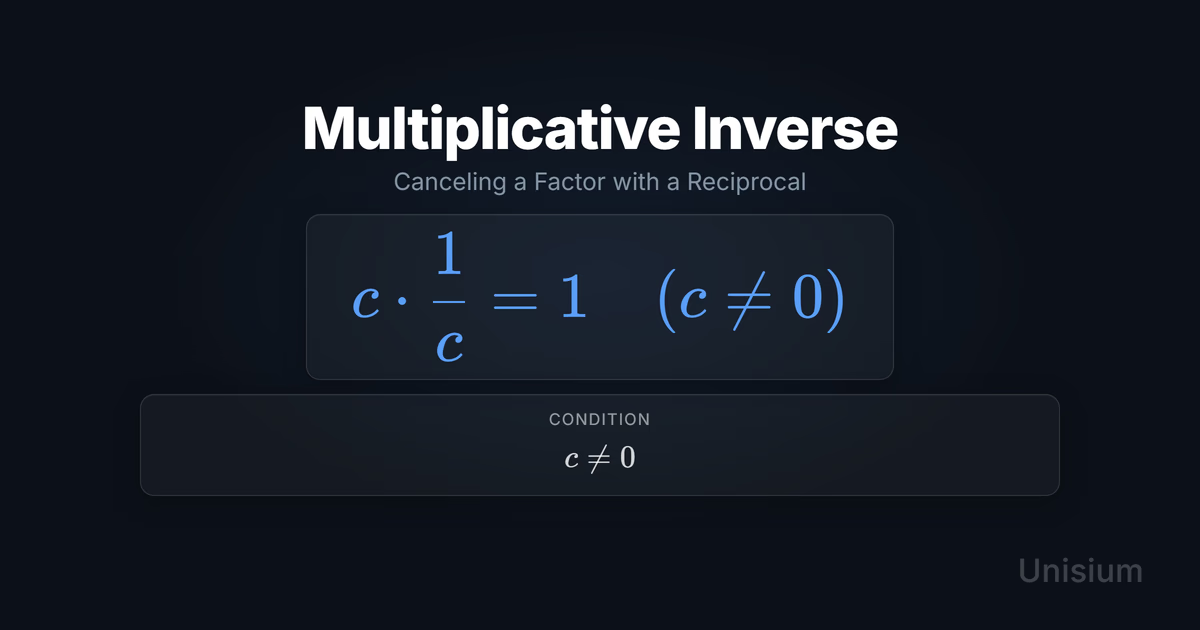
Multiplicative Inverse is the local cancellation principle that a nonzero factor and its reciprocal multiply to 1: when . In algebra, this is what makes a coefficient or denominator disappear — not just “divide both sides,” but the specific reciprocal eliminating the factor locally. In equation solving this local cancellation combines with Multiplicative Equality, which licenses applying the same reciprocal to both sides; building the structural reflex to distinguish these two layers is a core algebra fluency skill practiced in the Unisium Study System.
This guide sits inside the Algebra study map, where you can see the neighboring moves, models, and next-step guides that connect this principle to the rest of algebra.
On this page: The Principle | Conditions | Failure Modes | EE Questions | Retrieval Practice | Practice Ground | Solve a Problem | FAQ | How This Fits
The Principle
The move: Multiply a factor by its reciprocal so it becomes 1.
The local invariant: The cancellation is valid because a nonzero number and its reciprocal multiply to 1.
Canonical pattern:
Common algebra forms:
This principle is local: it explains why a specific factor disappears inside an expression. It is not the general rule that justifies doing the same multiplication or division to both sides of an equation. That justification belongs to Multiplicative Equality.
In equation solving
You often use Multiplicative Inverse together with Multiplicative Equality:
| Local cancellation ✓ | Not a valid cancellation ✗ |
|---|---|
| is only valid when |
The right column fails because cancellation only works for factors, not across addition, and only when the canceled factor is nonzero.
Conditions of Applicability
Condition:
Before applying, check: Confirm that the factor you want to cancel is nonzero and is truly a factor of the expression — not just part of a sum or difference.
Why the condition matters: The reciprocal exists only when . If , there is no multiplicative inverse, so the cancellation step is not defined.
- You may cancel a factor in a product:
- You may not cancel across addition:
- In equations, if the factor contains a variable, you must check whether the zero case is possible before canceling. Otherwise a valid solution may be lost.
This condition is not a side remark. It is the boundary between a real reciprocal and an illegal shortcut.
Want the complete framework behind this guide? Read Masterful Learning.
This move relies on Multiplicative Equality: dividing by the same nonzero quantity on both sides preserves equivalence. Compare it with Additive Inverse when the term must be removed by subtraction instead of division, and use it next in Clear Denominators once denominator factors need to be removed cleanly.
Common Failure Modes
Failure mode: treating cancellation as if it works across addition — e.g., → this is invalid because is not a common factor of the entire numerator.
Debug: Ask: “Is the quantity I want to cancel a factor of the whole expression, or only part of one term?” Cancellation works with factors, not with pieces of a sum.
Failure mode: canceling a variable factor without checking whether it can be zero — e.g., without noting → the simplification is only valid on the branch where .
Debug: State the condition explicitly before canceling: “valid for .” Then check separately whether the excluded value matters in the original problem.
Failure mode: describing the step only as “divide both sides” and never identifying the reciprocal that does the cancellation → the learner executes routine steps without understanding why the coefficient disappears.
Debug: Name the reciprocal directly: “multiply by so that .”
Elaborative Encoding
Use these questions to build deep understanding. (See Elaborative Encoding for the full method.)
Within the Principle
- Why does require ?
- In the expression , what disappears, and why does remain?
For the Principle
- What is the difference between canceling a factor and trying to cancel part of a sum?
- Why is simplifiable for , while does not allow cancellation of ?
Between Principles
- How does Multiplicative Equality let you apply a reciprocal to both sides of an equation, and how does Multiplicative Inverse explain the cancellation that happens afterward?
Generate an Example
- Write one example where a reciprocal cleanly cancels a coefficient, and one example where a student might try to cancel illegally across addition. Explain the difference.
Retrieval Practice
Answer from memory, then click to reveal and check. (See Retrieval Practice for the full method.)
State the Multiplicative Inverse principle in one sentence: _____A nonzero factor can be canceled by multiplying by its reciprocal, because c · (1/c) = 1 when c ≠ 0.
Write the canonical pattern: _____
State the canonical condition: _____
Practice Ground
Use these exercises to build move-selection fluency. (See Self-Explanation for how to use worked examples effectively.)
Procedure Walkthrough
Starting from , isolate . Each reciprocal-cancellation step has two layers: Multiplicative Equality licenses applying the same operation to both sides, and Multiplicative Inverse explains why the coefficient cancels locally.
| Step | Expression | Operation |
|---|---|---|
| 0 | — | |
| 1 | Distribute on both sides (Distributive Property). | |
| 2 | Subtract from both sides (Additive Equality). | |
| 3 | Add to both sides (Additive Equality). | |
| 4 | Apply to both sides (Multiplicative Equality, ). | |
| 5 | Left side: , so (Multiplicative Inverse). |
Drills
Local cancellation
What reciprocal cancels the factor ?
Reveal
The reciprocal is , since .
Simplify if valid, and state the condition:
Reveal
Valid because .
Simplify if valid, and state the condition:
Reveal
If , the original expression is undefined; check whether matters in the surrounding problem.
Is this a valid cancellation? Why or why not?
Reveal
Invalid. Cancellation works for common factors, not across addition. The numerator is a sum, not a single product with as a factor of the whole expression. The correct simplification is (for ).
Rewrite division by as multiplication by a reciprocal, then identify what cancels on the left.
Reveal
The factor cancels with via Multiplicative Inverse. The result is .
Isolate the variable
For each drill, reach the target form. Use a reciprocal to cancel the target factor. In equation steps, distinguish the bilateral move (Multiplicative Equality) from the local cancellation (Multiplicative Inverse), and confirm .
Reach isolated. Starting from .
Reveal
Multiply both sides by reciprocal (Multiplicative Equality, ). On the left, , so the factor cancels (Multiplicative Inverse):
Reach isolated. Starting from .
Reveal
Multiply both sides by reciprocal (Multiplicative Equality, ). On the left, , so the factor cancels (Multiplicative Inverse):
Reach isolated. Starting from .
Reveal
Multiply both sides by (Multiplicative Equality, ). On the left, , so the denominator cancels (Multiplicative Inverse):
Reach isolated. Starting from .
Reveal
Multiply both sides by (Multiplicative Equality, ). On the left, , so the coefficient-over-denominator cancels (Multiplicative Inverse):
Reach isolated. Starting from .
Reveal
Multiply both sides by (Multiplicative Equality, ). On the left, , so the factor cancels (Multiplicative Inverse): .
Then add to both sides (Additive Equality): .
(Negative) A student starts from and divides both sides by , obtaining . Is this a valid application of Multiplicative Inverse? Identify why (or why not).
Reveal
Not valid. Dividing by requires , i.e., . But satisfies the original equation: ✓. Dividing by silently discards this solution.
The correct move is to recognize that a product equals zero when at least one factor is zero:
The condition blocked the shortcut for good reason.
Reciprocal-cancellation step
Apply one reciprocal-cancellation step. In your answer, name the reciprocal used and confirm the factor it cancels.
Apply once: .
Reveal
Multiply both sides by (Multiplicative Equality, ). On the left, , so the factor cancels (Multiplicative Inverse):
Apply once: .
Reveal
Multiply both sides by (Multiplicative Equality, ). On the left, , so the denominator cancels (Multiplicative Inverse):
(Negative) A student has the equation and writes the next line as . Which rule did the student violate, and what is the correct result?
Reveal
The student divided only the right side by , leaving the left side unchanged. Multiplicative Equality requires dividing both sides by .
Correct move: multiply both sides by (Multiplicative Equality, ); on the left, , so the factor cancels (Multiplicative Inverse):
The student’s line would lead to , which is wrong.
Apply once: .
Reveal
Multiply both sides by (Multiplicative Equality, ). On the left, , so the factor cancels (Multiplicative Inverse):
Apply once: .
Reveal
Multiply both sides by (Multiplicative Equality, ). On the left, , so the factor cancels (Multiplicative Inverse):
Note: the right-hand side being zero does not make this move invalid — the zero is in the result, not in the factor being canceled.
Solve a Problem
Apply what you’ve learned with Problem Solving.
Problem: Starting from , isolate using Multiplicative Inverse as the key step.
Full solution
| Step | Expression | Move |
|---|---|---|
| 0 | — | |
| 1 | Multiply both sides by (Multiplicative Equality, ); on the left, , so the denominator is removed locally (Multiplicative Inverse). | |
| 2 | Distribute (Distributive Property). | |
| 3 | Subtract from both sides (Additive Equality). | |
| 4 | Multiply both sides by (Multiplicative Equality, ); the coefficient cancels locally (Multiplicative Inverse). |
FAQ
What is the Multiplicative Inverse principle?
Multiplicative Inverse is the principle that a nonzero factor can be canceled by multiplying by its reciprocal: In algebra, this is what removes a coefficient or denominator from an expression.
Why is the condition necessary?
Because zero has no reciprocal. The expression exists only when . If , the cancellation step is undefined.
Is this mainly an equation-solving principle?
Not by itself. The inverse principle is local: it explains why a factor disappears inside an expression. In equation solving, it is usually combined with Multiplicative Equality, which justifies applying the same reciprocal to both sides.
How is Multiplicative Inverse different from Multiplicative Equality?
Multiplicative Equality is the general equation rule: multiplying or dividing both sides by the same nonzero quantity preserves the solution set.
Multiplicative Inverse is the local cancellation principle: a nonzero factor disappears when multiplied by its reciprocal.
Can I always cancel a variable?
No. You can cancel a variable only when it is a factor and only on the branch where it is nonzero. You cannot cancel across addition, and you must track excluded values such as if they matter in the original problem.
How is Multiplicative Inverse different from Additive Equality?
Additive Equality adds or subtracts the same quantity to both sides, shifting all terms. Multiplicative Inverse is the local cancellation step: a factor times its reciprocal equals 1, making the coefficient disappear. They work together in linear equation solving, with Additive Equality gathering constant terms and Multiplicative Inverse then canceling the coefficient.
Does Multiplicative Inverse apply to inequalities?
Multiplicative Inverse itself is the local cancellation identity , so it is not the part that changes inequality direction — local cancellation of a factor has nothing to do with flipping a relation. What changes for inequalities is the bilateral operation rule: multiplying or dividing both sides by a negative reverses the inequality sign. That belongs to the corresponding inequality principle, not to this guide.
How This Fits in Unisium
Multiplicative Inverse gives the local mechanism of coefficient removal: a factor disappears because its reciprocal turns it into 1. In equation solving, this works together with Multiplicative Equality, which licenses applying that reciprocal to both sides. Unisium trains these as two distinct recognitions: first, “what reciprocal would cancel this factor?” and second, “is it legal to apply that same operation to both sides here?” The goal is structural fluency — seeing exactly why the coefficient vanishes and exactly what condition makes that cancellation valid.
Explore further:
- Multiplicative Equality — The bilateral equation rule that licenses applying a reciprocal to both sides
- Additive Equality — Gather constant terms first, then cancel the coefficient with Multiplicative Inverse
- Distributive Property — Expands grouped products so the coefficient becomes visible before canceling
- Elaborative Encoding — Build deep understanding of why matters and when cancellation is valid
- Retrieval Practice — Make the canonical pattern and condition instantly accessible
Ready to master Multiplicative Inverse? Check access and join the Unisium waitlist or explore the full learning framework in Masterful Learning.

Masterful Learning
The book behind these guides: a study system for physics, math, & programming built on retrieval, connection, explanation, and problem solving.
Ready to apply this strategy?
Unisium turns these evidence-based techniques into guided study sessions for math and physics. Places are limited during early access. Check current availability to start a trial; joining the mailing list is optional.
See plans and availability Read More GuidesAlready have access? Sign in