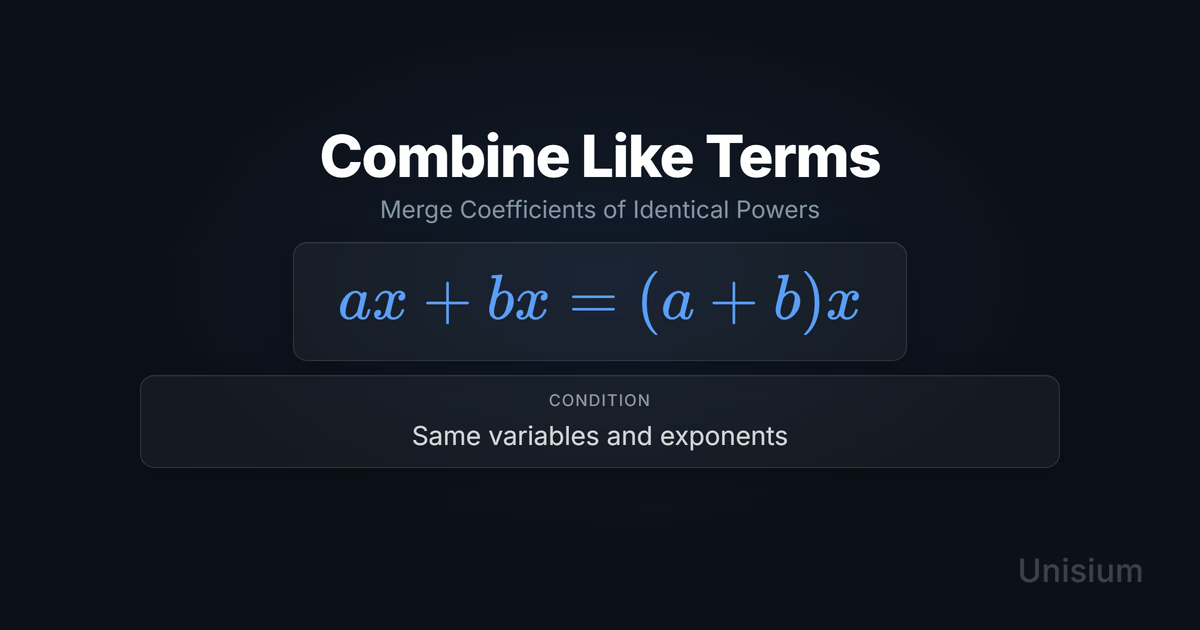
Combine Like Terms: Merge Coefficients of Identical Powers
Combine Like Terms lets you add or subtract the coefficients of terms that share exactly the same variables raised to exactly the same exponents — preserving the value of the expression for every allowed assignment of those variables. It applies whenever two or more terms in a sum have identical variable-and-exponent patterns. Mastering fast recognition of like terms is a core simplification skill practiced in the Unisium Study System.
This guide sits inside the Algebra study map, where you can see the neighboring moves, models, and next-step guides that connect this principle to the rest of algebra.
On this page: The Principle | Conditions | Failure Modes | EE Questions | Retrieval Practice | Practice Ground | Solve a Problem | FAQ
The Principle
The move: Add or subtract the coefficients of terms whose variable-and-exponent factors are identical, replacing two or more terms with a single term.
The invariant: This preserves the value of the expression for every allowed assignment of the variables: combining like terms produces an equivalent expression.
Pattern:
| Legal ✓ | Illegal ✗ |
|---|---|
| — exponents differ; cannot merge |
Conditions of Applicability
Condition: Same variables and exponents
Before applying, check: Verify that the terms share the same full variable-and-exponent factor, not just the same variable letter.
- and cannot be combined: the exponents differ ().
- and cannot be combined: the variable names differ.
- and cannot be combined: the exponent on differs.
Want the complete framework behind this guide? Read Masterful Learning.
When an expression needs rearrangement before terms can be merged, compare this move with Distributive Property. After the terms are collected cleanly, Factor Common Term is often the next algebra move that reveals more structure.
Common Failure Modes
Failure mode: combining terms with different exponents — e.g., writing as → the linear term is silently destroyed, producing a structurally wrong expression.
Debug: match the FULL variable-and-exponent factor exactly before adding coefficients; and are different factors.
Elaborative Encoding
Use these questions to build deep understanding. (See Elaborative Encoding for the full method.)
Within the Principle
- What does “coefficient” mean in , and why do you add the coefficients and while leaving unchanged?
- Why is , but cannot be reduced to a single term?
For the Principle
- How do you decide which terms in a multi-variable expression such as are “like”?
- What would go wrong if you applied this move to ?
Between Principles
- How does the Distributive Property justify why Combine Like Terms works: which algebraic identity makes valid?
Generate an Example
- Write an expression with four terms, exactly two of which are like terms, that requires this principle to simplify — and identify which pair qualifies.
Retrieval Practice
Answer from memory, then click to reveal and check. (See Retrieval Practice for the full method.)
State the move in one sentence: _____Add or subtract the coefficients of terms that have the same variables raised to the same exponents.
Write the canonical pattern: _____
State the canonical condition: _____Same variables and exponents
Practice Ground
Use these exercises to build move-selection fluency. (See Self-Explanation for how to use worked examples effectively.)
Procedure Walkthrough
Starting from , collect all like terms to reach simplified form.
| Step | Expression | Operation |
|---|---|---|
| 0 | — | |
| 1 | Group the terms together and the terms together — and are different factors, so they must stay separate | |
| 2 | Combine: for terms; for terms | |
| 3 | Rewrite as |
Drills
Format A — Forward step
Apply the principle once.
Reveal
Add the coefficients (); stays unchanged:
Apply the principle once.
Reveal
Subtract the coefficients (); stays unchanged:
Apply the principle once.
Reveal
Subtract the coefficients (); stays unchanged:
Apply the principle once.
Reveal
Add all three coefficients (); stays unchanged:
Apply the principle once.
Reveal
Combine left to right: :
Identify which terms are like, then apply the principle.
Reveal
and are like terms (both have ). is NOT like them (exponent differs).
Combine only the terms:
Reject the invalid rewrite. What is wrong?
Reveal
and are not like terms. They do not share the same full variable-and-exponent factor: one carries , the other carries . Adding their coefficients destroys the term entirely.
No combination is valid here. A collected form simply keeps both terms: .
Format E — Canonicalization
Rewrite in simplified (collected) form.
Reveal
Group by variable:
Rewrite in simplified form.
Reveal
terms: . terms: :
Rewrite in simplified form.
Reveal
terms: . terms: :
Rewrite in simplified form.
Reveal
terms: . terms: :
Rewrite in simplified form.
Reveal
terms: . terms: :
Solve a Problem
Apply what you’ve learned with Problem Solving.
Problem: Starting from , collect all like terms to reach simplified form.
Full solution
| Step | Expression | Move |
|---|---|---|
| 0 | — | |
| 1 | Group the terms | |
| 2 | Combine terms: | |
| 3 | Group the terms | |
| 4 | Combine terms: |
FAQ
What is Combine Like Terms?
Combine Like Terms is the algebraic rule that lets you replace two or more terms with a single term by adding or subtracting their coefficients, provided the terms share identical variable-and-exponent factors. For example, because both terms carry the same factor .
When is Combine Like Terms valid?
The move is valid whenever two or more terms share exactly the same variables raised to exactly the same exponents. and qualify (both have ); and do not (exponents and differ).
What goes wrong if I ignore the condition?
Combining terms with different exponents destroys one term. Writing discards the contribution, producing a structurally incorrect expression whose value differs from the original for almost every value of .
How does Combine Like Terms relate to the Distributive Property?
The Distributive Property () is the algebraic justification: by factoring out . Combine Like Terms is the move you execute; the Distributive Property is the identity that makes it valid.
Does Combine Like Terms extend to expressions with several variables?
Yes — the condition extends naturally. (both share the factor ), but and cannot be merged because the exponent on differs. Treat the full variable-and-exponent product as the unit of comparison.
How This Fits in Unisium
Combine Like Terms appears at the start of almost every multi-step algebra problem. Unisium builds fluency with this move through repeated forward-step and canonicalization drills — the same format used in the Practice Ground above. The goal is automatic recognition: seeing and immediately writing without pausing to think. The failure-mode drill (spotting when terms are NOT like) trains the safeguard that prevents coefficient errors from propagating through longer chains.
Explore further:
- Elaborative Encoding — Build deep understanding of why the variable-and-exponent condition matters
- Retrieval Practice — Make the pattern and condition instantly accessible
- Self-Explanation — Use the Practice Ground drills at maximum effectiveness
Ready to master Combine Like Terms? Check access and join the Unisium waitlist or explore the full learning framework in Masterful Learning.

Masterful Learning
The book behind these guides: a study system for physics, math, & programming built on retrieval, connection, explanation, and problem solving.
Ready to apply this strategy?
Unisium turns these evidence-based techniques into guided study sessions for math and physics. Places are limited during early access. Check current availability to start a trial; joining the mailing list is optional.
See plans and availability Read More GuidesAlready have access? Sign in