How to Study Math and Physics Over the Summer and Still Enjoy It
Summer can make next semester much easier if you know what to do with the time you have. This guide shows you how to choose a summer goal, gather enough problems and worked solutions, use fragmented time to build memory and understanding, and use your best desk blocks to get better at solving problems.
If you are preparing for calculus, physics, a placement test, or a retake, summer’s advantage is not just more time. It is earlier time. You can learn the names, equations, conditions, and worked-example structures before lectures, assignments, labs, and deadlines start competing for attention. That makes the course feel more like a second pass through the material instead of first contact.
The same loop scales. A lighter summer means more retrieval, elaborative encoding, and self-explanation in buses, trains, waiting rooms, and travel time, plus a few desk blocks for problems. A serious summer before a retake or hard semester uses the same system with more desk time, more old exams, and more re-solving.
The method comes from the same learning loop used across Unisium and the rest of these guides: elaborative encoding, retrieval practice, self-explanation, and problem solving. This guide draws on Vegard Gjerde’s experience teaching university mechanics and using pre-learning in demanding technical courses. The effect is large: when the course starts, you spend attention on the ideas instead of decoding the words and symbols.
On this page: Choose your goal | Why it pays off | Get the right materials | Start from problems | Match work to time | What you can do anywhere | What needs a desk | Avoid passive study | FAQ
Choose Your Summer Goal
Your goal changes the intensity of the plan, not the basic method.
| Goal | Summer target | How it changes the plan |
|---|---|---|
| Repair weak prerequisites | Fix the algebra, trig, functions, vectors, or calculus that keeps breaking your work | Use focused prerequisite problems and self-explain the steps that keep failing |
| Pre-learn next semester | Make the first month of calculus, physics, linear algebra, or another course feel familiar | Spend more time on principles, worked examples, and light problem solving |
| Prepare for a retake | Become able to solve representative exam problems independently | Use old exams heavily and re-solve helped problems until you no longer need the solution |
| Prepare for a placement test | Place into the course you need | Let sample placement questions expose the subskills to repair |
If you have been away from the subject for years rather than one summer, pair this with How to Restart Math and Physics After Years Away.
Why Summer Study Pays Off
Summer gives you more total hours of effective study, which means more total learning. It also makes your in-semester hours more productive, because you start each topic with principles, vocabulary, and worked-example structure already in place instead of meeting everything cold.
That matters in technical courses. During the semester, lectures, assignments, labs, deadlines, and life compete for the same attention. Summer gives you room to do the learning work that often gets crowded out: retrieval, self-explanation, elaborative encoding, and real problem solving.
Many students struggle to complete a full technical course load partly because the semester leaves too little room for focused learning. Summer study is one way to make the semester more survivable before it starts.
Want the complete framework behind this guide? Read Masterful Learning.
Get the Right Study Materials First
Most summer study plans fail at the same place: you sit down ready to work and have nothing good to study from. Compiling material is the slow, unglamorous part, especially representative problems that match your actual course. Sort it out before you build a routine.
You need four kinds of material:
| Material | Why you need it |
|---|---|
| Representative problems | Define the level you are aiming for |
| Worked solutions | Give you something to self-explain when you get stuck |
| A principle list | Tell you which names, equations, and conditions to retrieve |
| A way to space practice | Let you revisit principles and helped problems over time |
For problems and solutions, start with your course syllabus, old exams, and textbook problem sets. Old exams are the gold standard because they fix the real level. For mechanics, the free classical mechanics resources and the classical mechanics principle map are a starting point. There are also published principle maps for algebra, calculus, and functions, with electromagnetism and differential equations maps in draft. The published free subdomain maps also include structured retrieval practice, so you can practise recalling the principle structure for a whole course area or a selected part of it.
You do not have to build everything yourself. Unisium’s free principle guides already include elaborative-encoding questions, retrieval prompts, and two worked examples per principle — enough to run retrieval, elaboration, and self-explanation today, even though those worked examples sit below exam difficulty. What you still have to compile is exam-like problems with trustworthy solutions; that is where old exams, textbooks, and how to study with AI come in. Unisium also has free ready-made classical mechanics Anki deck resources, and the Anki for physics and math guide shows how to make your own for other courses and get the spacing right. Realistically, most students will lean on a textbook as well, because creating all of this from scratch is slow.
Start From Problems
When you have a real block of desk time, do not start by reading or revising. Start from a problem. Problems show you exactly what you cannot yet do, which tells you what to learn next — something a fixed weekly calendar of “read chapter 3 on Tuesday” can never do, because it has no idea where your gaps are.
The loop:
- Compile representative problems. Use old exams, course problem sets, textbook problems, placement samples, or Unisium principle pages. Getting problems that match the course you are preparing for is the hardest part — do not skip it. But do not turn it into a huge compilation project before you start either: three to five old exams, a few textbook sections, and a small set of worked examples can be enough to begin. Add more only when your current set stops revealing useful gaps.
- Try one seriously, at a desk. Do not read the solution first. Find out where your current understanding fails.
- Name the obstacle. Did you not know the principle, forget the equation, miss a condition, fail to set up the model, or get stuck in the algebra? (The problem solving guide sorts these into recall, condition, and procedure failures.)
- Self-explain the solution. This is usually the most important repair step. For each major move, work out which principle is used, why it applies here, how it is set up, and what the step is trying to achieve. (See self-explanation for the four elements that make this work.)
- Strengthen the principles you missed. For each one, retrieve its name, equation or form, and conditions, and use elaborative encoding to understand its parts, how it is used, and where it applies.
- Try a new problem, and re-solve helped ones later. Keep a list of problems you only solved with help. Come back after a few days and re-solve them until you can do them on your own without the solution. If you have a set of old exams, loop through them the same way.
This is the loop for high-quality time. Steps 4 and 5 — self-explanation and strengthening principles — are also the work you carry into low-quality time once a problem has shown you what to repair. When you are stuck mid-problem and want help without copying, use Hint and Try; for physics, structure each attempt with the Five-Step Strategy.
Match the Work to the Kind of Time You Have
The four strategies do not all need the same conditions. Three of them — elaborative encoding, retrieval practice, and self-explanation — are mostly thinking, so you can do them as a passenger on a bus or train, on a walk, on a plane, or while waiting. (If you are the one driving, leave the studying for later; it needs your attention.) Real problem solving is different: it needs a surface to write on, symbols, and uninterrupted focus.
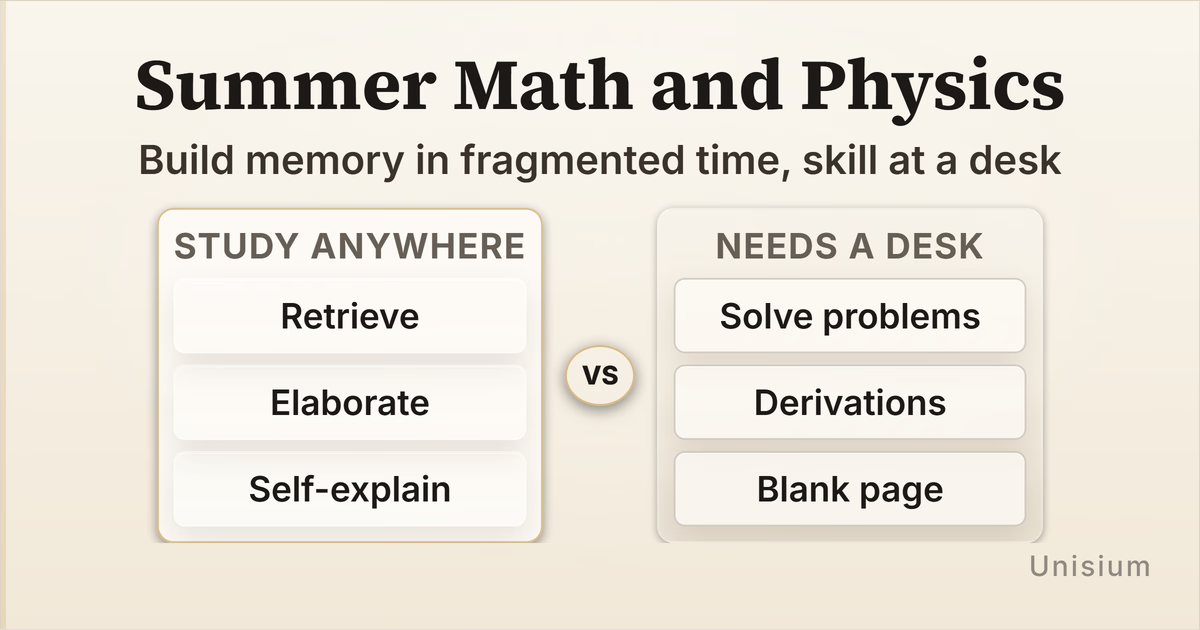
The simplest way to hold the whole idea: build knowledge and memory in low-quality study time, and build skill during high-quality desk time. Low-quality study time is not bad time — it is just time you cannot spend in an extended block of full focus: a beach, a bus, a train, a waiting room, a long trip. With the right strategy, that time still produces real learning.
| Time type | Use it for |
|---|---|
| Low-quality study time — beach, bus, train, waiting room, travel | Build knowledge, memory, language, and understanding through retrieval, elaboration, and self-explanation |
| High-quality desk time — quiet block, paper or tablet, full focus | Build problem-solving skill through blank-page attempts, derivations, and exam-like problems |
The spine of the whole approach is one sentence:
Use the study time summer gives you: build knowledge and memory in fragmented time, then spend your best desk blocks solving problems.
This is the same quality-of-time logic from How to Self-Study Math and Physics Effectively and How to Use Lectures, Workshops, and Other Learning Offers Effectively, pushed to the season where desk time is scarcest.
What You Can Do Anywhere
These three strategies travel well because they run as thinking. You can do them without a pen, which is what lets low-quality time produce real learning. Each one does a different job.
- Retrieval practice — for principles. Structured retrieval practice is for the small, high-value knowledge chunks you use constantly in math and physics: the principles. Cue yourself with a principle’s name and reconstruct its equation or form, and sometimes its conditions. The point is to build strong, fast memories for those chunks and to make them less dependent on context, so they surface the moment you need them. It is not for examples, and it is not vague review of everything. (Recall happens in every strategy; retrieval practice specifically means rehearsing principles — see retrieval practice.)
- Elaborative encoding — to understand a principle. Ask questions in four categories: within-principle questions about symbols, units, and parts; for-principle questions about what it says, how it is used, and when it applies; between-principle questions that compare it to nearby ideas or derive it from them; and concrete-example questions that make you generate or analyze examples. Discussing your answers with an AI tutor can sharpen this, as long as you answer first. (See elaborative encoding.)
- Self-explanation — the closest thing to exam-like learning you can do anywhere. This is the strongest of the three for getting ready, because explaining a full worked solution forces you to reconstruct the same reasoning an exam demands. The important part is the thinking: making sense of every move — which principle, why it applies, how it is set up, what the step achieves. Thinking is faster than talking, so if you are working alone, just think it through. Talk or dictate when you want to turn that thinking into something you can get feedback on, usually from an AI tutor, then iterate. Expect to re-explain a hard problem several times before you have pulled out all of its structure; that repetition is exactly the kind of distributed practice that fits scattered time. (See self-explanation for the elements of a strong explanation.)
The hard part over a whole summer is spacing this out so the memories stick. That is what Anki and Unisium are for: they schedule principles and helped problems to come back at the right time. If you are rolling your own, a list and a calendar reminder will do.
A practical setup, kept deliberately small:
- For self-explanation and elaboration: keep a few worked examples and a short principle list on your phone. In any idle stretch, pick one and work through it in your head — out loud or dictated if you want AI feedback.
- For retrieval practice: keep only the list of principle names for the course. Show yourself a name, try to recall its equation and conditions, check against your source, then move to the next. A flashcard app makes the checking and spacing automatic.
What Still Needs a Desk
Knowledge and strong memories are necessary but not enough. Being able to recall a principle and explain a worked solution is what makes problem solving pay off fast — but you only prove you can solve when the page is blank and nothing is in front of you. That final step happens at a desk:
- Full problem solving — choosing a model and executing it with no solution in view.
- Multi-step derivations and symbolic manipulation — where the line-to-line algebra is the work.
- Blank-page attempts — the honest test of whether the understanding you built away from the desk survives a real problem.
- Re-solving problems you previously needed help with.
The three thinking strategies are not a lesser substitute for this; they are what make it efficient. Retrieval, elaboration, and self-explanation are how you arrive at the desk already knowing the principles and the structure of similar solutions, so your scarce desk hours go into solving instead of looking things up. Skip them and every desk session starts from zero.
You do not need many desk blocks. A few protected sessions a week, aimed at the gaps your low-quality-time study surfaced, do more than daily half-hearted reading. You can get a long way on understanding through self-explanation before you have much desk time, and then a relatively small amount of well-targeted problem solving can solidify that understanding and start building automatic skill. For why a few genuine problem-solving hours are worth so much, see The Expected Value of One Hour of Deliberate Practice in Math and Physics.
Avoid Passive Summer Study
Reading, videos, and notes are useful when they answer a specific question. They are weak as the main plan. If you do not retrieve principles, explain worked solutions, and solve problems, summer can disappear into familiar-but-fragile study that collapses the first time you face a blank page. See 6 Ineffective Study Techniques for why this feels productive but stalls.
Use passive resources to feed the active loop: find a principle, understand it, retrieve it, self-explain examples, and test it in problems.
FAQ
What should I study over the summer before a math or physics course?
Pull representative problems from the upcoming syllabus, an old exam, or the course textbook, and let them tell you what is missing. Pre-learn the principles behind the first month rather than trying to cover the whole course. Aim for familiarity, so the term starts as reinforcement instead of first contact.
Can I really study math or physics on my phone?
For the thinking-heavy parts, yes. Retrieval practice on principles, elaborative encoding, and self-explanation of worked examples are mostly mental, so a phone — or nothing at all — is enough. Real problem solving still needs paper, symbols, and uninterrupted focus, so split your study by the kind of time you have.
How can I study math and physics on a bus, train, beach, or while waiting?
Use that time for the thinking strategies, not for problem solving. Retrieve the course’s principles from their names, run elaborative-encoding questions on one principle, or self-explain a worked example you half-understand — in your head, out loud, or dictated. Save the actual problem solving for a desk block.
How many hours a day should I study over the summer?
There is no fixed number; the honest answer is “fewer than during term, used better.” Spread short sessions of retrieval, elaboration, and self-explanation across your idle time, and protect a few real desk blocks each week for problem solving. If you are preparing for a retake, weight more of your time toward desk blocks and old exams.
Is summer enough time to retake or get ahead in a course?
For getting ahead and repairing prerequisites, yes — that is summer’s natural strength. For a retake you need independent solving, so use the previous course’s old exams as your targets and loop through them until you can solve most problems without the solutions, as in math and physics exam prep.
Do I need to recreate exam conditions to be ready?
Mostly no. Solve plenty of exam-like problems, but you do not need to recreate the exam room. A short timed run near the end can help if timing or anxiety is a known issue for you; otherwise, being able to solve representative problems with understanding is what makes you ready.
How This Fits in Unisium
Everything here runs on textbooks, old exams, and discipline — but compiling and scheduling all of it is the slow part. The Unisium Study System is being built around exactly this loop: principles with retrieval prompts and elaborative-encoding questions, worked examples to self-explain, exam-like problems, and spaced revisits so the right card comes back at the right time. The free principle and subdomain guides already let you do a lot of the fragmented-time work today.
Taking calculus or classical mechanics next semester? Use the summer break to start learning its principles before classes begin. Try Unisium free for 14 days. Both subscription plans include all currently available subjects. See pricing for current availability, payment-method requirements, and renewal terms. For more context, read What Is Unisium? or explore the study framework in Masterful Learning.
Masterful Learning
The book behind these guides: a study system for physics, math, & programming built on retrieval, connection, explanation, and problem solving.
Ready to apply this strategy?
Unisium turns these evidence-based techniques into guided study sessions for math and physics. Places are limited during early access. Check current availability to start a trial; joining the mailing list is optional.
See plans and availability Read More GuidesAlready have access? Sign in