How to Use Lectures, Workshops, and Other Learning Offers Effectively
Most of your progress in math and physics comes from focused self-study. But your course offers a whole ecosystem of learning arenas: lectures, workshops, office hours, problem walkthroughs, labs, and fellow students. Used well, they multiply the effect of your own work. Used poorly, they absorb hours without moving you closer to exam-level skill.
For the broader context on how the system is meant to work end-to-end, see Is Unisium Right for You?.
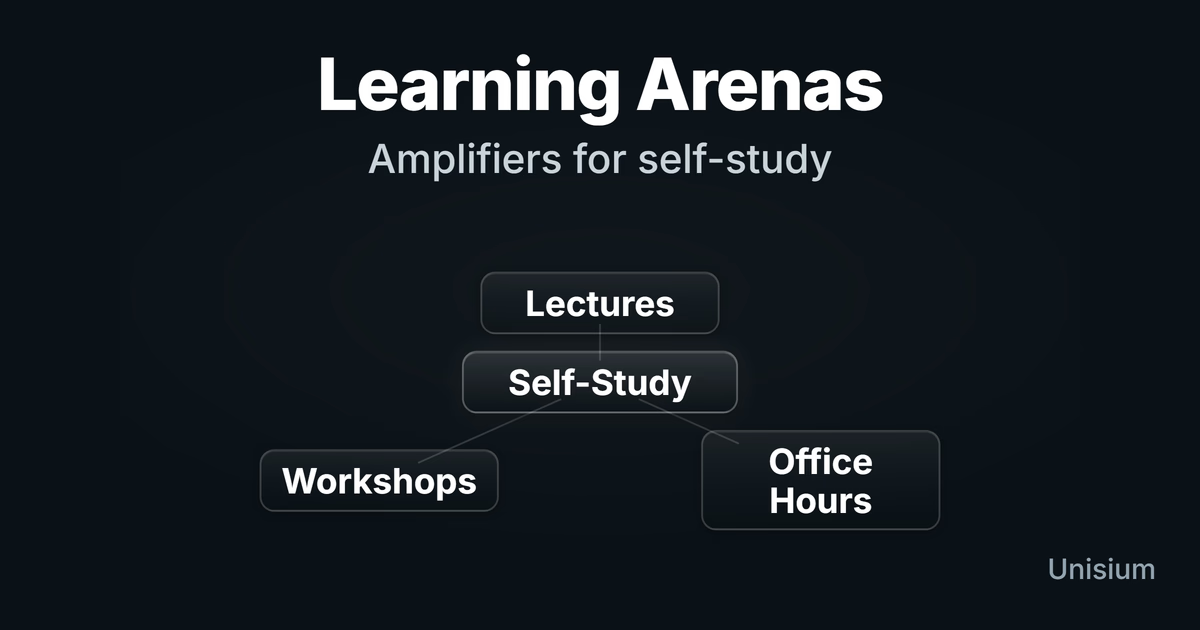
The Core Idea: Arenas Are Amplifiers, Not Replacements
Courses often feel like a stream of things other people do to you: lectures you attend, workshops you sit through, emails with deadlines. It is easy to slip into a consumer mindset and hope that if you just show up often enough, understanding will appear at the right time.
That story is wrong.
The right way to think about learning arenas is simple: your self-study loop (Elaborative Encoding, Retrieval Practice, Self-Explanation, Problem Solving) does the heavy lifting. Lectures, workshops, office hours, and peers exist to amplify that loop:
- They help you spot and fix misunderstandings.
- They give you feedback on your reasoning, not just on final answers.
- They keep you connected and motivated over a long semester.
Unisium is built around this view. It handles the structure of what you do when you are on your own. This guide shows how to plug the rest of your course’s learning offers into that same loop instead of treating them as separate worlds.
Lectures: Decide What They Are For
Traditional lectures
Many lectures in math and physics are still traditional: the instructor derives principles on the board, works through a couple of examples, and the students copy. Historically this made sense when students had no books. Now you have textbooks, solution manuals, and the internet.
In a traditional lecture, the person who learns the most is usually the lecturer. They are the one doing elaborative encoding and self-explanation in real time. You are mostly watching.
If your course leans heavily on this style, you have two choices: attend with a clear plan, or attend rarely and invest your time elsewhere. Both can work; drifting in with no plan does not.
If you attend, drop the idea that your main job is to write everything down. Your notes will never be better than the textbook. Instead:
- Listen for principle names and conditions.
- Try to decode each step in terms of “which principle, under what condition, toward what goal”.
- Write down questions, not derivations. Those questions drive later self-study, workshops, or office hours.
You are there to understand, not to transcribe.
Interactive lectures and active learning
If you are lucky, your lectures already use active methods: questions, clickers, think–pair–share, small-group discussion. In physics, Peer Instruction is a well-known example, where you first vote on a conceptual question, then argue with your neighbours, then vote again.
This style is far more powerful than passive lecturing. It gives you repeated chances to:
- commit to an answer,
- articulate your reasoning,
- confront alternative arguments,
- update your model.
When you have interactive lectures, treat them as high-value testing grounds. Commit properly to each question. Do not wait to see what others say. When you are wrong, do not feel bad; that is how you find the edges of your mental model.
The same principle applies to self-study: you commit first, then compare to a model answer or critique. Good lectures feel like live study sessions with many students at once.
Recorded lectures and videos
Recorded lectures and video walkthroughs are tempting to binge. They feel productive, and you can watch without much effort. The danger is that you spend hours on passive exposure that never hardens into skill.
Use videos in three targeted ways:
- To support Elaborative Encoding: watch short segments to clarify the meaning, form, or conditions of a principle you are already working on.
- To clarify a specific point that blocked you during self-study (one confusion, one short clip).
- For problem-walkthrough videos, to support Self-Explanation: pause before each step, predict it, then check and explain.
Do not treat “watch all the videos” as preparation; treat them as raw material you mine for specific questions and explanations.
If you find yourself watching entire series while tired, tell yourself the truth: it is entertainment, not primary study.
How to Prepare for Any Session
Preparation does not need to be heroic. Even fifteen focused minutes changes everything. If starting is the hard part, use a Pomodoro timer to lower the barrier: commit to one 25-minute block and let momentum carry you.
Before a lecture, workshop, or office hour slot:
- Do a short Elaborative Encoding pass on the relevant textbook section or notes: meaning, equation form, conditions, and neighbouring principles.
- Run a few Retrieval Practice prompts: principle name, equation form, conditions, maybe a quick sketch.
- Note down two or three specific questions that would move you forward if answered.
This feels small, but it flips the dynamic. You arrive with partially built models, ready to be refined. Without that, you often sit there trying to decode symbols you have never seen before.
In a good study system, this preparation often happens before you walk into the room. You do a short focused pass on the relevant principles, then walk into the lecture or workshop with those memories freshly activated.
Problem-Solving Workshops, Recitations, and Tutorials
Most STEM courses offer some form of problem workshop: recitations, tutorials, exercise sessions, studios. These hours can be the most valuable offers in the course if you use them well.
Show up, even if you feel behind
Many students disappear from workshops once they fall behind. That is backwards. Workshops are where you can repair the damage. Even if you feel underprepared, walk in. Bring whatever messy attempts you have.
Attempt on your own first
The workshop is not a place to see a problem for the first time. Try to solve the weekly problems on your own beforehand, even if that means making many false starts. Mark where you get stuck. Write short notes in the margin: “Do not know why this sign is negative” or “Not sure which principle to choose here”.
Your goal is not “finish everything before the workshop”. Your goal is “arrive with questions that are expensive to answer alone and cheap to answer with help”.
Ask specific questions
The quality of your questions determines the value you get.
Vague questions like “How do I solve this?” give the assistant almost no information about your thinking. The easiest way for them to respond is to do the problem for you.
Specific questions sound more like:
- “Can I apply conservation of energy here, or does friction break it?”
- “Why is the normal force not in the forward direction in this free-body diagram?”
- “Is this a valid substitution for the integral, or am I changing the domain?”
You do not need to be clever. You just need to show what you have already tried and where your understanding stopped.
Explain back every time you get help
Every time the assistant explains a step, bounce it back in your own words before moving on. Start with: “So if I understand this correctly, then…” and walk through the argument.
This loop can take 20–30 seconds, but it is where most of the learning sits. The person who explains learns more than the person who listens.
The pattern is the same whenever you see a model answer: hear the explanation, then restate the key parts in your own words. Treat workshops as live versions of that loop.
Office Hours and One-to-One Time
Office hours with lecturers or teaching assistants look intimidating from the outside, but they are one of the most potent learning offers you will ever get. You have access to someone who has solved thousands of problems in your field. The question is how you use that access.
Here is a simple pattern:
- Go early in the semester, not just right before the exam.
- Bring specific problems where you got stuck, with your own attempts written down.
- Start by describing where you got lost in your reasoning.
- Ask which principle or idea your difficulty really hinges on, so you can practise that specifically later.
You are not there to impress anyone. You are there to accelerate your learning curve. That requires some willingness to look foolish in the short term.
Problem Walkthroughs and Solution Sessions
Many courses offer sessions where an assistant goes through the weekly problems on the board. These can feel safe: you see the solution and write it down. The danger is that you leave with pages of copied work and no internal model.
To turn walkthroughs into real learning:
- Read each problem statement before the session and make a quick plan for how you would start.
- While the assistant is solving, pause your pen regularly and ask yourself which principle is being used and why it applies.
- After the session, pick a few of the problems and do a short Self-Explanation pass on the solution, without rewriting every line.
If the level is far below you, you may be better off solving harder problems on your own. If the level is far above you, use the session for exposure but do not pretend it did the same work as a real solve.
Recorded walkthroughs can be even more useful. You can pause before each step, predict what comes next, then self-explain the reasoning when you see it.
Fellow Students and Study Groups
Fellow students are not listed on the course page as a learning offer, but they might be the most important one you have.
A good study group does at least three things:
- It makes it easier to sit down and start.
- It forces you to explain your thinking instead of staying in your own head.
- It gives you quick feedback on whether your understanding matches that of others.
You do not need a formal group with rules. You do need some structure. For example:
- Work silently on a problem for a fixed time.
- Then take turns explaining your approach.
- Challenge each other’s assumptions and principle choices.
- Only then look at a solution or ask for outside help.
Avoid letting the group turn into a complaint circle or a copying machine. The goal is not to have the same answers; it is to pressure-test each other’s reasoning.
Studying alone forever is a waste. Being social without ever touching the work is a waste. The point is to combine the two.
A shared language for strategies (elaborative encoding, retrieval practice, self-explanation) makes these sessions sharper. When everyone in the room knows what these mean, you can design group sessions around those moves instead of vague “study together” plans.
Using Online Forums and AI Help
Beyond campus, you have online forums, Discord servers, and AI tools. These can be powerful or disastrous, depending on how you approach them.
Treat forums and AI chats as amplified office hours:
- Show your attempt, not just the question.
- Ask about your reasoning, not just for the final result.
- After you get an answer, rewrite the key parts in your own words and do a self-explanation pass.
If you paste a problem into an AI chat and accept the first shiny solution with no scrutiny, you are using the tool as a ghostwriter. If you treat it as a fast, patient assistant and keep doing the thinking yourself, it becomes another strong learning arena.
A good study system keeps you on the right side of that line: you commit first, then compare; you answer before you get feedback; you use AI as a critic, not as a solver of record.
When You Are Behind: Using Arenas for Recovery
Falling behind happens. Weeks slip by, assignments stack up, and lectures start sounding like a different language. The instinct is to panic and binge-read everything. That often leads to exhaustion without much extra understanding.
A better plan is to use the learning arenas around you as a recovery network.
Pick a small set of core ideas that dominate your course’s exams. You can usually detect them by scanning past exams and weekly problem sets. Then, for each of those ideas:
- Do a short Elaborative Encoding pass on the principle: meaning, form, conditions, neighbouring principles.
- Run Retrieval Practice on name, equation, and conditions until you can recall them a few times in a row.
- Take the weekly problems you could not solve and move through their model solutions with Self-Explanation. Focus on the physics or math model, not on algebraic details.
- Bring the most confusing parts to workshops or office hours as specific questions.
- Use study groups to rehearse explanations and to hear how others reason about the same principle.
You are not trying to restore every detail. You are trying to become robust on the ideas that carry most of the marks. The same rule applies in any serious study system: focus sessions on high-value principles and push them toward exam-like performance levels.
How This Fits in Unisium
Unisium gives you a structured way to study alone: which principles to work on, which cards to see, how to space and mix tasks through time. It cannot decide for you how to use your course’s lectures, workshops, and people.
This guide completes that picture.
When you:
- prepare for lectures with systematic Elaborative Encoding and Retrieval Practice,
- walk into workshops with questions that emerged from problem-solving cards,
- use office hours to debug misunderstandings that the system surfaced,
- and return from all these arenas to fresh study sessions that consolidate what you learned,
you turn each learning offer into part of one coherent system instead of a pile of disconnected events.
You are no longer just “attending” things. You are running a deliberate study system, with Unisium handling the backbone and the rest of your environment feeding into it.
FAQ
Should I go to lectures if I learn mostly from self-study?
Often, yes—if you go with a purpose. Use lectures to spot what matters, surface confusions, and collect questions that make your next self-study session more focused.
How do I ask better questions in workshops and office hours?
Show your attempt and ask about a specific decision: which principle applies, which condition is violated, or why a modeling step is justified. Vague “how do I solve this?” questions tend to invite full solutions you don’t learn from.
What should a study group do (so it doesn’t turn into copying)?
Structure it around explanation and selection: silent attempt first, then take turns explaining your model and principle choice, challenge assumptions, and only then consult solutions or outside help.
Related Guides
- How to Self-Study Math and Physics Effectively – The sister guide to this one; focuses on structuring your own week.
- Elaborative Encoding – How to prepare for lectures and workshops in a way that makes them pay off.
- Retrieval Practice – How to make principles available on demand before you walk into any learning arena.
- Self-Explanation – How to use solutions, walkthroughs, and explanations from others without going passive.
- Hint and Try – How to use help, solutions, and AI without turning them into a crutch.
Ready to apply this strategy?
Unisium turns these evidence-based techniques into guided study sessions for math and physics. Places are limited during early access. Check current availability to start a trial; joining the mailing list is optional.
See plans and availability Read More GuidesAlready have access? Sign in