Ineffective Study Techniques for Math & Physics
Most popular study techniques are ineffective by default for math and physics. Rereading, highlighting, and summarizing often produce familiarity—the illusion of learning—without building the retrieval strength or problem-solving skill needed for exams.
If you want a simple workflow that beats passive techniques: start with Elaborative Encoding, then Retrieval Practice, add Self-Explanation when you have examples, and finish with Problem Solving (in physics, use the Five-Step Strategy). Use spacing and interleaving to make it stick.
What Are Ineffective Study Techniques?
Ineffective study techniques feel productive but deliver minimal learning per unit of time. They:
- Don’t engage working memory enough to build connections.
- Confuse familiarity with recall. Smooth reading ≠ retrieval without notes. This is the illusion of learning (a fluency illusion).
- Skip when it applies. Students memorize formulas but don’t know when to apply them. (See Principle Structures for how to encode when it applies properly.)
- Miss transfer-appropriate processing. Practice doesn’t match what exams demand (select a principle → justify why it applies → execute). See Problem Solving and the Five-Step Strategy for how to learn through deliberate practice.
- Provide weak feedback. You don’t know what you misunderstood until the test.
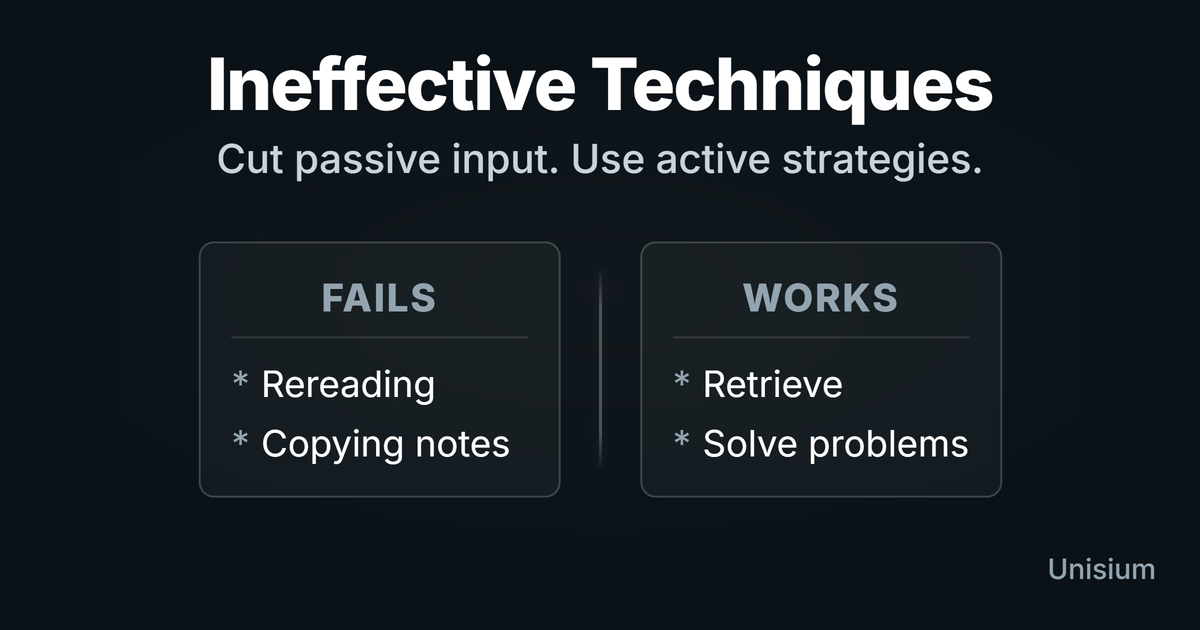
Common culprits: rereading, highlighting, open-book summarizing, verbatim copying (typed or handwritten), binge-watching lectures, keyword mnemonics, unfocused imagery.
The core problem: They crowd out the four strategies that do work.
Why These Strategies Fail
Low Cognitive Demand
Rereading and highlighting require minimal active manipulation of information. Your brain skims the surface; deep learning happens when you work to connect ideas, retrieve them, and use them.
Illusion of Understanding
As you reread, you recognize the content. That fluency and familiarity feel like learning—but recognition without retrieval is an illusion. Tomorrow, without notes, you’ll struggle to reconstruct the principle or know when to apply it.
No “When It Applies” Encoded
Students memorize formulas but can’t answer: When does this apply, and what would make it invalid? On exams, they panic because they can’t select the right principle.
Opportunity Cost
Every hour spent rereading or copying notes is an hour not spent on elaboration, retrieval, explanation, or problem-solving—the four strategies with proven impact on transfer and speed. For a fuller look at how large that opportunity cost can become over time, see The Expected Value of One Hour of Deliberate Practice in Math and Physics.
The Guide to Ineffective Strategies (and How to Fix Them)
Most of these strategies fail because they are passive (input-focused) or unconstrained (no feedback loop). However, some can be salvaged if you rigorously inject the core learning processes.
1. Recognition Traps (The Fluency Illusion)
Strategies that make you feel familiar with the text but fail to build retrieval strength.
-
Start Here: Rereading
- Why it fails: It builds recognition (“I’ve seen this”), not recall (“I can use this”).
- Also in this family: Summarizing, rewriting notes, copying lecture notes.
- Verdict: Replace. Use Retrieval Practice instead.
-
Start Here: Highlighting
- Why it fails: It marks text, but doesn’t force retrieval or build when it applies.
- Verdict: Replace. Use Elaborative Encoding: write meaning, when it applies, one example.
2. The “Active” Traps (Underspecified)
Strategies that feel active but often lack the constraints needed for accuracy.
- Start Here: The Feynman Technique
- Why it fails: Can become a performance (“I explained it smoothly”) that hides gaps.
- Also in this family: Blurting.
- Salvage: Must include a rigorous gap-check against source material.
3. External Crutches
Strategies that outsource competence to a sheet of paper.
- Start Here: Equation Sheets
- Why it fails: If used as a menu during practice, they destroy retrieval strength.
- Salvage: Build them from memory to structure your knowledge, then throw them away.
4. Visual Traps
Strategies that prioritize aesthetics over logic.
- Start Here: Mind Maps vs Concept Maps
- Why it fails: Mind maps are associative (loose links). Math and physics require logical relationships.
- Verdict: Upgrade. Use Concept Maps with labeled, directional links.
5. Mnemonic Traps
Strategies that memorize labels instead of models.
- Start Here: Keyword Mnemonics
- Why it fails: Great for vocabulary, useless for derivation and logic.
- Also in this family: Memory Palace (Method of Loci).
- Verdict: Use only for arbitrary definitions or names.
What to Do Instead (Minimal and Effective)
If a technique doesn’t force you to retrieve, choose a principle, and check when it applies, it’s usually noise.
Use this minimal loop:
-
Encode meaning + when it applies (2–4 min): Write what the principle means and when it applies. Add one contrast or example.
→ See: Elaborative Encoding -
Retrieve without notes (1–3 min): Close everything. Recall name → form → when it applies → one example.
→ See: Retrieval Practice -
Explain a worked step (3–8 min): For each key step: name the principle + why it applies here + what the step does (e.g., isolates a variable, applies conservation, sets up a model). Keep it short.
→ See: Self-Explanation
Related: the Feynman Technique is explaining simply to expose gaps—but only if you verify against the source. -
Solve one fresh problem (10–20 min): Pick the principle, justify why it applies, execute, then check and reflect.
→ See: Problem Solving / Five-Step Strategy
Common Pitfalls (and Fixes)
| Pitfall | Fix |
|---|---|
| ”One more read will make it click.” | EE a targeted question, then RP immediately. Rereading rarely helps. |
| Neon pages of highlights | Convert to a principle table. Use it for RP. Highlights are a discovery tool, not learning. |
| Beautiful notes, weak recall | Keep notes minimal (questions only). End sessions with RP. |
| Studying only in topic blocks | Interleave neighbor principles to force selection. |
| No timing plan | Space brief revisits (daily early, then weekly). Posttest later. |
| Passive visualization | Use targeted diagrams to explain steps, not decorate. |
FAQ
Are any “ineffective” techniques ever useful?
Yes—as input or bookmarking. Skim or highlight only to locate key definitions or examples, then immediately switch to elaborative encoding, retrieval practice, and self-explanation. The passive technique isn’t the learning step.
What should I do if I don’t have enough time to do everything?
Run a minimal loop: do one elaborative encoding pass on a principle (meaning + when it applies), do one retrieval attempt without notes, then self-explain one worked example. If you have time left, solve one fresh problem.
How do I know I’m stuck in the “illusion of learning”?
If things feel smooth while reading but you can’t recall the idea tomorrow without notes, or you can’t choose a principle on a new problem, you’re getting recognition without retrieval. That’s your cue to shift from input to retrieval and explanation.
How This Fits in Unisium
Unisium turns this “stop passive input” advice into a default workflow: you’re prompted to explain meaning and when it applies, retrieve without notes, and self-explain worked solutions before moving into problem solving. That’s the Unisium Study System implemented as short, repeatable sessions with feedback and spacing built in. Ready to try it? Check access and join the Unisium waitlist or explore the full framework in Masterful Learning.
Related Guides
The Core Strategies (What Works)
- Elaborative Encoding — Connect new ideas to what you know.
- Retrieval Practice — Test yourself to build recall.
- Self-Explanation — Explain why steps work.
- Problem Solving — Practice transfer and application.
The Traps (What Fails)
- Rereading — Why familiarity isn’t knowledge.
- Highlighting & Underlining — Why marking text feels productive but doesn’t build recall.
- The Feynman Technique — When explanation becomes a performance.
- Equation Sheets — Why lookup tables kill retrieval.
- Mind Maps vs Concept Maps — Why structure matters more than pictures.
- Keyword Mnemonics — Why labels aren’t logic.
← Prev: Principle Structures | Next → Retrieval Practice
Ready to apply this strategy?
Unisium turns these evidence-based techniques into guided study sessions for math and physics. Places are limited during early access. Check current availability to start a trial; joining the mailing list is optional.
See plans and availability Read More GuidesAlready have access? Sign in