Why You're Not Ready for the Math and Physics Exam (and What to Do Instead)
You walk out of a math or physics exam thinking: “This was nothing like what we practiced” or “I had no idea how to start most problems.” You studied a lot, but you weren’t prepared.
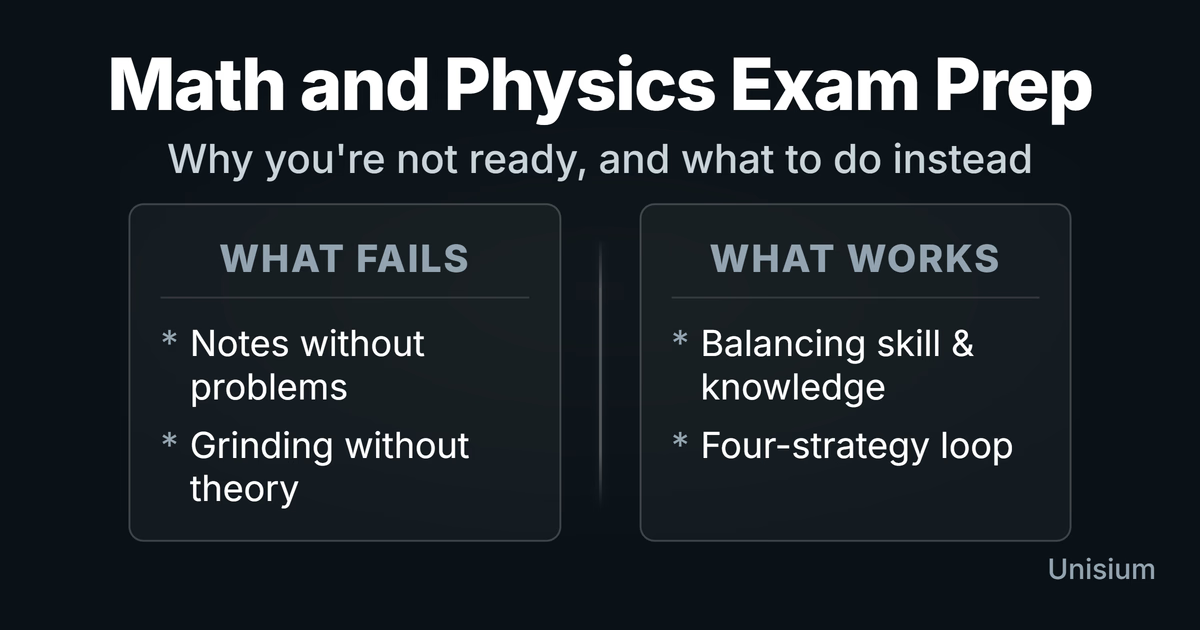
Most students who end up here have not been lazy. They’ve just spent weeks preparing for the wrong game.
Exam prep in technical subjects often collapses into one of two dead ends:
- Endless input (notes, summaries, videos) that builds familiarity but no problem-solving ability.
- Endless blind problem grinding that builds calculation habits but fragile understanding.
Neither prepares you for a written, problem-solving exam where you have to recognize problem types, select principles, and build models under time pressure.
This guide explains why you can “know the material” and still fail, how two one-sided study paths quietly sabotage you, what different exam types demand, and how to use a simple four-strategy loop on old exams to get ready. The focus is on written problem-solving exams in math and physics, with shorter notes on oral and conceptual exams. This loop is also a core loop inside the Unisium Study System (see Is Unisium Right for You?).
For the four-strategy loop, see Elaborative Encoding, Retrieval Practice, Self-Explanation, and Problem Solving.
1. Warning Signs You’re Not Getting Ready
If any of these feel familiar, you’re busy, but not preparing for the exam you’re going to sit:
- You can follow solutions but can’t reproduce them alone. Past exams look “fine” when you read them—but a blank page kills you.
- You keep collecting resources instead of using them. More notes, more videos, more PDFs—but your ability to solve new problems isn’t moving.
- You recognize formulas but don’t know when to use them. You stare at a problem and think, “Is this energy? Momentum? Something else?”
- You depend on solution manuals or model answers. You “check how it’s done” for almost every question and copy the pattern.
- You feel you “know how to solve problems,” but real exam problems feel unfair. You think, “We never did anything like this,” or “I have no idea where to start.”
These are not personality traits. They are predictable outcomes of how most students study.
2. The Two One-Sided Study Paths That Fail
Students in physics and math usually drift into one of two traps.
2.1 One-Sided Focus on Retrievable Knowledge
These students spend most of their time consuming and reproducing information—reading textbooks and rewriting notes, watching lecture videos, and writing summaries.
They get good at recognizing the material. But on the exam, they can’t set up problems from scratch and panic because nothing looks exactly like their notes. They built retrievable knowledge in a narrow sense—facts and formulas they can talk about—but never trained the skills to use them under constraints.
2.2 One-Sided Focus on Unconscious Skills
Other students go the opposite way: they ignore theory and “just do problems”, hunting for look-alike examples and mimicking them step by step.
They treat physics and math as a bag of formulas to plug numbers into. They do better than the “only notes” students—until the exam shifts slightly (two principles in one problem, a new context, a twist). Then they hit a wall. Their skills are fast but brittle.
3. What Different Exam Types Really Demand
Most of what follows is aimed at written problem-solving exams. That’s where students are most exposed and where past exams are most useful.
Other exam types (oral, conceptual multiple choice) put a different weight on the same ingredients: principled understanding, retrieval, and problem-solving skill.
3.1 Written Problem-Solving Exams (Main Focus Here)
Classic multi-step written exams test whether you can:
- Decode the problem: Identify what is given and what is being asked.
- Choose principles and build a model: Select which laws or techniques apply and express them as equations or logical structures.
- Carry out the mathematics: Manipulate equations correctly.
- Reflect on the solution: Check if the answer is reasonable (units, signs, limiting cases).
If your study never rehearses this end-to-end process, your performance will swing wildly depending on how similar the exam is to what you’ve seen before.
3.2 Oral Exams
Oral exams often lean more on:
- Your ability to state and connect principles.
- Your ability to explain reasoning clearly on simple or mid-level problems.
- Sometimes, your ability to derive key results on the board.
Here, Elaborative Encoding + Retrieval Practice matter more: you have to be able to say what a principle means, when it applies, and how it links to neighbors. You still need problem-solving practice, but you should also practice explaining aloud—to a friend, to a study group, or into empty air—using problems and questions close to what your lecturer uses. Ask for example questions if you can. This is the specificity principle in action: practice in the format you’ll be tested.
3.3 Conceptual Multiple-Choice Exams
Well-written conceptual MCQs are not about guessing tricks. They are about:
- Understanding the idea behind the formula.
- Distinguishing neighbor concepts (work vs. energy, average vs. instantaneous, etc.).
- Seeing through tempting wrong answers that match a common misconception.
Here, Elaborative Encoding + Self-Explanation dominate. Old MCQs (if available) are gold, but only if you:
- Decide on an answer before looking at options.
- Explain why each wrong option fails (what misconception it represents).
- Tie the correct answer back to principles and conditions.
For the rest of this guide, assume the default target is: written, problem-solving exams, with oral and conceptual exams adjusted by shifting the weight toward EE, RP, and verbal explanation.
4. The Real Fix: Balance Knowledge and Skill with Four Strategies
You don’t fix one-sided prep by “working harder” at the same methods. You fix it by deliberately combining:
- Elaborative Encoding (EE) — Build meaningful, principled understanding.
- Retrieval Practice (RP) — Make principles accessible under pressure.
- Self-Explanation (SE) — Turn worked examples into reusable solution rules.
- Problem Solving (PS) — Train those rules into unconscious skills by using them.
The fastest way to bring these together for exam prep is to run them on old exams from the same course.
5. The Fastest Way to Get Ready: Old Exams + Four-Strategy Loop
If your exam is close, you don’t have time for a beautifully balanced, long-term study plan. You need high-fidelity practice: the same kind of tasks, at the same level, with the same constraints.
The most direct route is:
Old exams from the same course + a tight strategy loop.
You’re matching the real exam on format, level, and principles. This gives you transfer-appropriate processing: you practice in the way you’ll be tested.
The Loop:
Retrieval warm-up → PS → Hint & Try → SE → EE → mark for revisit → next problem.
(PS → Hint & Try → SE is the core.)
Step 0: Pick the Right Material (and Fill Gaps)
Start with old exams from the same course (ideally same teacher/exam board).
Old exams are high-value but incomplete. They might not cover every topic in the curriculum, especially in small courses.
- Use old exams as your core practice.
- Use weekly problem sets or textbook problems to cover important topics that haven’t appeared in recent exams, especially hard ones.
- (For how to use workshops and office hours to support this phase, see How to Use Lectures, Workshops, and Other Learning Offers Effectively).
Step 1: Kickstart With Retrieval Practice (5–10 min)
Before you touch any exam problems, do a short, closed-book retrieval warmup on core principles:
Spend 5–10 minutes writing down the names of key principles, recalling for each one the form/definition/key equation, and stating when it applies or fails—without looking at notes.
This wakes up the knowledge you’ll need and exposes what’s missing. For more detail on how to design these prompts (and how often to revisit them), see Retrieval Practice.
Step 2: Try the Exam Problem First (Problem Solving)
Pick one exam problem and set a time box (e.g., 10–20 minutes).
- Decode the problem.
- Select principles and build a model.
- Execute the mathematics.
- Reflect on the result.
Work forward from the givens using principles. No solutions yet.
If you solve it cleanly, do a short reflection (“Why did this approach work? Which principle was central?”) and move on. If you get stuck or finish with a vague feeling of “I don’t really know why this works,” shift into Hint & Try mode.
Step 3: Use Hint & Try Instead of Copying
Most students either bang their head against the problem or copy the full solution. Both are a waste of effort.
Instead, use a Hint & Try loop:
- Reveal one small hint (e.g., “Use energy conservation” or a key diagram or the next equation).
- Close the solution and continue on your own.
- When you get stuck again, reveal one more step, then close and try again.
You alternate between guided input and your own output, keeping effort high but frustration contained. You still do the thinking; the solution just stops you from drifting too far off course.
Step 4: Self-Explain the Full Solution (Model First)
Once you’ve seen the full solution and made a real attempt to complete it yourself, switch into Self-Explanation and focus on the model.
For each major step in the model, hit four elements:
- Principle: Which principle is used here?
- Conditions: Why does it apply in this situation (and not a neighbor principle)?
- Setup of the principle: How is it set up? Why this sign, why sine and not cosine, why is there no force in the forward direction, why this coordinate system?
- Goal: How does this step move you toward the target quantity or equation?
The model is the bridge between your verbal decoding, visual decoding, and the later mathematical procedures. This is where most of the learning sits; algebra after a bad model is just polished confusion.
Short is fine: one concise sentence per element. The aim is to turn “a solution you’ve seen” into solution rules you can later recall and re-apply.
Step 5: Elaborative Encoding on Weak Principles
Every exam problem exposes principles you don’t fully control: a law you forgot, a condition you misapplied, a concept you misclassified.
Pick one or two such principles per session and run a tight Elaborative Encoding pass:
- Clarify the meaning in your own words.
- Write down conditions of use and failure.
- Contrast with neighbor principles you confuse it with.
Update your principle tables/structures. The goal is simple: the next problem of that type should feel clearer.
Step 6: Mark and Move On (Independent vs. Helped)
Use a simple rule:
- Mark each problem as either Solved independently or Solved with help (needed hints, solution, or AI).
- For “Solved with help”, put a small mark or note to revisit later.
Your medium-term goal is clear:
Loop through all available old exams until you can solve every problem independently (with only normal checking at the end).
One of the perks of old exams is that they already mix topics. You don’t have to create artificial interleaving—each exam naturally spans the domain. Just keep moving through questions instead of cherry-picking only the ones that look familiar.
6. How to Rotate Through Old Exams Day by Day
You don’t need a complicated calendar. You need a repeatable daily block and a simple rotation rule.
6.1 Daily Session Template (60–90 Minutes)
Use this as your default block during the last weeks:
- Retrieval (10–15 min): Mixed principles, no notes.
- Exam problems (35–60 min): Work through old exam problems in order using the loop:
- PS → Hint & Try → SE → EE → mark “independent/helped”.
- Short conceptual or oral check (5–10 min): Answer a few conceptual questions or explain one of the solutions aloud as if in an oral exam.
That’s it. If you have more time, add multiple blocks per day separated by real breaks.
6.2 Rotation Across Exams
Across days:
- Start with Exam 1 and run all questions, marking each as Solved independently or Solved with help.
- Then move to Exam 2, same process.
- Keep going until you’ve been through all available exams once.
On your second pass:
- Go back to Exam 1 and redo only the problems you previously marked as “Solved with help” until you can do them independently.
- Repeat for Exam 2, Exam 3, and so on.
If you eventually run out of old exams, use hard problems from weekly sets to mimic exam style.
You don’t need a fancy schedule. You need to keep shrinking the set of “helped” problems across all exams until almost everything is in the “independent” bucket.
7. What If There Are No Solutions?
Sometimes old exams don’t come with official solutions. That’s annoying, but not a blocker.
You have three main options:
- Ask your lecturer or TA for a solution sketch or hints for specific problems.
- Use hard problems from weekly sets or the textbook as proxies (these usually have solutions).
- Use AI to generate solution sketches.
For AI, you want to avoid pure answer-giving and instead enforce process. For example:
“You are a tutor helping me prepare for a written physics exam. For the following problem, guide me using a five-step strategy: (1) verbal decoding, (2) visual decoding, (3) physics modeling with principles and conditions, (4) mathematics, (5) reflection. Start by asking me questions about step (1) only. Don’t give me the full solution at once.”
Then paste the problem.
You can then combine this with Hint & Try: get the next step, close the chat, and work on your own again. Use the AI as a flexible solution manual that still forces you to think.
If you haven’t already, see the Five-Step Strategy guide for how to structure solutions.
8. Test Day: How to Use What You Built
You don’t “rise to the occasion” in exams. You fall to the level of your preparation.
8.1 First Pass: Scan the Entire Exam
Quickly read all questions. Mark obvious “easy” ones. Note anything with ambiguous wording or where you’re unsure what is being asked.
8.2 Start with the Easiest Problems
Secure all the marks you can get with high confidence. Avoid burning the first half of the exam on a monster problem that might not even be graded heavily.
8.3 Use a Systematic Strategy on Complex Problems
Resist the urge to dive straight into algebra.
For physics, use the Five-Step Strategy:
- Verbal decoding
- Visual decoding (diagrams)
- Physics modeling (principles + conditions)
- Mathematics
- Reflection
The point is to do on paper what you’ve been training on old exams: classify the problem, pick principles, and build a model consciously before drowning in symbols.
8.4 Accept and Handle Test Anxiety
Expect nerves. The goal is not to eliminate anxiety; it’s to function with it.
Two practical moves:
- Physiological reset. If anxiety spikes, use a simple pattern: two short inhales through the nose, one long exhale through the mouth. Repeat three times. This doesn’t make the exam easier, but it calms your physiology enough to think clearly again.
- Shift attention back to process. Instead of staring at the page and catastrophizing, write down the name of a relevant principle, its form, and its conditions. Start drawing a diagram. Acting on your preparation pulls attention away from the panic narrative and back to the task.
You’ve already rehearsed this process in your simulated sessions; the exam is just another run-through.
9. How Unisium Mirrors This Exam-Prep System
You can do all of this manually with paper, PDFs, and discipline. Unisium exists to remove friction and make the system repeatable.
All levels in Unisium use the same four core strategies—Retrieval Practice, Elaborative Encoding, Self-Explanation, and Problem Solving. What changes by level is complexity, context, and how close the tasks are to typical exam questions.
Roughly:
-
Lower levels (e.g., Level 1–2):
Simpler contexts, cleaner single-principle problems, and shorter solution paths. You still see RP, EE, SE, and PS, but on “easy mode” versions of the ideas. -
Mid levels (around Level 3):
Problems start to look like standard written exam questions: more steps, more realistic wording, and occasional combinations of ideas. -
Level 4:
Designed to sit roughly at A-level exam difficulty for that topic when you can solve the cards independently. Same strategies, but in exam-like form. -
Beyond Level 4:
Above-exam difficulty and more mixed contexts, which gives you buffer and robustness.
As a rough rule of thumb:
If you can consistently handle Level 3–4 Problem-Solving and Self-Explanation cards for a topic without hints, you’re close to exam-ready for that topic. Levels above that give you margin.
The app also:
- Handles spacing and scheduling so important principles come back at the right time.
- Tracks which cards you’ve mastered independently and which still need work.
- Lets you run a mini exam-style loop inside the app: RP → EE → SE/PS on increasingly demanding questions.
Instead of designing your own system, you log in and follow the next card. The logic in this guide is what the system is trying to implement for you.
FAQ: Common Exam-Prep Questions
I’m 2–3 weeks before the exam and feel far behind. What’s the minimum viable plan?
Focus on core topics and old exams. For each core topic, alternate between:
- Short principle sweeps (EE + RP) on central ideas.
- Exam-style problems using the loop PS → Hint & Try → SE → EE, marking problems as independent/helped.
Rotate through old exams until you can solve most problems independently. Don’t waste time polishing low-yield topics while core principles are shaky.
Can I just prepare by doing past exams?
Past exams should be your main practice material in the last weeks, but on their own they tempt you into pattern copying. Use them to reveal gaps, then:
- Fill coverage gaps with hard problems from weekly sets on topics that haven’t shown up.
- Repair misunderstandings with elaborative encoding, retrieval practice, and self-explanation on the principles you messed up.
If you’re going to study superficially anyway, it’s still better to waste that effort on past exams than on random notes or videos. The point of this guide is to not waste it.
How many problems should I solve per day?
There is no magic number. For most students, three to six well-solved, reflected-on problems per session build more skill than twenty rushed ones. Track whether you solved each problem independently or with help, and work to shrink the “helped” list over time.
Should I understand all the theory before I start solving problems?
No. Waiting for perfect understanding is often a polite form of avoidance. Do a brief round of elaborative encoding on key principles, then start solving problems that force you to use them. Use self-explanation of solutions afterwards to deepen understanding.
My biggest issue is test anxiety. How should I adjust this plan?
Two adjustments:
- More simulation. Do short, timed sets under exam-like conditions (no notes, fixed time, no solution manual open). Get used to the experience of pressure.
- Stronger unconscious skills. Make sure enough core patterns are practiced that some moves feel automatic. Anxiety damages deliberate reasoning before it touches well-practiced habits.
Related Guides
- 6 Ineffective Study Techniques (and What to Do Instead) — Why your current methods feel productive but stall your exam prep.
- Elaborative Encoding — How to understand principles and their conditions.
- Retrieval Practice & The Testing Effect — How to make knowledge accessible.
- Self-Explanation — How to learn from worked examples.
- Problem Solving & Five-Step Strategy — How to convert principles into skill.
- Hint & Try — How to use solutions without copying.
- Interleaving — How to mix topics to classify exam problems.
- Spacing — How to distribute your study.
- Studying Over the Summer Before a Retake — How to use a summer before an exam to reach independent solving.
How This Fits in Unisium
Unisium turns this exam-prep loop into a repeatable session format: you warm up with retrieval, solve old-exam problems first, use Hint & Try instead of copying, then self-explain to extract rules you can reuse. That’s the Unisium Study System applied to exams: practice the same decisions you’ll face under time pressure and revisit what you missed until “helped” becomes “independent.” Ready to try it? Check access and join the Unisium waitlist or explore the full framework in Masterful Learning.
Bottom line: If your exam prep is all notes or all blind problem grinding, you’re preparing for the wrong game. Use old exams with a principled loop—Retrieval, Problem Solving, Hint & Try, Self-Explanation, and Elaborative Encoding—until you can solve the vast majority of problems independently.
Ready to apply this strategy?
Unisium turns these evidence-based techniques into guided study sessions for math and physics. Places are limited during early access. Check current availability to start a trial; joining the mailing list is optional.
See plans and availability Read More GuidesAlready have access? Sign in