What to Do When You're Stuck on a Math or Physics Problem
The question: What should you do when you are stuck on a math or physics problem but still want to learn from it?
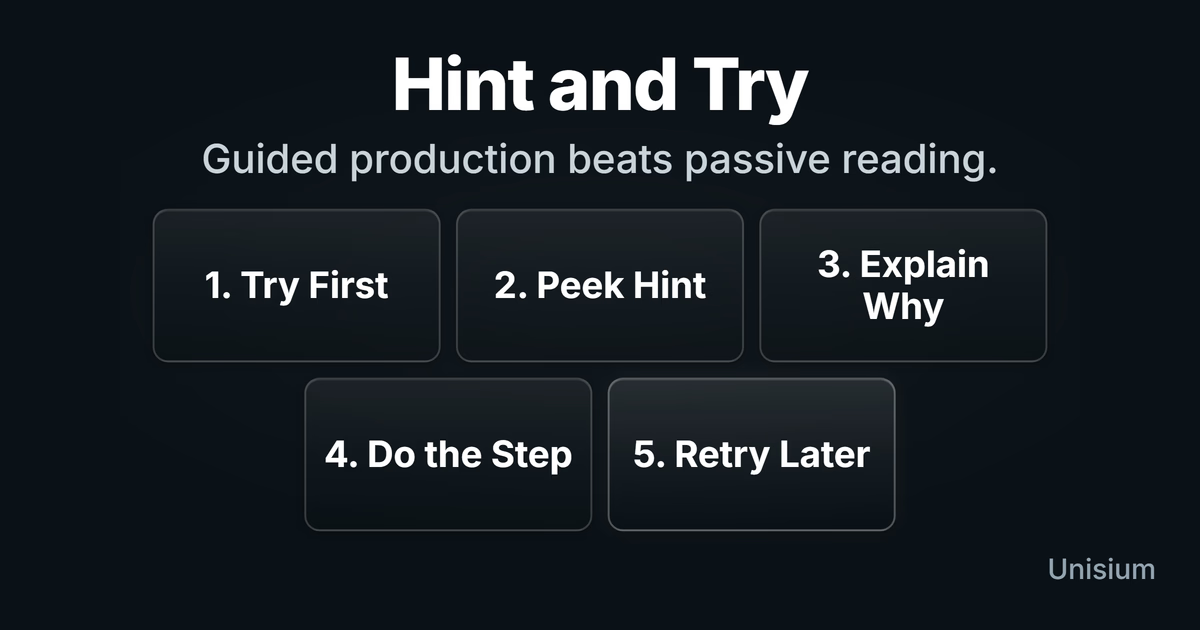
Hint and Try is the middle path between copying the whole solution and wasting twenty minutes on a dead end. You try first, reveal one targeted hint, explain the principle behind it, then continue on your own.
Use it in the middle zone: you are blocked, but still close enough that one good nudge could restart your reasoning. If you are far below that threshold, start with Self-Explanation. If the bottleneck is physics modeling before calculation, use Five-Step Strategy. If you want the broader why and when of building problem-solving skill, see Problem Solving.
Why it works: Pretesting primes attention, a single hint prevents unproductive stalls, self-explanation builds understanding, and posttesting (with spacing) cements it. See the complements: Pretesting and The Testing Effect.
Hint and Try combines pretesting, self-explanation, and delayed retry. It is one of the core loops inside the Unisium Study System, but it also works with textbooks, past papers, worked solutions, and AI hints as long as you keep the hint minimal and do the next step yourself.
What is Hint and Try?
Hint and Try (sometimes called anticipative reasoning, cover-and-predict, faded worked examples, or guided generation) means you consult a minimal piece of the solution (a line of code, a formula, a sub-goal, or a step) and then you execute the next step from memory. You aren’t copying; you’re generating with guidance.
- Pretest: attempt first, closed-book, to create a prediction.
- Hint: reveal the smallest solution fragment that would have unblocked you.
- Explain: in one sentence, name the principle or reason the hint works.
- Try: produce the next step yourself.
- Quick retry later: check your work now; try a tiny variant later.
It’s the middle path between “read the whole solution” (too passive) and “grind in the dark” (too wasteful).
Why Hint and Try Works
- Pretesting sharpens attention. A quick attempt creates “search images” for what matters next (Pretesting).
- Selective hints reduce floundering. You keep momentum without turning the task into copy-typing.
- Self-explanation builds meaning. A short rationale connects the step to a principle, not just pattern matching.
- Posttesting—then spacing—creates durability. Producing an answer from memory, then revisiting at increasing intervals, beats re-reading every time (Testing Effect).
Research Snapshot: Anticipative Reasoning and Worked Examples
Worked-example research repeatedly finds two especially effective behaviors: explaining why steps are valid (principle-focused self-explanations) and anticipating the next step before seeing it (cover-and-predict). These behaviors are largely independent and both support learning; anticipating typically benefits from some prior knowledge, while explanations help even with thin backgrounds. Hint and Try deliberately combines them: explain just enough, then anticipate and act.
For effect sizes, moderators, and full citations, see Learning Literature.
When to Use Hint and Try
- You’re close but stuck. You can see the goal but not the next move.
- Procedural skills. Math, coding, statistics, physics derivations, proofs, transformations.
- Studying examples and tutorials. Don’t read straight through—interleave prediction and minimal peeks.
- Model building (conceptual). Use one revealing equation or constraint to clarify the model, then continue unaided.
Which strategy should I use right now?
| Your confidence you can solve unaided | Best move |
|---|---|
| <30% | Self-explain worked steps |
| 30–60% | Hint and Try |
| 60–90% | Solve without hints |
| >90% | Increase difficulty |
How to Use Hint and Try (Step-by-Step)
The Core Loop (3–7 minutes)
- Try, closed-book (60–120s). Write your best next step.
- Predict the next line/choice. No peeking.
- Reveal one hint to verify. Uncover the smallest fragment needed to check that prediction.
- If different, explain why (1 sentence). “It uses ___ because ___.”
- Hide the solution and continue unaided. Keep going until the next genuine stall.
- Stop at the first clean pass. Later, do one quick retry or a tiny variant.
Note: Posttests don’t need to be immediate. Delayed posttests are normal—and often better. What matters is spaced successful recalls.
For Model Building (Conceptual Problems)
- Hint: reveal one key relation (e.g., conservation law, constraint equation, type signature).
- Explain: name the governing principle and the condition that makes it applicable.
- Try: finish the model or diagram, then proceed to a micro-derivation.
For Procedures (Math/Coding)
- Predict first. Write the next transformation/line from memory.
- Reveal to verify (minimal). Uncover just enough of the worked example to confirm that one prediction.
- If wrong, explain why (one sentence). Tie the correction to a rule/constraint (e.g., “product rule, not chain rule, because both factors vary”).
- Hide and continue unaided. Only peek again at the next real stall.
- Stop rule. End at your first clean pass; save repeats for later.
Examples (Predict → tiny Hint → Explain → Continue)
Pattern: work forward; when you genuinely stall, do Predict → tiny Reveal → Explain → continue unaided. Hints are literal one-liners from a worked solution.
Example 1 — Calculus: Implicit Differentiation
Problem. Find if .
You work forward unaided:
- Plan: differentiate both sides.
- Write: .
Stuck point 1 (product/chain details). You’re uncertain where appears.
Predict (no peek). “Probably .”
Reveal (one line from solution).
Explain (1 sentence). “Product rule; depends on , so .”
Continue unaided. Add the sine term: . You have: .
Stuck point 2 (isolate ). Unsure about factoring.
Predict (no peek). “Factor : .”
Reveal (tiny).
Explain (1 sentence). “Both terms share ; factoring isolates it.”
Finish unaided.
Later retry (quick). Try a close cousin: .
Example 2 — Physics: Projectile With Launch Height
Problem. A projectile is launched from height with speed at angle . Ignore air resistance. Find total flight time and horizontal range .
You work forward unaided:
- Decompose velocity: , .
- Vertical position model: .
- Set landing condition → quadratic in .
Stuck point 1 (quadratic root choice). Unsure which root is physical.
Predict (no peek). “Use the positive root for future time.”
Reveal (tiny).
Explain (1 sentence). “Discriminant gives two roots; the positive, later-in-time root is the flight time.”
Continue unaided. Horizontal motion is uniform:
Stuck point 2 (sanity). Unsure about limiting behavior.
Predict (no peek). “If , range reduces to .”
Reveal (tiny). Use when .
Explain (1 sentence). “With , the standard ground-launch time appears, so the classic range formula follows.”
Finish unaided. Conclude dependence on via the square-root term.
How This Ties to the Core Strategies
- Self-Explanation: every hint is followed by “why this step?”, linking step ↔ principle ↔ goal.
- Retrieval Practice: the “Try” is closed-book production.
- Problem Solving: you act under constraints with minimal scaffolding.
Match the exam: Use Hint and Try with formats that mirror your test (short-answer, MCQ, oral, derivation). Then upgrade to generation—producing answers from memory—to lock in durable skill.
See: Self-Explanation · Retrieval Practice · Five-Step Strategy
Hint and Try in the Unisium Study System
The Unisium Study System turns this strategy into concrete cards and schedules it for you:
- Try first on every study card. We prompt a closed-book attempt by default.
- Targeted mapping. When you check, you see the answer and where it lives.
- Automatic posttests. Missed or “Hard” cards return at increasing intervals; retrieval cards are scheduled for you.
Common Pitfalls (and Fixes)
| Pitfall | Fix |
|---|---|
| Peeking too much | Reveal one hint, then hide the solution again |
| Explaining nothing | Force the one-sentence “why this step?” before typing |
| Endless immediate repeats | Stop after a clean pass; schedule the next one |
| Using hints too early | If you couldn’t even start, self-explain a worked example first. If you keep bouncing off the first minutes, fix entry resistance. |
FAQ
Isn’t peeking a hint the same as cheating?
No. A minimal hint prevents waste while still requiring you to generate the step. Copying entire solutions is passive; Hint and Try is guided production.
What if I don’t have a solution?
Use partial solutions from textbooks, past papers, or generate a draft with AI. Reveal only the smallest helpful piece each time.
How many hints should I use?
As few as possible. If you need more than one hint per step, you’re probably below the “30% ready” threshold—self-explain a worked example first instead.
Do I need a formal posttest?
No. After a clean run, a brief retry or tiny variant later is enough to confirm the skill stuck. Keep it light; avoid grinding.
When should I switch strategies?
- <30% confident: Self-explain worked steps (Self-Explanation)
- 30–60% confident: Hint and Try
- 60–90% confident: Solve without hints
- >90% confident: Increase difficulty
Is Hint and Try the same as self-explanation?
No. Self-Explanation focuses on “why the step works.” Hint and Try adds production: you must generate the next step from memory after a minimal hint. They combine well: explain → then try.
For Teachers (2–3 minute classroom loop)
Ask 1 prediction at slide 1 → reveal a minimal hint (one line, one equation, one constraint) → students write the next step in 1–2 min → teach the content → 1 quick variant at the end (closed-book, 1 min) → post the answer key with exact locations (slide numbers or page refs).
Start Now (5 minutes)
- Pick one problem you almost solved yesterday.
- Pretest the next step, closed-book (60–120s).
- Reveal one hint when stuck; explain it in a sentence.
- Do the next step yourself; check.
- Schedule a retry for 1–2d.
How This Fits in Unisium
Unisium supports the same active rhythm: attempt first, check, and come back later for another try instead of reading passively. On study surfaces that include scoring or feedback, the goal is still to keep production in your hands rather than replace it with a full solution immediately.
Related Guides
- Pretesting — Aim your study with fast guesses and feedback.
- The Testing Effect — Space your posttests for durability.
- Self-Explanation — Turn examples into understanding.
- Problem Solving — A deliberate strategy for turning principles into skill.
- Five-Step Strategy — Physics-specific problem-solving framework.
Evidence at a Glance
Combining brief pretests, targeted hints, self-explanations, and spaced posttests consistently improves learning and transfer across domains. The method synthesizes decades of research on worked examples, retrieval practice, spacing, and self-explanation—all with a focus on guided production over passive consumption.
For effect sizes, moderators, and sources, see Learning Literature.
Ready to apply this strategy?
Unisium turns these evidence-based techniques into guided study sessions for math and physics. Places are limited during early access. Check current availability to start a trial; joining the mailing list is optional.
See plans and availability Read More GuidesAlready have access? Sign in