How to Restart Math and Physics After Years Away
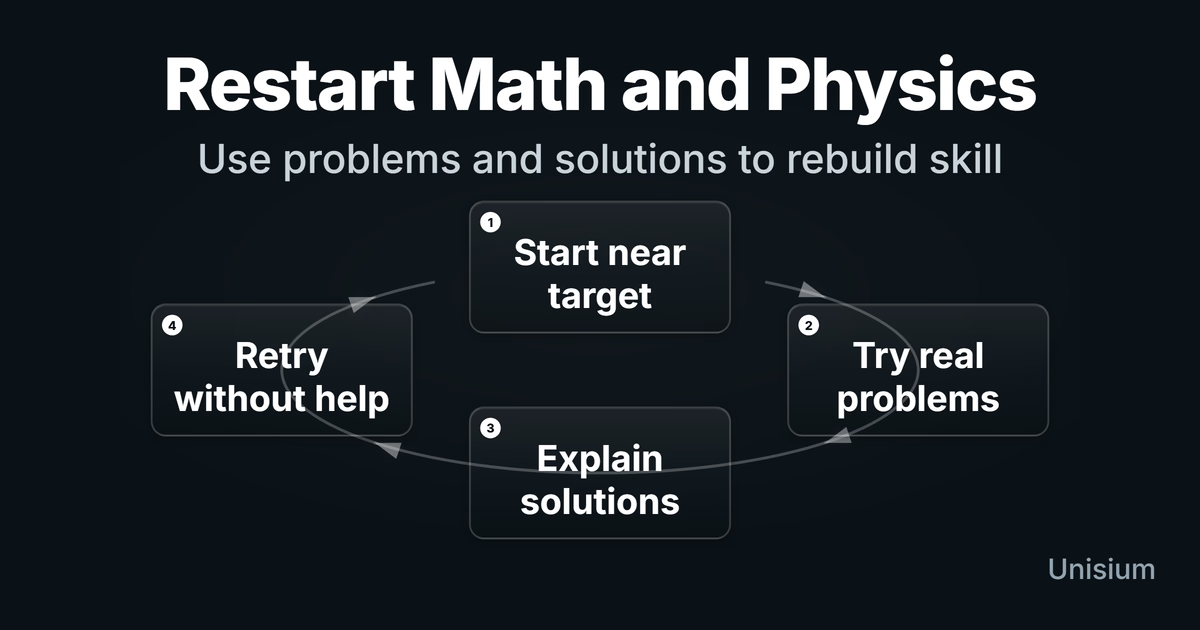
Restarting math and physics after years away usually does not mean going all the way back to zero. Start near the subject you want to regain, try real problems with worked solutions, self-explain the steps you cannot yet produce, and retry until the skill starts coming back.
If you have been away from algebra, calculus, or classical mechanics for years, you probably do not want a casual refresher. You want to feel capable again: to read a problem without freezing, follow a solution without getting lost, and rebuild serious skill.
Most people do not get that back through months of videos, reading, and easy review. They get it back by returning to real problems and using worked solutions the right way.
If you mainly want a casual refresher, videos and books are fine. If you want to become capable again, understand what you are doing, and get genuinely good, use the workflow below.
Restart rule: Start one level below your target only when problems from your target area stay unreadable even after careful study of a worked solution. Otherwise, stay near the target and rebuild missing principles, setup choices, and mathematical steps in context.
On this page: Why Most Restart Plans Fail | Start Near the Target | Restart Workflow | Formulas Without Logic | Math Before Physics | FAQ
Why Most Restart Plans Fail
Most restart plans fail because they keep you busy without making you think. People spend weeks watching videos, rereading, following tutorials, and doing section-labeled exercises where the needed formula or method is obvious from the heading.
That work can feel productive because you recognize the material and can follow it in the moment. But it does not force you to understand the situation, choose a principle, set up the equations, or explain why the steps work.
A strong restart plan uses explanations and easier exercises as support, not as the center. The center is real problems, worked solutions, self-explanation, and repeated attempts until the skill starts to return.
Want the complete framework behind this guide? Read Masterful Learning.
You Probably Do Not Need to Start From Zero
If you want to restart calculus, do not automatically go back through a full algebra-to-trig ladder. Start with early calculus or precalculus problems that include worked solutions, then let those problems show you which older ideas need repair.
If you want to restart physics, do not automatically postpone it until your math feels complete. Start with simple mechanics problems built around force, energy, momentum, or kinematics, again with worked solutions you can study carefully.
Move lower only when even the worked solution is hard to read. That is the sign that the symbolic language itself is still too weak, not just that one problem is difficult.
A deeper restart makes sense when:
- You cannot solve straightforward algebra problems without guessing.
- Graphs, functions, fractions, exponents, or basic trig are failing constantly, not occasionally.
- Even worked solutions feel unreadable because the symbolic steps themselves are opaque.
If that is not your situation, stay with the subject you want back.
The Restart Workflow: Try, Study, Self-Explain, Retry
Use this loop with problems from the subject you want to relearn.
- Choose one target area. Pick early calculus, precalculus for a calculus return, introductory mechanics, or another concrete part of the subject you want back.
- Choose problems with worked solutions. A restart resource should give you real problems and detailed solutions you can study.
- Try the problem before reading the solution. Work on paper first.
While You Try the Problem
Pay attention to where you stall:
- Do you understand what is given and what is being asked?
- Can you represent the situation with a diagram, graph, free-body diagram, equation, or other useful picture?
- Can you identify relevant principles, rules, or equations?
- Can you model the situation with the right equations or relationships?
- Can you carry out the algebra, trig, calculus, vector, or graph step?
Your attempt tells you where the breakdown starts. It rarely tells you the whole story.
- When you get stuck, study the worked solution and self-explain it. Do not only read it. Use Self-Explanation to make sense of each important step.
When You Study the Solution
Ask:
- What principle, definition, rule, or equation is used here?
- Why does it apply in this situation?
- Why is the equation set up this way?
- Why this sign, component, term, substitution, or limit?
- What operation moves this line to the next line?
- Which part could I not have produced on my own?
- Learn the missing piece. That may be a principle, a condition of use, a setup choice, a sign convention, a vector component, or a mathematical operation.
- Retry the same problem later without looking. The goal is not only to follow the solution. The goal is to make the work reproducible.
- Then move to a similar problem, then a mixed problem. Once one worked example is reproducible, test whether you can choose the method when the formula is not telegraphed for you.
When to Move Lower
Move to simpler or earlier material only when even the worked solution stays hard to read after careful self-explanation. If the solution becomes understandable when you slow down and explain it line by line, you are close enough to keep working near that level.
What to Do If You Remember Formulas but Not the Logic
This is a common restart state. You remember the chain rule, conservation of energy, or a kinematics equation, but you no longer feel why it fits the problem.
Do not respond by rereading formulas in isolation. Rebuild each principle as a usable tool: what it means, what each term represents, when it applies, and what nearby idea it is easy to confuse with.
When symbols feel dead, translate them back into meaning. Ask what quantity a term represents, what role it plays in the setup, what condition makes the step legal, and what would change if the situation changed. That is how formulas stop feeling familiar-but-empty and start becoming useful again.
Should You Review Algebra Before Calculus, or Finish Math Before Physics?
Usually no. The first step is to try the subject you want to learn or relearn, using problems and worked solutions that are close to that target.
If early calculus problems expose a specific algebra or trig weakness, repair that exact weakness and return to calculus. If mechanics problems expose weak vectors, trig, or derivatives, repair that exact step and return to mechanics.
Do not turn math into an endless gate you must clear before you are allowed back into physics or calculus. Let the target subject show you what needs repair.
Sometimes the target will prove that you truly need a lower level. That is fine. But let the problems and the solutions prove it. Do not assume it in advance.
If you want the wider weekly version of that system, see How to Self-Study Math and Physics Effectively and Why You Are Not Ready for the Math and Physics Exam.
FAQ
Am I too old to get good at math and physics again?
Usually, age is not the main bottleneck. The harder question is whether your restart method rebuilds skill or keeps you hiding in passive review. If your main worry is age, adulthood, or whether it is “too late,” read Is It Too Late to Learn Math or Physics as an Adult?. This guide focuses on the restart procedure.
How do I know whether to restart with algebra or jump into calculus?
Try a few early calculus problems, or precalculus problems close to calculus, that have worked solutions. If the solution is mostly readable but the algebra or trig blocks one or two steps, repair those steps in context and stay near calculus. If even the solution is opaque from start to finish, move lower and rebuild those ideas first.
Should I finish math before I start physics again?
Usually no. Try introductory mechanics again and let those problems show you whether the blocking issue is algebra, trig, vectors, or derivatives. Repair that step, then return. Only delay physics if even basic setup and interpretation are unreadable.
What if I can follow solutions but still cannot solve problems alone?
That usually means recognition is ahead of skill. Self-explain the worked solution step by step, then retry the same problem later without support. If you still freeze, the solution has not become yours yet.
How many hours per week do I need to restart properly?
Enough to keep steady contact with the subject and the weak points it reveals. For many rusty learners, 5 to 8 focused hours per week is a realistic starting range if the time goes to real problems, worked solutions, self-explanation, and retrying instead of passive review. More helps, but only if the loop stays sharp.
Do I need the perfect textbook, course, or app before I begin?
No. You need a decent source and a better loop. One solid textbook or course with real problems and worked solutions is enough to start trying, self-explaining, learning the missing steps, and retrying.
Related Guides
- Self-Explanation for learning how to study worked solutions instead of only reading them.
- How to Self-Study Math and Physics Effectively for the weekly version of this loop.
- How to Study Physics and Math with AI for using AI as a checker and hint source without outsourcing the thinking.
- Why You Are Not Ready for the Math and Physics Exam for shifting from recognition and copied patterns to real problem performance.
- If it is one summer before a course rather than years away, see how to prepare over the summer before a course.
- Browse all guides if you want the larger study-method cluster.
How This Fits in Unisium
Within the Unisium Study System, the same restart logic shows up as principle-focused review, self-explanation on worked steps, and problems that make you retrieve and choose a method under pressure instead of recognizing it on sight. If you want the full framework behind that workflow, start with Masterful Learning. If you want to use the workflow directly, check access and join the Unisium waitlist.
Masterful Learning
The book behind these guides: a study system for physics, math, & programming built on retrieval, connection, explanation, and problem solving.
Ready to apply this strategy?
Unisium turns these evidence-based techniques into guided study sessions for math and physics. Places are limited during early access. Check current availability to start a trial; joining the mailing list is optional.
See plans and availability Read More GuidesAlready have access? Sign in