How to Self-Study Math and Physics Effectively
Most progress in math and physics happens when you study alone. Lectures, videos, and notes can help, but they don’t decide whether you pass, fail, or reach the level you want. How you structure your self-study week does. (For how to use lectures, workshops, and office hours as support, see How to Use Lectures, Workshops, and Other Learning Offers Effectively).
For the four strategies, see Elaborative Encoding, Retrieval Practice, Self-Explanation, and Problem Solving.
If you want practical tools, start with How to Use Anki for Physics and Math, How to Study Physics and Math with AI, and Note-Taking During Lectures in Math and Physics. If you want the broader case for why study quality matters so much, read The Expected Value of One Hour of Deliberate Practice in Math and Physics.
Why Does Self-Study Matter So Much in Math and Physics?
In technical subjects, contact hours are a small slice of the week. Most of your learning happens when nobody is watching: pen-in-hand, working through a problem set or a past exam.
You can attend every lecture, take neat notes, and still be lost on the exam. You can also become strong with poor teaching, as long as your self-study is structured and heavy on the right kinds of work.
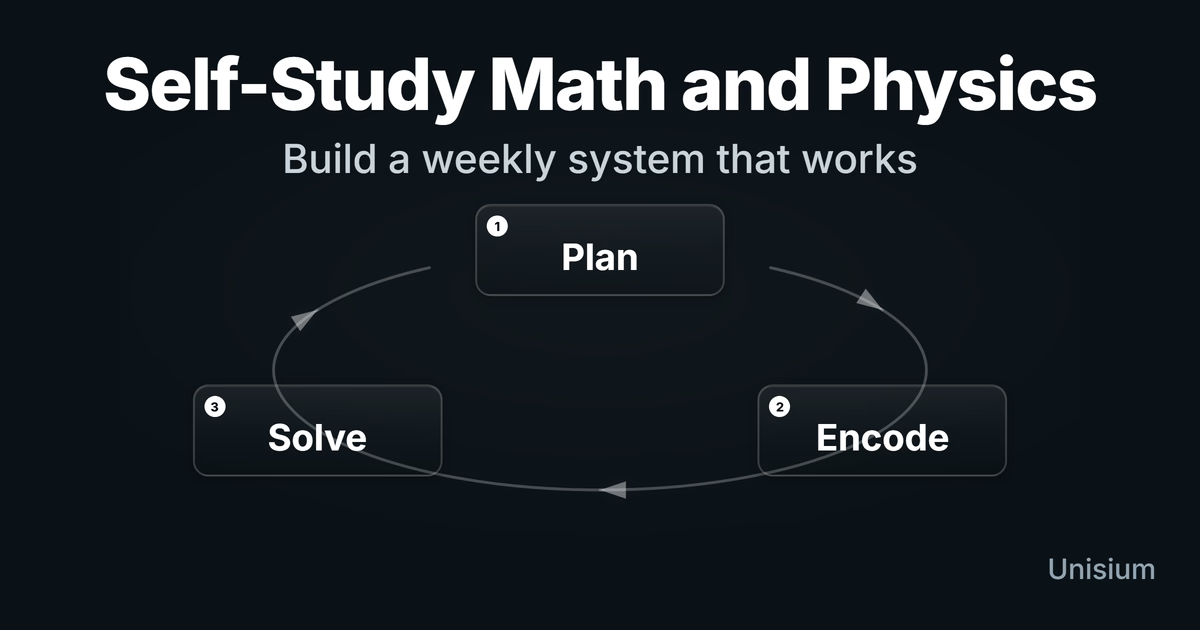
This guide gives you a concrete system for self-studying math and physics:
- how many hours to aim for
- what to do first on a new topic
- how to structure a week
- what to do when you are behind
- how to use past exams and time tracking
This guide draws on Vegard Gjerde’s experience teaching university mechanics and on physics-education research into how students turn principles into usable skill: elaborative encoding, retrieval practice, self-explanation, and problem solving. For research sources, see Learning Literature.
These same principles also shape how Unisium is designed. If you are still deciding whether the work itself fits, start with the math and physics fit assessment. If the work fits and you want to evaluate the product, see Is Unisium Right for You?.
What Kind of Work Are You Aiming For?
It is easier to plan a week when you know what you want your future workday to look like.
If you are in math or physics because you want to understand how the world fits together, you need durable principles and the ability to build models. If you want to work as an engineer, data scientist, or researcher, you need to be able to set up problems, not just plug formulas.
That means your self-study time must move you toward:
- clear, retrievable principles with conditions
- flexible problem-solving skill in realistic settings
Unisium is built around this goal. Everything else is subordinate.
What Should You Stop Doing?
Self-study starts by cutting work that burns time without building recall or skill.
If your current habits are heavy on:
- rereading
- copying or rewriting notes
- highlighting pages
- “watching one more video”
- drifting through lectures without questions
you are spending much of your week on low-yield activities. If you want the longer-run case for being strict about study quality, see The Expected Value of One Hour of Deliberate Practice in Math and Physics.
Use the benchmark from 6 Ineffective Study Techniques:
- If you could do the activity while tired, distracted, and half on your phone, it is probably too passive to be a core method.
- If it does not force you to recall, explain, or solve, it belongs in low-quality time, not in your best hours.
Self-study in math and physics should be dominated by:
- Elaborative Encoding: understanding new principles and their conditions.
- Retrieval Practice: recalling principles without notes.
- Self-Explanation: extracting rules from worked solutions.
- Problem Solving: attacking fresh problems.
Everything in this guide is about fitting those four into a real week.
How Many Hours Per Day Should You Self-Study?
You do not need to study all day. You do need several hours of focused work most days.
For a demanding semester with math and physics, a realistic target is:
- Around 3–5 hours of focused work per day, across your full course load.
That focused time is where you:
- do elaborative encoding on new principles
- run retrieval practice on recent and older material
- self-explain worked examples
- solve problems and work on past exams in the final weeks
It does not include:
- scrolling forums or Discord
- half-watching lectures while doing something else
- reorganizing notes or “making things look nice”
If you are consistently below ~2 hours of real work on most weekdays, it will be hard to keep up in serious courses. If you are consistently near the upper end of the 3–5 hour band with high-value work, you are almost certainly doing enough for a full course load.
The system in Unisium uses this logic: progress comes from many focused sessions over time, not a last-minute sprint.
For help measuring real effort, see Tracking Study Time and the time-tracking section later in this guide.
What Should You Do First on a New Topic?
When you start a new topic, the temptation is to read or watch everything linearly. That feels safe and familiar, but it is slow and fragile.
A better sequence is:
- Elaborative Encoding on core principles
- Retrieval Practice on those principles
- Self-Explanation on a few worked examples
- Problem Solving on simple, targeted tasks
In practice this means:
- Identify the key principles for the topic (e.g., conservation of energy, Gauss’ law, chain rule, eigenvalues).
- For each one, run a short Elaborative Encoding pass: meaning, form, conditions, and contrast with neighbors. See Elaborative Encoding.
- Within the same day, test yourself without notes: name → form → conditions. That is Retrieval Practice. See Retrieval Practice.
- Once you can recall the principle, study one or two worked examples with Self-Explanation: step by step, name the principle used, the condition that makes it valid, and how it moves the solution forward. See Self-Explanation.
- Then attempt a few fresh problems using the same principles. That is Problem Solving. See Problem Solving and the Five-Step Strategy for physics.
Unisium follows this arc: principles are encoded, retrieved, explained, and then used in problems, with spacing built in.
How Should You Structure a Self-Study Week?
An effective week balances hard work, light work, and rest, and brings the four strategies in at the right time.
Think in terms of quality of time:
- High-quality time: long, uninterrupted blocks when your mind is clear.
- Low-quality time: short fragments, tired evenings, commutes.
Use high-quality time for:
- problem solving
- demanding self-explanation
- retrieval practice on new or weak principles
Use low-quality time for:
- light elaborative encoding (reading with questions)
- scanning notes to pick topics for deeper work
- short retrieval checks on already strong principles
A sample week for a 10-credit course inside a 30-credit semester might look like:
-
Weekend:
- Read upcoming textbook sections with elaborative encoding questions in mind.
- Build or update principle tables and structures.
-
Monday:
- 15 minutes of retrieval practice on old principles.
- 60–90 minutes of elaborative encoding on new principles.
- 30–45 minutes of retrieval practice on those new principles until you can recall them cleanly several times.
- The rest on weekly assignments, with Hint and Try and self-explanation.
-
Tuesday–Friday:
- 10 minutes of retrieval practice each morning on all principles you have seen so far.
- The bulk of your time on problem solving and self-explanation, using Hint and Try when you are stuck.
- Late-day or low-quality time for videos or reading to plug specific gaps.
This pattern gives you roughly 500 minutes of effective self-study on that course per week before counting lectures.
Unisium mirrors this flow by surfacing the right kind of study card at the right time: retrieval earlier in the day or week, problem solving once principles are stable, and revisits spaced over time.
How Should You Use Lectures and Videos?
Lectures and videos are easy to overvalue. For self-study, they are tools, not the main event.
If your lectures are interactive—using questions, discussion, and reasoning—they can be high-value, especially after you have done some elaborative encoding and retrieval. You arrive with questions and mental models, and the session sharpens them.
If your lectures are passive, mostly derivations and presentations, treat them as optional. In that case:
- Use them for low-quality time.
- Watch only the segments that address specific questions you already have.
- Avoid using them as your main method for learning a topic from scratch.
In both cases, frame lectures around the four strategies:
- Before the lecture, run a brief retrieval session on relevant principles.
- During the lecture, focus on decisions and conditions, not copying slides.
- After the lecture, self-explain one or two derivations or examples, then solve related problems.
Unisium is designed for the part you control fully: your self-study outside the room.
What If Physics Exposes Weak Math Skills?
In physics-heavy programs, sooner or later the course will expose weak math skills. You might be fine in a pure math course, then hit mechanics or electromagnetism and suddenly stall on algebra, vectors, or calculus.
You don’t need to master every corner of mathematics at once. You do need fluency in the subskills your physics course relies on. For early university physics, that often means:
- algebraic manipulation
- working with functions and graphs
- basic vector operations
- introductory calculus (derivatives and integrals) where relevant
When you notice that you keep getting stuck on the same kind of manipulation—fractions, powers, logs, chain rule, vector components—treat that as a separate topic in your self-study week:
- Spend a few days doing pure math problems on that weak point, using self-explanation and Hint and Try.
- Only then return to the physics problems that depend on that skill.
In Unisium, math and physics principles are tracked separately so that weaknesses in prerequisite skills can be trained directly before they are recombined in more complex physics contexts.
What If You Are Behind or Starting Late?
Sometimes you reach the middle of the semester or a few weeks before the exam and realise you are behind. The answer is not to panic-read everything. You have to decide what to prioritise and what to let go.
When you are behind:
-
Pick the few ideas that matter most.
Use past exams and weekly assignments to identify the core principles and topics that dominate marks in your course. -
Run a compressed loop on each core principle:
- a short elaborative encoding session (meaning, form, conditions, contrasts)
- brief retrieval practice on the principle (name → form → conditions, no notes)
- one or two worked examples with self-explanation
- a small handful of carefully chosen problems
- Use old weekly problem sets intelligently.
Instead of trying to solve every old problem from scratch, take the weekly assignments from earlier in the semester and self-explain the official solutions:
- What principle is used?
- Which condition makes it valid here?
- What is the goal of each major step?
This is often the fastest way to get conceptually up to speed before you spend energy on fresh problem solving.
- Let past exams drive problem choice, but don’t copy.
Use past exams to choose representative problems, and combine them with Hint and Try instead of reading full solutions. Reveal only a tiny hint or one step, cover it, then continue on your own. Afterwards, self-explain the full solution.
You are no longer trying to cover everything. You are trying to become solid at the ideas that carry the most marks and open up many problems.
Unisium can help here by focusing your study cards on those high-value principles and measuring your performance at exam-like levels.
For a deeper exam-specific plan, see Why You’re Not Ready for the Math and Physics Exam (and What to Do Instead).
How Should You Study for Exams?
In the final weeks before a written exam, your self-study should tilt toward past exams and exam-like problems.
A simple loop:
- Start each session with 5–10 minutes of retrieval practice on core principles.
- Attempt exam problems under light time pressure.
- When stuck, use Hint and Try instead of copying.
- After seeing the solution, run a short self-explanation pass.
- Mark each problem as solved independently or solved with help.
- Revisit “helped” problems after a few days.
Past exams give you interleaving (mixed topics), spacing (gaps between repeats), and a realistic sense of level. This is the same logic as Unisium: by Level 3–4 on a topic, cards begin to resemble written exam questions; higher levels create buffer beyond the exam.
Again, see Math and Physics Exam Prep for a full exam-period plan.
How Do You Track Time and Avoid Self-Deception?
Self-study plans fail if you have no sense of where your time goes. It is easy to tell yourself you “study all the time” while doing little focused work.
A minimal tracking system:
- Pick a place to log minutes (notion, spreadsheet, paper).
- Use a timer whenever you start focused work.
- Pause it when you check your phone, talk to someone, or change tasks.
- At the end of the day, write the total minutes for each course.
- At the end of the week, sum it and evaluate:
- Did you reach your target hours?
- How much of that was hard work (retrieval, self-explanation, problems)?
- How much was light work (reading, videos)?
You are not tracking to punish yourself. You are tracking to see whether your self-study week matches your goals.
In Unisium, the Study Session and card logs aim for the same role: they reflect how often and how deeply you have engaged with different principles and problem types, so your feeling of effort lines up better with reality.
How Should You Combine Solo and Group Study?
You need both. Use solo time for retrieval and problem solving, including exam-like tasks. Use group time for explanation and argument: explain your solutions, challenge each other’s reasoning, and ask “why this principle, not that one?”. If group sessions drift into copying answers or complaining, they are not helping.
How This Fits in Unisium
You can run everything in this guide with textbooks, notes, and discipline. The Unisium Study System exists to remove friction:
- It takes the four core strategies—Elaborative Encoding, Retrieval Practice, Self-Explanation, Problem Solving—and turns them into concrete study cards.
- It tracks which principles you have seen, how well you retrieve them, and how you perform on problems.
- It schedules revisits using spacing and interleaving and surfaces exam-like tasks at higher levels.
- It keeps a record of your attempts so you can see progress in a way that matches how learning in math and physics works.
The goal is simple: when you sit down for self-study, you should not waste time deciding what to do. You open the app, follow the next card, and the system pushes you toward the kind of week this guide describes.
FAQ: Common Self-Study Questions in Math and Physics
Do I need 5 hours of study every day?
No single number fits everyone, but you need enough focused time that the four strategies have room to work. For a heavy math or physics course, several hours of real work most weekdays is a reasonable baseline. If you are far from that, your first priority is to build up consistent time, not chase perfect techniques.
Should I keep taking detailed notes and writing summaries?
Not as a main method. Detailed notes, summaries, and rewritten lectures use up time that could be spent on retrieval, self-explanation, and problems. Keep minimal notes with key principles and questions, then let your time go into the strategies with proven impact. See Ineffective Study Techniques for a deeper argument.
How do I use solutions without just copying them?
Use the Hint and Try strategy. If you get stuck, reveal only the smallest possible hint or one step of the solution, then cover it and try to proceed on your own. Once you finish (or if you have to view the whole solution), run a full self-explanation pass to understand the logic. Never just copy a line you don’t understand.
What if my math is too weak for the physics course?
Treat math gaps as separate topics, not as an embarrassment you hide inside physics. Identify one or two weak skills at a time, run the full strategy loop on them (EE, RP, SE, PS), and only then bring them back into physics problems. It feels slow in the moment but speeds everything up once the weakness is gone.
Is there any point in changing methods late in the semester?
Yes. Switching from passive methods to a focused loop of retrieval, self-explanation, and problem solving can shift your trajectory even in the last weeks. You will not rewrite the whole term in a few days, but you can tilt the odds sharply in your favour on core topics and build habits that carry into the next course.
How do I stay motivated for months?
Motivation follows progress. When you see principles becoming automatic and problems that used to scare you becoming manageable, it is easier to keep going. That is why this guide emphasizes tracking time, seeing independent solves grow, and using systems like Unisium that make progress visible.
Related Guides
- Elaborative Encoding – How to build meaningful connections around principles.
- Retrieval Practice – How to make principles fast and durable with spaced recall.
- Self-Explanation – How to turn worked examples into solution rules.
- Problem Solving – How to convert principles into exam-ready skill.
- Math and Physics Exam Prep – How to use these strategies in the final weeks.
- How to Study Math and Physics Over the Summer – The seasonal version of this system: pre-learning before the semester starts.
Ready to apply this strategy?
Unisium turns these evidence-based techniques into guided study sessions for math and physics. Places are limited during early access. Check current availability to start a trial; joining the mailing list is optional.
See plans and availability Read More GuidesAlready have access? Sign in