Anki for Physics and Math: Remember What You Need for Hard Problems
For Anki physics and math, keep the system simple: make principle cards for equations, definitions, conditions, theorem assumptions, and named ideas, plus worked-solution self-explanation cards. Principle cards keep reusable knowledge available when the work gets hard; self-explanation cards help you unpack solved examples. Anki supports problem practice; it does not replace it.
Yes, Anki is good for physics and math if you use it to remember the principles behind the work: equations, definitions, conditions, theorem assumptions, and representations. It is especially useful when you can follow explanations but lose access to the right idea once the cues are less obvious. Use Anki to keep that knowledge available, then use worked-solution self-explanation and problem practice to learn how the principles are used.
A useful Anki system for math and physics has two main card families:
- Principle cards for equations, definitions, conditions, theorem assumptions, and core ideas.
- Worked-solution self-explanation cards for learning from solved examples without pretending Anki is a problem set.
The distinction matters. You are not trying to memorize every possible problem type. You are trying to remember the knowledge that should be ready when harder study begins, then spend your best focus time applying it.
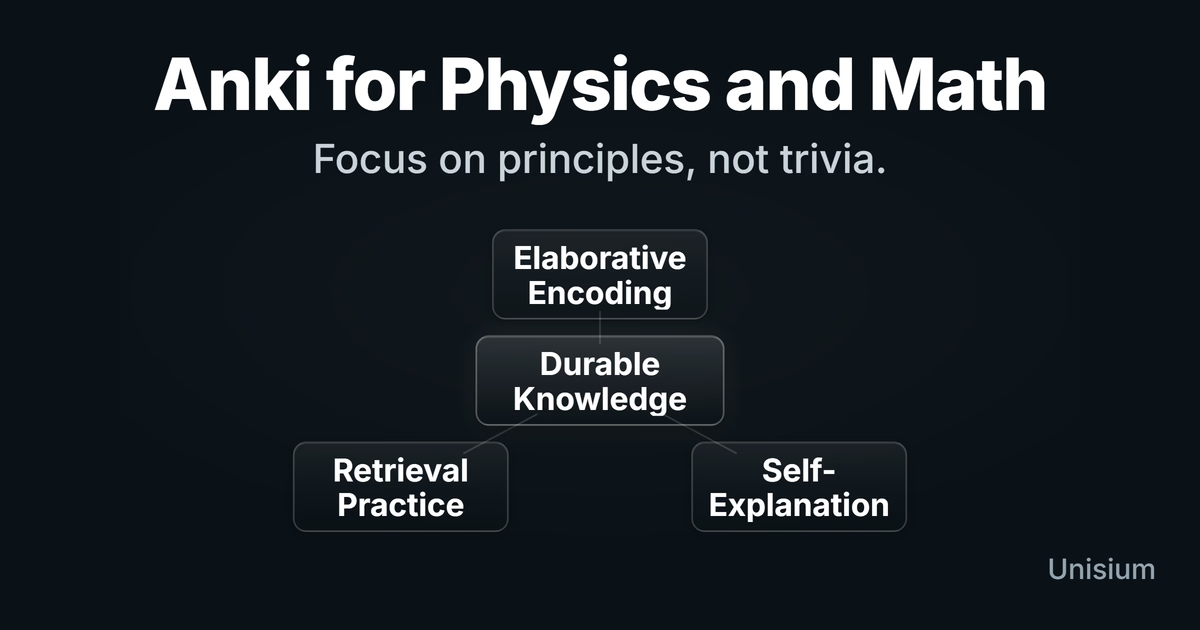
This guide uses the same principle-first learning framework behind the Unisium Study System: retrieval practice, elaborative encoding, self-explanation, and problem practice have different jobs. Anki can support the first three, but it should not take over the fourth.
Anki can schedule what comes back. It cannot turn memory, worked examples, and unfamiliar problems into a complete study process by itself. If that is the system you are trying to build, Masterful Learning shows how retrieval fits with connection, self-explanation, and problem solving.
On this page:
Simple System · What Counts as a Principle · Elaborative Cards · Retrieval Cards · Self-Explanation Cards · Course Workflow · AI Prompts · Common Mistakes · Where Anki Helps · Where Anki Stops · FAQ · How This Fits
The Simple System: Principles and Worked Solutions
For physics and math, the highest-value Anki cards come from a small system you can reuse across the course. Start with the knowledge structure, not with a pile of card formats.
Most useful cards fit one of two families:
1. Principle Cards
A principle is reusable knowledge with a stable shape:
- Name: what the principle is called.
- Representation: the equation, theorem statement, symbolic rule, diagram, or mathematical form.
- Conditions or assumptions: when the principle is allowed to be used.
- Role: what the principle does in study, such as representing a physical situation, representing a mathematical object, or transforming an expression or state.
Put that into a compact principle capsule, then build cards from the capsule.
Principle cards split into two subtypes:
- Retrieval principle cards ask for compact chunks: the name, representation, condition, assumption, or short statement.
- Elaborative principle cards ask reusable questions about meaning, structure, conditions, examples, contrasts, and use.
2. Worked-Solution Self-Explanation Cards
A worked-solution self-explanation card helps you learn from a rich solved example.
The front contains the problem and worked solution. Your task is not to solve the problem inside Anki. Your task is to explain why the solution works:
- which principles are used
- which conditions or assumptions are required
- how the setup, representation, or transformation works
- how the model reaches the goal
This is where cue-to-principle judgment begins to develop. The important cue recognition usually comes from explaining worked solutions and then doing new problems outside Anki.
What Counts as a Principle?
A principle is not just “an equation” or “a definition.” The equation is usually the representation of the principle. The name, representation, conditions, and role together make it useful.
Physics principles often represent physical situations: motion under constant acceleration, conservation in an isolated system, force balance, energy transfer, field behavior.
Math principles may represent mathematical objects or transform expressions and states: a derivative rule transforms a composite expression, a theorem gives a condition-bound guarantee, and a definition identifies the structure of an object.
Use this capsule format:
Principle capsule
- Name: Conservation of linear momentum
- Representation:
p_tot,i = p_tot,f - Condition: net external impulse on the system is zero
- Role: represents how total momentum stays fixed for an isolated system
Another example:
Principle capsule
- Name: Chain rule
- Representation:
d/dx f(g(x)) = f'(g(x))g'(x) - Condition: the outer and inner functions are differentiable where used
- Role: transforms the derivative of a composite expression
Once you have the capsule, card-making gets easier. You are not inventing a new format every time. You are deciding which part of the capsule to retrieve and which question about the capsule to elaborate.
Elaborative Encoding Cards for Principles
Elaborative encoding is the process of making a new idea meaningful by connecting it to what you already know.
Use elaborative Anki cards when a principle is not yet solid. These cards can be longer than retrieval cards because their job is not instant recall. Their job is to make the principle clearer each time you meet it.
The easiest workflow is:
- Write the principle capsule once.
- Copy the capsule onto the front of several cards.
- Put one reusable question on each card.
- Adjust the question slightly for physics vs math, or for representational vs transformational principles.
Most questions can be reused across many principles.
Reusable elaborative questions:
- What does this principle represent or transform?
- What does each symbol or part of the representation mean?
- What conditions or assumptions must be true?
- Why do those conditions matter?
- What is an example where this principle is useful?
- What is a nearby principle it is easy to confuse with?
- What is a common misuse of this principle?
- How does this principle connect to a principle I already know?
Example:
Front:
Principle capsule:
- Name: Conservation of mechanical energy
- Representation:
K_i + U_i = K_f + U_f - Condition: non-conservative work on the system is zero
Question: What does this principle represent, and why does the condition matter?
Back:
Mechanical energy is conserved when only conservative forces do work, or when non-conservative work is zero. The equation says the sum of kinetic and potential energy is the same at two states. It fails when friction, air resistance, applied forces, or other non-conservative work changes the mechanical energy of the system.
These cards are especially useful right after lectures, textbook reading, or AI tutoring conversations. They keep you from copying a sentence that sounded clear once but never became usable knowledge.
Retrieval Practice Cards for Principles
Retrieval practice is Anki’s home territory. Use it when a compact chunk of a principle needs to come back quickly.
Retrieval cards should stay narrow. They test:
- the name
- the representation or equation
- the condition or assumption
- the short principle statement
If the card asks “why,” “how,” “compare,” or “explain,” it belongs under elaborative encoding instead.
Example cloze cards:
{{c1::Conservation of linear momentum}}applies when the{{c2::net external impulse}}on the system is zero.- The total momentum equation is
{{c1::$\vec p_{\text{tot},i} = \vec p_{\text{tot},f}$}}. - The Mean Value Theorem requires
{{c1::continuity on [a,b]}}and{{c2::differentiability on (a,b)}}. - The derivative of a composite expression uses the
{{c1::chain rule}}.
Example front-back card:
Front:
State the work-energy theorem.
Back:
Keep retrieval cards compact and high-value. The point is not to explain the whole principle on every review. The point is to retrieve a precise chunk that carries meaning into later elaboration, self-explanation, and problem practice.
If a card is too vague, make it more specific. If it is too fragmented, reconnect it to the principle.
Self-Explanation Cards for Worked Solutions
Self-explanation is how you turn worked solutions into learning instead of passive reading.
This is the second major use of Anki in physics and math.
Use rich worked solutions, often exam-level or close to it. The value comes from repeatedly self-explaining a solution with enough structure to be difficult: several principles, a model, conditions, transformations, and a goal.
Front:
Problem statement + worked solution.
The solution may be structured with parts of the Five-Step Strategy, such as verbal decoding, visual decoding, model, procedures, and reflection. You do not need every part on every card. The front should give you enough structure to explain the solution without turning the card into a fresh problem attempt.
Your review task:
Move through the worked solution and explain why it works before checking the back.
Good front-side material:
- the problem statement
- the worked model or setup
- the equations used
- the algebraic or symbolic transformations
- a diagram instruction if a drawing is useful
- a reflection check, such as dimensional analysis or size assessment
Good self-explanation questions:
- Which principles are part of the model?
- Which conditions must be true for those principles to apply?
- How are the principles set up in this situation, and why this way?
- How is the model used to reach the goal of the problem?
Back:
Use a stable checklist:
- Which principles are part of the model?
- Which conditions must be true for those principles to apply?
- How are the principles set up in this situation, and why this way?
- How is the model used to reach the goal of the problem?
For example, a projectile-motion snowball card might put the full worked solution on the front: verbal decoding, a drawing instruction, horizontal and vertical kinematics equations, algebra eliminating time, the final launch speed, and a reflection check. The back does not need a second solution. It can simply prompt you to explain the principles used, the conditions required, how the kinematics model is set up, and how the model reaches the launch-speed goal.
You may need to explain the same solution multiple times over a period before everything clicks. That is the point of putting this in Anki: distributed attempts at better explanation. Once you can explain the solution cleanly without the back, suspend or delete the card.
A Simple Course Workflow
Here is a sustainable way to use Anki through a semester.
Before the Course
If you have access to a good shared deck, use it lightly to build a skeleton of the subject.
For introductory mechanics, that might mean:
Kinematics Anki Deck -> Forces & Newton’s Laws Anki Deck -> Work & Energy Anki Deck -> Momentum Anki Deck -> Rotational Kinematics Anki Deck -> Rotational Mechanics: Forces & Energy Anki Deck -> Rotational Mechanics: Angular Momentum Anki Deck.
The goal is not to master the course before it starts. The goal is to recognize core terms and equations so lectures and worked examples have more hooks.
If this is the summer before the course, see how to study math and physics over the summer for the wider pre-learning plan.
During the Course
Clear reviews in low-friction moments: before class, on a commute, or during a short study warm-up. If the daily loop does not start reliably, fix the start without willpower.
After lectures or problem sessions, add a small number of cards:
- one or two elaborative cards for new principles
- a few retrieval cards for definitions, equations, and conditions
- a worked-solution self-explanation card when a solution exposed a gap
If you use music during lighter review blocks, keep it low-interference and cut it when the session turns into real reasoning. The rule in Should You Listen to Music While Studying Math or Physics? fits Anki well: music can help you start, but lyrics and surprises are a bad trade once you need to think hard.
Use the rule of three: if you look up the same equation, condition, definition, or principle three times while doing problems, make a card.
Before Exams
In the final week, Anki should move into the background.
Use it to keep important knowledge warm, especially during low-quality time. But your best focus blocks should go to exam problems, mixed practice, and self-explaining worked solutions. If you start strong and then drop the system, build a motivation system around the smallest repeatable review loop.
Prune aggressively:
- suspend cards that no longer map to course tasks
- delete vague cards that only create stress
- stop adding new cards if the queue is stealing time from problem practice
- keep the principles that are still showing up in mistakes
When mixing problem types, interleave topics deliberately so you practice choosing among principles, not just executing a memorized sequence. See Interleaving for a simple rotation pattern.
Using AI to Build Better Anki Cards
AI can help you draft cards, but it should not decide what your deck means. You still need to connect the output to your course, textbook, and mistakes. For the broader frame, see How to Study Physics and Math with AI.
Use AI for four jobs:
1. Turning Notes into Principle Capsules
I am studying [topic] in [course]. From these notes, identify the reusable principles worth remembering. Do not make flashcards yet. For each principle, create a capsule with: name, representation or equation, conditions or assumptions, and role. Mark whether each principle mainly represents a situation/object or transforms an expression/state.
2. Drafting Elaborative Principle Cards
Use the principle capsules below to draft elaborative Anki cards. Copy the relevant capsule onto the front of each card and ask one reusable question per card: meaning, symbol interpretation, conditions, example, contrast, misuse, or connection to another principle. Keep the back focused on explanation, not just recall.
3. Drafting Retrieval Cards
Use the principle capsules below to draft focused retrieval cards. Test only compact chunks: name, representation/equation, condition, assumption, or short principle statement. Do not ask why/how/explain questions here; those belong in elaborative cards. Avoid hiding half a paragraph.
4. Structuring Worked Solutions for Self-Explanation
Here is a worked solution to a rich physics/math problem. Rewrite it as a self-explanation Anki card. Front: problem statement plus worked solution, including the model, equations, transformations, and a reflection check if useful. Back: a checklist asking which principles are part of the model, which conditions must be true, how the principles are set up in this situation, and how the model reaches the goal. Do not solve a different problem.
Then edit the cards yourself. AI can make plausible mistakes, especially with conditions, signs, units, and theorem assumptions. Verify against your notes or textbook before importing.
If you want import-ready output, ask for CSV formatting only after the cards are correct.
Advanced formatting tip: after the content is correct, use a real card as a formatting reference. Download a free Unisium mechanics deck such as the Kinematics Anki Deck, open a principle or self-explanation card in Anki’s editor, and look at how the front, back, MathJax, and spacing are structured. Then ask AI to format your checked card content in a similar style. Do this only after verifying the principle, equation, conditions, and worked solution; polished formatting does not fix weak content.
Common Failure Modes
1. Detached Fact Decks
You have hundreds of cards like “unit of force = newton” or “kinetic energy formula = …” but little connection to principles, conditions, or use.
Fix: Rebuild the important cards around principles. Include meaning and conditions, not just names and formulas.
2. Too Many Special Cases
You make a separate card for every problem variant. The deck grows quickly, but your judgment does not.
Fix: Ask which principle the example is teaching. Make one principle card and, if needed, one worked-solution self-explanation card.
3. Replacing Problems with Anki
Reviews feel productive, so you keep clearing the queue instead of doing hard problem practice.
Fix: Put Anki in low-quality time and warm-ups. Put your best focus time into problems, old exams, and self-explaining worked solutions. If you are tempted to swap real recall for a shallow memory dump, read Is Blurting Effective for Learning Math & Physics? Rarely.
4. Passive Review
You flip the card, read the back, and think, “Yes, I knew that.”
Fix: Say the answer out loud, write it quickly, or sketch the representation before flipping. If you cannot produce it, press Again.
5. Letting AI Build the Whole Deck
AI-generated decks often look polished but miss your course emphasis and your mistakes.
Fix: Use AI for drafts and structure. You choose the principles, verify the details, and delete cards that do not support real study.
Where Anki Helps Most
Anki helps most when the thing you keep forgetting is small enough to retrieve but important enough to reuse.
Use it for:
- equations you need often
- definitions that organize later work
- theorem assumptions and conditions
- principle statements
- short conceptual contrasts
- recurring mistakes in worked solutions
- prompts that make you explain why a principle applies
Anki is especially useful when your problem is not effort but availability: you learned the idea once, but it does not come back when the work gets harder.
Where Anki Stops
Anki is a scheduling engine. It does not know which principles matter most in your course, whether your explanation is good, or whether you can solve a new problem without cues.
That is why Anki should support, not replace:
- working through new problems
- comparing methods
- self-explaining worked solutions
- checking assumptions and conditions
- getting feedback from teachers, peers, textbooks, or tutors
If you enjoy designing your own decks and workflows, Anki can take you a long way. The patterns in this guide give it better inputs.
How This Fits in Unisium
The Unisium Study System uses the same learning strategies, but it does not leave every card, schedule, and next step to a separate deck. If you want guided retrieval, self-explanation, and problem practice inside one physics and math study flow, compare Unisium vs Anki. If you are choosing among several tools rather than comparing only Anki and Unisium, compare physics learning apps by the job they do.
FAQ
Is Anki good for physics and math?
Yes, if your cards target reusable knowledge: definitions, equations, principle statements, conditions, theorem assumptions, and worked-solution structure. Anki is useful for remembering what you need during study, but it does not replace doing problems.
What should I put on Anki cards for physics and math?
Start with principle cards. Make cards for equations, definitions, theorem assumptions, conditions, meaning, and common mistakes. Then add worked-solution self-explanation cards when you need to understand why a solution works.
Should I make cards for methods?
Sometimes, but avoid turning every method choice into a separate flashcard category. In physics and math, method choice usually depends on recognizing principles, conditions, models, and representations. That judgment is built through self-explaining worked solutions and doing new problems.
Should I use cloze deletion?
Yes, especially for equations, theorem assumptions, and conditions. Cloze works best when it hides one precise recall target, not half a paragraph.
How many new cards should I add per day?
Small is sustainable. Many students do better with 3-10 high-quality new cards per course per day than 30 low-quality ones. The real learning still needs problem practice and worked-solution self-explanation.
Should I download a shared deck?
A shared deck can be useful for pre-learning vocabulary, equations, and basic definitions. Treat it as a starting point, not the whole system. Suspend weak cards and add your own principle and self-explanation cards from your course.
Related Guides
- Retrieval practice for equations and conditions - Why pulling information out of your head works.
- Elaborative Encoding - How to connect ideas to make them stick.
- Self-Explanation - The strategy that turns examples into skills.
- Problem Solving - How to train the skills Anki is supporting.
- How to Study with AI - Using LLMs as a tutor, not a solver.
- Unisium vs Anki - When a flashcard system is enough, and when a guided study system makes more sense.
Ready to apply this strategy?
Unisium turns these evidence-based techniques into guided study sessions for math and physics. Places are limited during early access. Check current availability to start a trial; joining the mailing list is optional.
See plans and availability Read More GuidesAlready have access? Sign in