Note-Taking in Math and Physics Lectures: Why It Fails and What to Do
This is not a better note-taking system. It is a different way to use lectures: identify principles, reconstruct steps, and write questions you can ask while the professor, teaching assistants, and peers are still available.
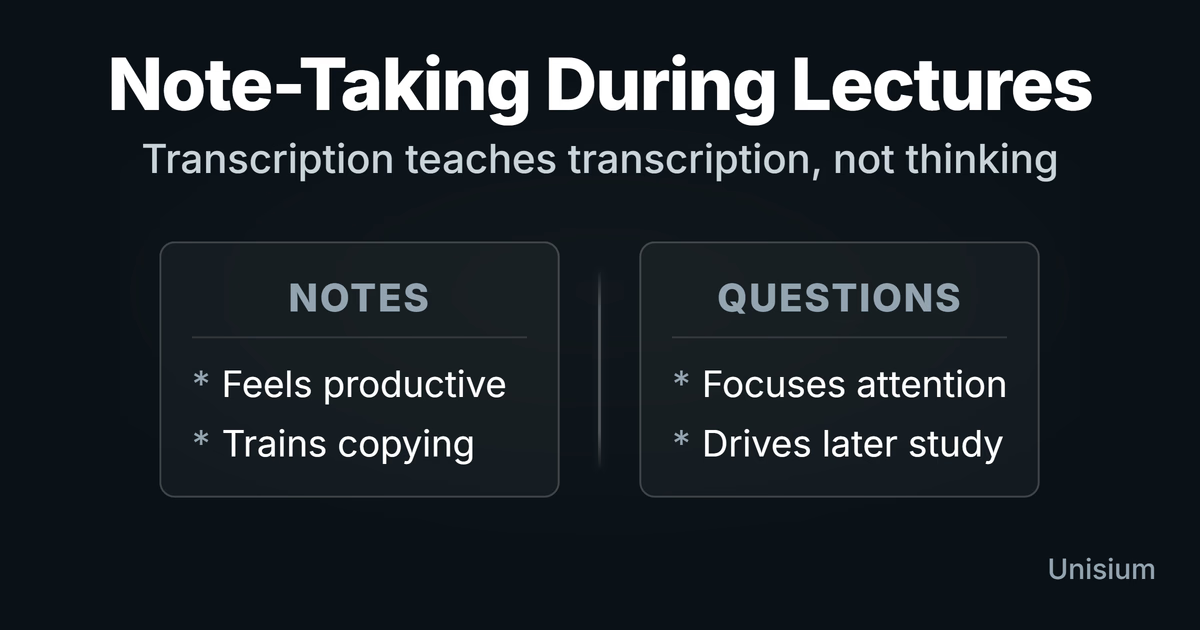
Detailed note-taking often moves your attention away from learning and into transcription. You may leave with more written material, but the opportunity cost is high: while you are copying, you are not identifying the principle behind the current step, seeing why it applies, or noticing the question that would move your understanding forward.
In a derivation or worked problem, your first job is to understand the current step before the next one arrives. Identify the principle behind the step and why it applies. Then try to rederive the step from the previous line. If you have time, predict what should come next.
Write only what helps you ask better questions:
- a question about the step you do not understand
- the equation, slide, or board line where the question belongs
- the principle you could not identify
- a compact pointer that helps you return to the confusion after class
Do not write a full derivation transcript. Textbooks, slides, professor’s notes, and course materials are usually better sources for transcript-level detail than anything you can produce while half-following and half-copying.
The aspect I enjoyed most about teaching classical mechanics was when students asked questions in the breaks or after class. A specific question about a principle or derivation step is not a nuisance. It is the kind of thinking a lecture should provoke.
The learning principle is simple: you improve at the cognitive work you practice. Transcription trains transcription. Identifying principles, reconstructing steps, asking questions, and explaining solutions train the work you need later.
Looking for Cornell notes, outline notes, Zettelkasten, rewriting, or aesthetic notes? Jump to how common note-taking systems compare for math and physics.
On this page: Why Note-Taking Fails | What to Do Instead | When Brief Notes Are Useful | Common Methods | Common Mistakes | FAQ
Why Note-Taking During Lectures Fails
In derivation-at-the-board lecture formats—where an instructor derives equations while you frantically copy them down—adding note-taking only makes things worse.
Divides attention. When you’re focused on capturing everything the professor writes, you’re not thinking critically about concepts, connecting ideas to prior knowledge, or identifying gaps in understanding.
Trains the wrong skill. You practice transcription. And that’s what you learn: to transcribe. Not to recognize patterns, select principles, build mental models, or execute solutions fluently.
Creates false comfort. Having complete notes feels productive and secure. But having notes and understanding the material are completely different things.
Leads to more wasted time. Reading your notes (passive exposure), rereading your notes (even less effective), copying your notes (pure transcription practice)—all activities that steal time from strategies that work.
Note-taking becomes a form of procrastination—a missed opportunity to engage with the material while it’s being presented.
Note-Taking vs. Learning: What You’re Practicing
| During Lecture | Note-Taking Approach | Active Learning Approach |
|---|---|---|
| Attention | On transcribing symbols and words | On connections and meaning |
| Skill practiced | Fast copying | Pattern recognition, principle selection |
| Cognitive load | Split between writing and understanding | Focused on understanding |
| Post-lecture | Reading notes (passive) | Self-explaining and problem solving (active) |
| Long-term result | Good at transcription | Good at problem solving |
The bottom line: You learn what you practice. Transcription trains transcription, not understanding.
What to Do Instead of Taking Notes During Lectures
Ready to swap transcription for learning? Here is the lecture-specific job.
During Lecture: Active Reasoning
Instead of copying, use the board, slides, and spoken explanation as prompts for live reasoning:
- Understand the current step before the next one arrives.
- Identify the principle behind the step and why it applies.
- Reconstruct the step from the previous line if you can.
- Predict the next step when you have enough attention left.
Generate questions as soon as you lose the thread. Jot down the question and enough context to ask it later: the equation, slide, example, or board line where the confusion belongs. This is elaborative encoding in action. You are processing what you do not yet understand instead of recording symbols you have not processed.
The goal is live reasoning and question generation, not recording.
After Lecture: Get Your Questions Answered First
Your most valuable lecture notes are not polished summaries. They are good questions tied to specific moments in the lecture.
Right after class, look at the questions you wrote down. Start with the ones that block your understanding of a derivation, principle, or worked example. The best option is often to ask the professor during the break or immediately after the lecture.
When I taught classical mechanics, those questions were among the parts of teaching I enjoyed most. A student who asks, “I understand the previous line, but I cannot see why this principle applies here,” is not wasting the lecturer’s time. That student is doing the kind of thinking the lecture is supposed to support.
Useful questions sound like this:
- “On this line, which principle are we using?”
- “What makes this transformation valid?”
- “I understand the previous step, but I cannot rederive this step. What am I missing?”
- “Why does this principle apply here but not in the previous example?”
Peers are also valuable. A short discussion after lecture can show whether your confusion is personal, shared, or caused by a missing assumption.
After your lecture questions are resolved, move into self-study. Use the textbook, slides, or official notes for details, then use effective learning strategies such as self-explanation, problem solving, and retrieval practice. But do not confuse later self-study with the lecture-specific job: follow the reasoning, find the gaps, and get your best questions answered while the teaching situation is still alive.
The Social Reason to Attend Lectures
There is another reason not to treat lectures as private transcription sessions: lectures put you near other people learning the same material.
That matters. Students you talk to before and after class can become study partners, friends, and part of your academic network. A short conversation about a confusing derivation can turn into a problem-solving group.
This social side is not separate from learning. Feeling connected to other students makes it easier to keep showing up, ask questions, and stay engaged when the material gets difficult. It is one reason lectures can still matter even when textbooks, videos, slides, and AI tools can deliver content outside the classroom. For the motivation side of this, see Motivation in Math and Physics.
So do not use lectures only to copy. Use them to notice confusion, ask better questions, and become part of the group studying the subject.
When Brief Notes Are Still Useful
This guide is not saying that writing is forbidden. It is saying that transcription should not be the main activity.
Brief notes are useful when they support thinking:
- Question notes: the question you want to ask, plus the step, slide, equation, or example where it belongs.
- Principle notes: the principle you could not identify, or the reason you could not see why it applies.
- Notation notes: symbols or conventions that differ from the textbook.
- Recovery notes: a compact pointer that helps you find the relevant place in the slides, textbook, or board derivation later.
Brief notes become harmful when they replace attention. If you are writing so much that you stop identifying principles, reconstructing steps, predicting what comes next, or asking questions, you have crossed back into transcription.
Evaluating Common Note-Taking Systems
If you came here because you are choosing a note-taking method, the main question is not which format looks best. The question is whether the method forces active processing in math and physics, or whether it gives transcription a nicer wrapper.
Better Options With Modifications
- Cornell Notes: Useful if the cue column becomes retrieval practice and the summary becomes elaboration. Weak if it is just a cleaner transcript.
- Outline Method: Useful for definitions and hierarchy, but often weak for derivations. Use it for initial capture, not deep study.
- Zettelkasten: Useful for deep synthesis and writing, but inefficient for exam fluency. Use it to connect ideas, not to memorize worked examples.
Avoid as Primary Study Methods
- Rewriting Notes: Usually delayed transcription. It feels productive because it makes clean pages, not because it trains problem solving.
- Aesthetic Notes: Optimizes for visual appeal, not cognitive load. Often a form of procrastination.
- Progressive Summarization: Good for finding text later, but risky for math because compressing notation can strip the conditions you need to solve problems.
Common Mistakes
- Trying to capture every derivation: This feels safe, but it splits the attention you need for real understanding.
- Turning post-class study into note cleanup: Rewriting or beautifying notes is usually delayed transcription, not learning.
- Confusing question prompts with real engagement: A short question list helps; a page of copied symbols does not.
- Treating notes as the main study artifact: The real post-lecture work is still self-explanation, retrieval, and problem solving.
Is it possible to turn note-taking into an effective learning strategy?
To make note-taking effective, you must change it into something else than what is typically called note-taking. At that point, calling it “note-taking” becomes misleading.
Question generation is valuable. During lectures, write down genuine questions as they arise: “Why does this principle apply here but not in the previous example?” “What makes this step valid?” These questions guide your post-lecture learning and make office hours productive. This is elaborative encoding—actively processing what you don’t yet understand—not transcription.
Post-problem reflections help. After solving problems, you might capture patterns (“when forces are perpendicular, use component method”) or record errors and why you made them. But this is reflection and pattern extraction, not note-taking.
Elaborative note-taking systems (Cornell notes, concept mapping, etc.) can be more effective than passive transcription because they involve hypothesis generation and connection-making—introducing elaborative encoding. But you still can’t escape the fundamental constraint: during lectures, someone else controls the rate and order of information. Your cognitive effort is better spent on understanding and generating questions than on recording what’s being presented.
Try It for One Lecture
For one lecture, do not try to build a full transcript. Focus entirely on following the reasoning and generating questions. After class, use your questions to guide self-study: self-explain a worked example, then solve problems using the Five-Step Strategy in physics or an analogous forward-reasoning structure in math.
Track what happens. Do you understand the material better? Can you solve problems more confidently? Give it 2-3 weeks. Habit change is uncomfortable at first, but the payoff is that your class time starts training the same reasoning you need in exams.
If you are prepping for a big written exam, tie these habits into Why You’re Not Ready for the Math and Physics Exam (and What to Do Instead). It sequences retrieval, problem solving, Hint & Try, self-explanation, and elaborative encoding around old exams.
The Research Support
This isn’t just opinion—cognitive science research consistently shows:
- Generation effects: Material you generate yourself (through thinking) is remembered better than material you passively record
- Desirable difficulties: Strategies that feel harder during learning (like retrieval practice) produce better long-term retention
- Transfer-appropriate processing: You learn what you practice—transcription trains transcription, not understanding
For the complete research foundation behind these strategies, see the Learning Literature guide.
FAQ: Common Questions About Note-Taking During Lectures
Should I stop taking notes during lectures entirely?
Yes, pause note-taking during lectures. Use class time for reasoning—predicting steps, identifying principles, flagging confusion. Take short, structured notes after thinking: errors you made, patterns you spotted, condition→action→goal rules you’ve generated through problem solving.
Are laptop notes better than handwriting?
The medium doesn’t matter if both involve transcription. Learning gains come from generation (creating understanding) and retrieval (testing recall), not from typing vs. writing. Focus on the cognitive process, not the tool.
What if my course is derivation-heavy (like theoretical physics or pure math)?
Track principles instead of copying symbols. During lecture, focus on why each step is valid and why the principle applies. Post-class, self-explain one worked example from your textbook, then solve problems to build fluency. The understanding comes from actively reconstructing the logic, not from having a transcript.
Won’t I miss important details without notes?
Use official materials for details. Your professor’s slides, textbook explanations, and worked examples are more accurate and complete than anything you’d capture while divided attention. Invest your cognitive effort in understanding and application, not transcription.
What about elaborative note-taking systems (like Cornell notes)?
They’re better than passive transcription because they involve question formulation and synthesis—see Cornell Notes for how to upgrade the format. But they still face a fundamental constraint: someone else controls the rate and order of information during lectures. You’ll learn more by engaging actively during class, then working through materials at your own pace afterward.
How do I stay engaged without writing?
Make it active:
- Predict what comes next before the professor writes it
- Identify which principle applies and why
- Notice your confusion points in real-time
- Connect to previous examples
- Generate questions when something is unclear
You can (and should) write down questions as they arise—but that’s elaborative encoding, not transcription. This is harder than transcribing—which is exactly why it works better.
The Bottom Line
Note-taking during traditional lectures is popular because it feels productive. But feeling productive and learning are different things.
What note-taking teaches you: How to transcribe quickly.
What you need: To recognize problem structures, select principles, and execute solutions.
The gap between these is why so many students feel busy but not improving.
Related Learning Guides
Self-Explanation: Learning from Worked Solutions — Turn worked examples into reliable problem-solving skill through principle-driven explanation. This is what you should do after lectures instead of reviewing notes.
Mind Maps vs Concept Maps — If you want to diagram relationships, use concept maps with labeled links—not radial mind maps that hide the logic.
Problem Solving: Turn Knowledge into Skill — Use problems deliberately to convert principles into automatic skill. The core active learning strategy alongside self-explanation and retrieval practice.
Five-Step Strategy — A physics-specific framework for systematic problem-solving, built on forward reasoning rather than formula hunting.
Principle Structures: Building Mental Frameworks — Learn how to organize knowledge into powerful mental frameworks using retrieval practice and spatial anchoring.
Highlighting and Underlining: Why They Don’t Work — Another popular strategy that creates the illusion of learning. The same principles apply to all passive study methods.
Learning Literature: The Research Behind Effective Study Techniques — Explore the complete cognitive science foundation behind retrieval practice, elaborative encoding, and self-explanation.
How This Fits in Unisium
Unisium turns “do not transcribe - think” into a default workflow: you answer questions first, self-explain worked examples, and solve problems before seeing full solutions. That is the Unisium Study System applied to lecture-heavy courses: class time produces questions and confusion points, and your next study session turns them into retrievable, usable knowledge. Check access and join the Unisium waitlist or use Masterful Learning for the broader framework.
← Prev: Highlighting and Underlining | Next → Elaborative Encoding
A note on scope: This guide focuses on traditional lecture formats where instructors derive equations while students copy them down. Some lecture styles—particularly those incorporating active learning, demonstrations, or conceptual questions—provide value beyond transcription. The key question: Am I learning, or am I just recording? (For a full guide on how to get value from different lecture styles, see How to Use Lectures, Workshops, and Other Learning Offers Effectively).
Ready to apply this strategy?
Unisium turns these evidence-based techniques into guided study sessions for math and physics. Places are limited during early access. Check current availability to start a trial; joining the mailing list is optional.
See plans and availability Read More GuidesAlready have access? Sign in