Does Highlighting Help You Study Math and Physics? Usually Not
Highlighting and underlining are weak study tools for math and physics. They can help you mark principles, definitions, conditions, and worked-example steps you want to return to later, but highlighting alone does not build understanding. Use it, at most, to collect material for better study: questions, principles, equation sheets, condition checks, explanations, and retrieval practice.
If you rely on highlighting while reading math or physics textbooks, you are probably wasting a lot of study time.
The problem with highlighting is that it lets you postpone the thinking that builds understanding. You mark a formula, definition, or worked step and feel like you have done something useful. But the real work is still waiting: What does this mean? What principle is this? When does it apply? Why does this step follow? How would I know to use it in a new problem?
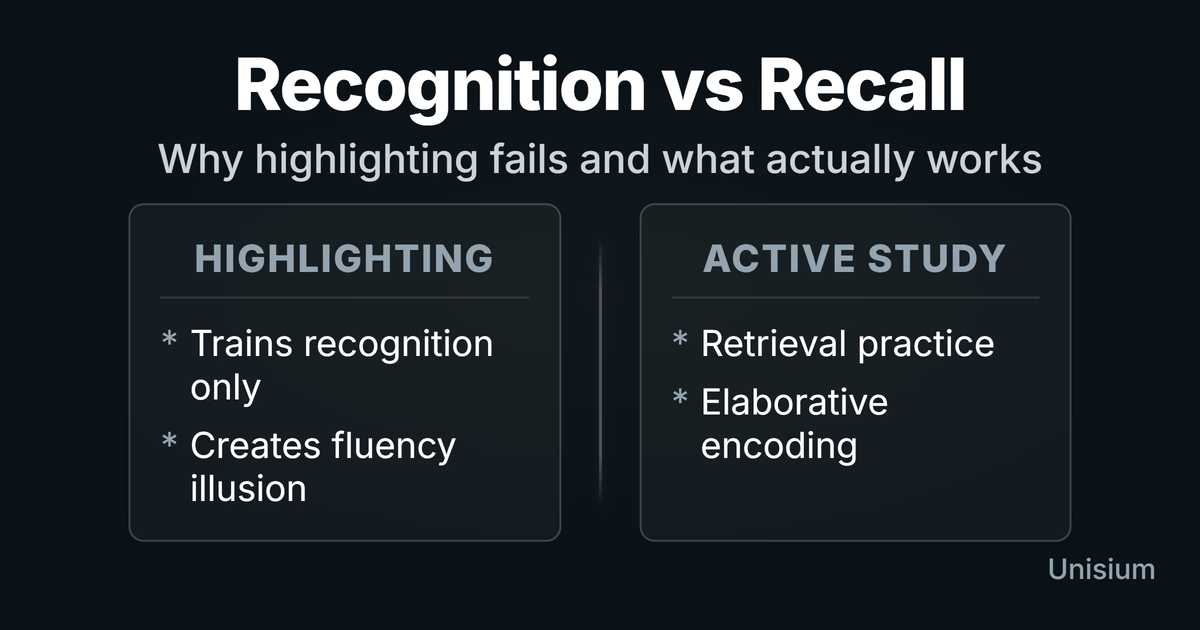
Highlighting also makes rereading look like a plan. You mark the important parts now, then promise yourself you will come back later and learn them properly. But when you reread highlighted text, it often feels familiar because you have seen it before. That familiar feeling can be misleading: recognition can feel like understanding even when you still cannot explain the idea, check its conditions, or use it in a problem. In learning science, this is one form of the fluency illusion.
The better textbook habit is not to color more carefully. It is to turn important material into usable knowledge. Identify key equations, names, assumptions, conditions, and examples. Ask yourself what each principle means, when it works, when it fails, and why each worked-example step follows. If highlighting replaces that thinking, it is not studying; it is just marking text. If highlighting helps you collect those pieces for a principle sheet or equation sheet, that can be useful.
On this page: Why it fails · What to do instead · When it might help · Quick comparison · FAQ · How This Fits
For a broader look at the passive techniques that steal time and what to do instead, see 6 Ineffective Study Techniques (and What to Do Instead).
Why Highlighting and Underlining Underperform
1) They Reward Selection, Not Understanding
You practice marking lines with a highlighter. Your brain gets trained at identifying candidate text—not at building models, extracting principles, or linking concepts. The outcome: a book with neon stripes and a brain with shallow traces. Using a highlighter looks productive. It’s not.
2) They Delay Thinking
Highlighting defers the elaboration you need to do now:
- What does this mean, precisely?
- When does it apply?
- How does it differ from related ideas?
You tell yourself “I’ll think about it later,” then never do the hard pass. The highlighting becomes a procrastination device—fix the start without willpower.
3) They Inflate Confidence
On the second read, highlighted text looks familiar → fluency illusion → overestimation of preparedness. You’ve seen it before. It feels like you know it. This is one of the big learning myths that quietly derails progress.
But: Familiarity is not understanding. Recognition is not recall.
4) They Don’t Map to Performance
There are no exact sentences to reproduce on exams. Performance requires:
- Recognizing problem structures and principles
- Knowing conditions of use (when principles apply, when they don’t)
- Executing procedures (solving novel problems)
Highlighters train none of that.
The Illusion of Productivity
Highlighting feels productive because:
- You’re making micro-decisions (important? yes/no)
- You’re creating a visual artifact (a marked-up textbook)
- You’re doing something while reading
But effort and learning are decoupled. You learn what you practice. Highlighting practices selection and aesthetics. Learning requires generation, explanation, and testing. Like other ineffective study methods, it trades the illusion of work for actual learning.
What to Do Instead of Highlighting
Do not replace highlighting with another ritual. Replace it with the thinking the mark is postponing.
| Highlighting gives you | Missing operation | Better replacement |
|---|---|---|
| Familiarity | Recall without the page | Retrieval Practice |
| Marked sentences | Meaning and conditions | Elaborative Encoding |
| Passive solution exposure | Step-by-step reasoning | Self-Explanation |
| Visual organization | Knowing when to use an idea | Principle and condition checking |
When you reach a sentence you want to highlight, stop and ask what work the highlight is avoiding:
- Meaning: What does this say in my own words?
- Conditions: When is it valid, and what would break it?
- Recall: Could I produce the key idea without looking?
- Use: Where would this show up in a problem, derivation, or explanation?
For math and physics, this is the real replacement: turn a marked line into a principle, condition, contrast, or explanation you can use later. If the highlighted sentence is a definition, retrieve the definition and one example. If it is a formula, state the name, form, and conditions. If it is a worked step, explain why that step follows instead of merely marking it.
If you insist on highlighting, use it to harvest pieces you will process afterward: principle names, general equations, assumptions, conditions of application, examples, and near-misses. Then compile them into a principle structure or equation sheet. The learning comes from the explanation, condition check, organization, and retrieval attempt, not from the ink.
When Highlighting Can (Narrowly) Help
Information retrieval for projects/writing. Mark passages you’ll cite later. This is document management, not study. Acceptable use case.
Anchors for navigation. If you must highlight, mark only key definitions and principle names—minimal landmarks for later active work.
Signal: If you’re coloring more than 5–10% of a page, you’re decorating, not thinking.
Quick Comparison: Highlighting vs. Effective Alternatives
| Goal | Highlighting | Effective Alternative |
|---|---|---|
| Understand meaning | Weak (labels only) | Strong: Elaborative Encoding questions |
| Know when it applies | None | Strong: Conditions during self-explanation |
| Recall under pressure | Weak (recognition only) | Strong: Retrieval Practice with spacing |
| Solve new problems | None | Strong: Problem Solving + Five-Step Strategy |
FAQ
Should I stop highlighting completely?
For learning, yes. Use highlights only as bookmarks for projects. For studying, redirect the time to elaboration, self-explanation, and retrieval. Why highlighting doesn’t work for studying is simple: you’re practicing the wrong skill.
What if highlighting keeps me engaged while reading?
Use margin prompts instead. Write a 5-word question in the margin (e.g., “When does this fail?” or “What condition makes this true?”). Then answer it aloud. Engagement via thinking, not ink.
Is color-coding ever useful?
Only as a visual support for structure you already understand. For example, color by principle type (definitions in green, conditions in yellow, examples in blue) after you’ve encoded the content. Never as a substitute for understanding.
What if my professor says highlighting is important?
That’s a signal about what your professor values—not what your brain needs. Your professor likely wants you to be selective when citing sources for papers (reasonable). For learning, the evidence base is stronger for generation, retrieval, feedback, and testing than for highlighting as a primary study method. See the learning literature guide for the research background.
How This Fits in Unisium
Unisium turns the missing operations into the study flow for physics and math: explain concepts, state conditions, retrieve from memory, and practice using ideas instead of only recognizing them. That’s the Unisium Study System applied to real technical study, not passive marking or rereading. Ready to try it? Check access and join the Unisium waitlist or explore the full framework in Masterful Learning.
Related Guides
- Elaborative Encoding — Build meaningful connections that enable recall and transfer.
- Self-Explanation — Turn worked examples into retrievable solution rules.
- Retrieval Practice — Make knowledge fast and durable through spacing and recall.
- Problem Solving — Turn principles into automatic skill through deliberate practice.
- Five-Step Strategy — A physics-specific framework for systematic problem-solving.
- Note-Taking During Lectures — Why this popular strategy also fails—and what works instead.
← Prev: Note-Taking During Lectures | Next → Elaborative Encoding
Ready to apply this strategy?
Unisium turns these evidence-based techniques into guided study sessions for math and physics. Places are limited during early access. Check current availability to start a trial; joining the mailing list is optional.
See plans and availability Read More GuidesAlready have access? Sign in