Mind Maps vs Concept Maps: Better for STEM Learning
Concept maps beat mind maps for learning physics and math. Mind maps help you brainstorm, but unlabeled branches hide the relationship you need to solve problems. Concept maps force you to write a claim on every link (“depends on”, “is a case of”, “determines”), so you can test, correct, and retrieve the structure later—the kind of knowledge the Unisium Study System is built to train.
Visualizing knowledge is powerful, but not all diagrams are created equal. In Unisium, we prioritize structure and relationships over loose association. Physics isn’t a bag of related words; it’s a rigorous logical structure.
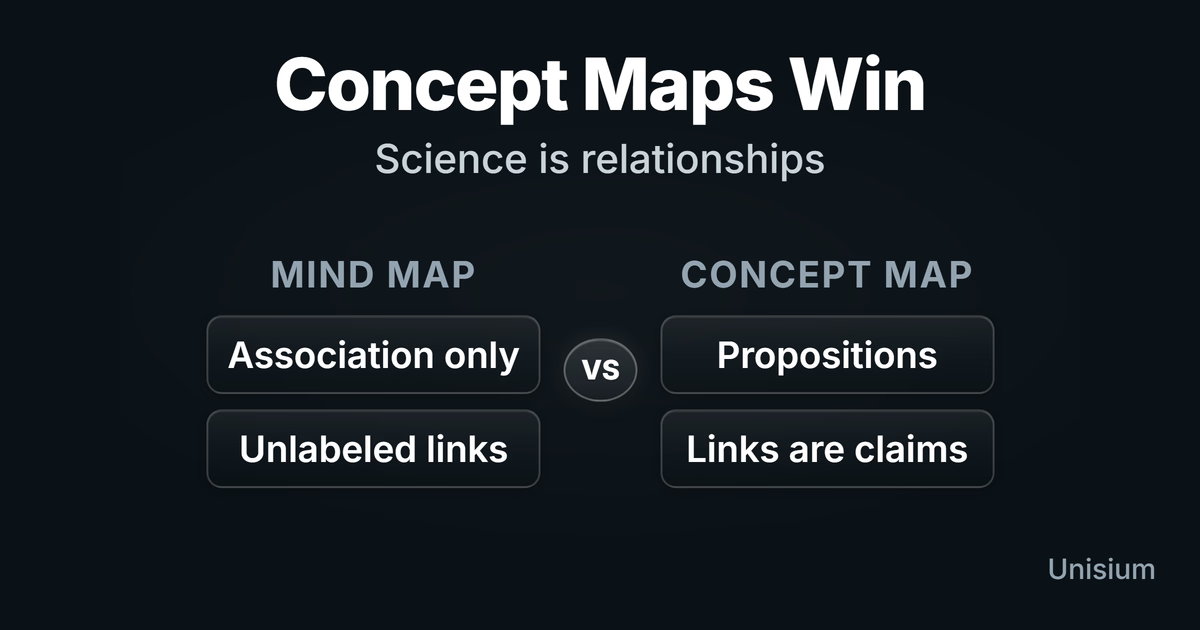
Mind maps capture association. Concept maps force relationships. STEM runs on relationships.
On this page: The Difference · Can It Be Salvaged? · How To Make One · Common Mistakes · Start Now · FAQ · How This Fits
The Core Difference
| Feature | Mind Map | Concept Map |
|---|---|---|
| Structure | Radial (center out) | Often hierarchical (top down) |
| Links | Associative (lines only) | Relational (labeled links) |
| Focus | Brainstorming, exploration | Relationships you can test |
| Best for | Generating ideas | Understanding systems |
Mind Maps are about association. You put “Energy” in the middle and branch out to “Sun,” “Food,” “Movement.” It shows that things are related, but not how.
Concept Maps are about propositions. You connect “Net force” to “Acceleration” with a labeled link like “determines.” This forms a claim you can check.
Want the complete framework behind this guide? Read Masterful Learning.
Can It Be Salvaged?
Mind maps are often ineffective because they are associative (“this reminds me of that”) rather than logical (“this causes that”). To salvage them, you must upgrade to Concept Maps.
1. Explicit Relationships Concept maps force you to label the line. You can’t just draw a line; you have to decide if the relationship is “increases,” “opposes,” “is conserved in,” or “is the derivative of.” This turns the map into a set of testable claims, similar to the Feynman Technique.
2. Hierarchical Organization Knowledge in physics is hierarchical. Newton’s Laws are fundamental; friction is a specific force. Concept maps visually represent this hierarchy, helping you organize your principle structures.
3. Cross-Links Concept maps encourage linking different branches. This is where deep understanding happens. Like Summarizing, the goal is to restructure your knowledge, not just list it.
Skeptical take: If your diagram can’t be read as sentences, it’s decoration. Science knowledge is relationships you can state and check.
How to Make a Concept Map (Step by Step)
Best Workflow
Start with a quick mind map (3 minutes) to dump your brain. Get all the terms out. Then, switch to concept mapping: arrange them and force yourself to label the connections. Use mind maps to generate nodes; use concept maps to test links.
Finally, check your map against the textbook. Did you get the relationships right? This combines elaborative encoding (building connections) with retrieval practice (reconstructing them from memory).
Step 1: List Key Concepts
Write down 10-15 key terms for the topic (e.g., Force, Mass, Acceleration, Velocity, Position, Time).
Step 2: Arrange Hierarchically
Place the most general, inclusive concepts at the top (e.g., “Dynamics”). Place specific concepts below them.
Step 3: Link and Label
Draw lines between related concepts. Crucial Step: You MUST label the line with a verb or phrase that explains the relationship.
- Example: Velocity —(is the time derivative of)—> Position.
- Example: Net Force —(determines, via )—> Acceleration.
Step 4: Add Cross-Links
Look for connections between different “branches” of your map. Does a concept on the left relate to one on the right? Link them.
Common Mistakes (and the Fix)
| Mistake | Fix |
|---|---|
| No Labels | A line without a label is a guess. Label every connection to make it a proposition. |
| Spider Web | Don’t radiate from the center. Build a structure that flows logically (usually top-down). |
| Too Many Words | Nodes should be single concepts (1-3 words). The explanation goes in the linking phrases. |
| Passive Copying | Don’t copy a map from the book. Build it from memory as a form of retrieval practice. |
Start Now (15 minutes)
Map your current chapter:
- List the 10 most important terms.
- Arrange them on a blank sheet.
- Connect them with labeled arrows.
- Check: Does every arrow form a true sentence?
FAQ
Can I use mind maps at all?
Yes, for initial brainstorming or essay planning. But when you need to understand how a system works, switch to concept mapping.
Can I do this during lectures?
It’s hard to do well in real-time. Instead, capture the key terms (nodes) during class, then build the map afterwards as part of your post-lecture workflow.
Should I use software?
Paper is often better for learning. It’s faster, less distracting, and the physical act of drawing helps memory. Use software only for final reference sheets.
Is this a form of retrieval practice?
If you do it closed-book, yes! “Blurt mapping” (drawing a map from memory) is an excellent retrieval exercise.
How This Fits in Unisium
Concept mapping is a powerful tool for elaborative encoding, a key component of Masterful Learning. By using concept maps to build your principle structures, you force yourself to self-explain the relationships between concepts. Drawing these maps from memory forces reconstruction, ensuring you own the knowledge rather than just recognizing it.
Pair concept maps with Cornell Notes (use the summary box to sketch the map) or the Feynman Technique (translate the map back into plain-language explanation).
Ready to try it? Check access and join the Unisium waitlist or explore the full framework in Masterful Learning.
Next Steps
- Do instead: Elaborative Encoding
- Big picture: Ineffective Study Techniques
Masterful Learning
The book behind these guides: a study system for physics, math, & programming built on retrieval, connection, explanation, and problem solving.
Ready to apply this strategy?
Unisium turns these evidence-based techniques into guided study sessions for math and physics. Places are limited during early access. Check current availability to start a trial; joining the mailing list is optional.
See plans and availability Read More GuidesAlready have access? Sign in