Is the Outline Method effective for learning math and physics? Usually no
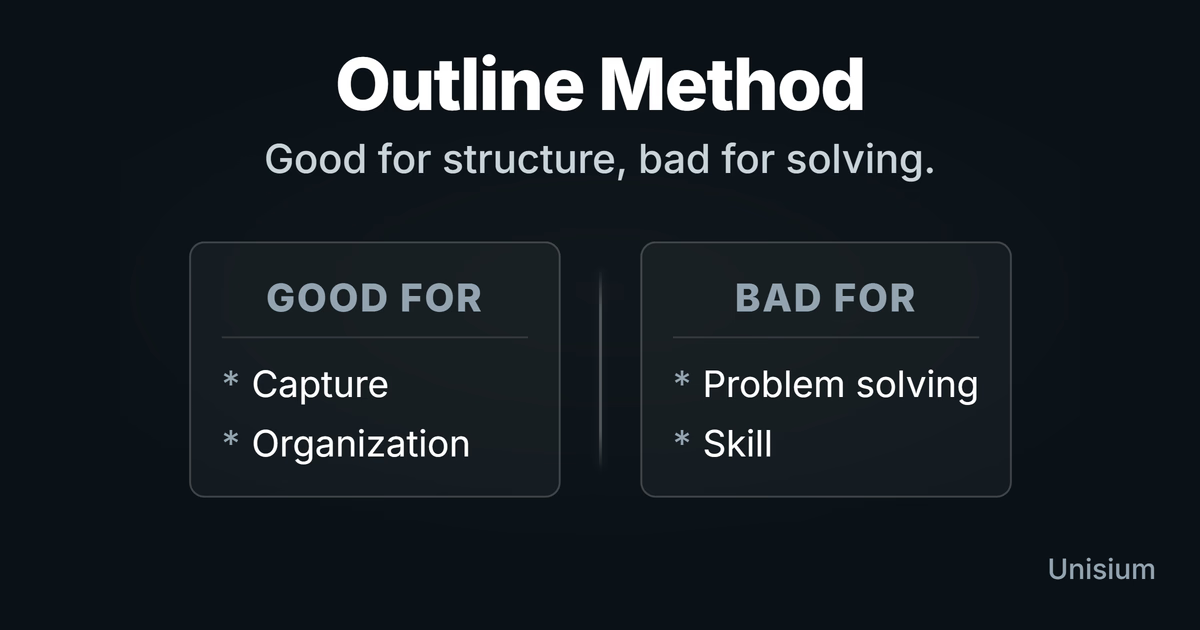
The Outline Method is a hierarchical note-taking system that uses indented bullet points to show relationships between main topics and subtopics. It works by enforcing a strict parent-child structure, which helps organize declarative knowledge like definitions and theorems. However, for math and physics students in the Unisium Study System, it often fails to capture the nonlinear connections and step-by-step derivations required for deep problem-solving.
On this page: Why It Works (and Fails) · When to Use It · How to Adapt It · Start Now · Comparison · FAQ
Why It Works (and Fails)
The Outline Method is seductive because it looks clean. You start with a main topic (I. Newton’s Laws), indent for a subtopic (A. Second Law), and indent again for details (1. ). This structure forces you to categorize information immediately, which reduces cognitive load during a fast-paced lecture.
The Mechanism: Hierarchy vs. Linearity
Outlining relies on hierarchical classification, assuming that every piece of information belongs strictly “inside” a larger category. This mirrors how textbooks are organized (Chapter > Section > Subsection), making it excellent for summarizing reading material or capturing the “what” of a subject. However, it often creates “organized non-knowledge” because it doesn’t force you to generate the causal links between steps. If your outline feels clean but you can’t produce the next line in a derivation without looking, the method is acting like a fluency illusion amplifier.
The Failure Mode: Math is a Graph
Math and physics are not strictly hierarchical trees; they are interconnected graphs where a concept like “Energy” appears in mechanics, thermodynamics, and electromagnetism. If you bury “Energy” under “Mechanics > Work,” you might miss its connection to “Capacitors” later on. Furthermore, derivations and problem-solving are linear and sequential, not hierarchical; forcing a derivation into a bulleted list often breaks the logical flow or hides the “because” link between steps.
When to Use It
Despite its limitations, the Outline Method has a specific place in the Unisium Study System as a tool for initial capture of declarative knowledge. It is not a primary method for building derivation skill or problem-solving fluency.
Decision Rule
Use the Outline Method if the content is definition-heavy, you need fast navigation, and you are disciplined about converting bullets into prompts later. Avoid it as your main tool if you need to master derivations, are preparing for timed problem solving, or tend to reread organized notes without testing yourself.
Use it for:
- Capturing Lecture Theory: When a professor is listing properties, definitions, or conditions for a theorem. These fit naturally into a list.
- Indexing Textbook Summaries: When you are doing a first pass of a chapter to understand the scope of the material.
- Building Taxonomies: Classifying types of forces, particles, or mathematical functions.
Do NOT use it for:
- Derivations: Use a linear block of math with side-notes for justification.
- Problem Solving: Use the Five-Step Strategy instead.
- Complex Relationships: Use Concept Maps to show how concepts across different chapters relate.
How to Adapt It for Math
If you prefer the cleanliness of outlines, you must adapt them to handle the density of math and physics. Standard text bullets are not enough to drive deep learning.
1. The “Because-Layer” (Elaboration)
For any non-trivial bullet, require one child bullet that answers why or how you know. Instead of just writing “Conservation of momentum,” add a child bullet: “Condition: isolated system (net external impulse )” and “Because: internal forces cancel pairwise (Newton 3).” This forces elaborative encoding into the outline structure.
2. The “Test-Layer” (Retrieval)
Turn your outline into a question bank by adding a prompt and a trap for each top-level node. For example, add “Prompt: State it + conditions from memory” and “Trap: What’s the common misapplication?” This converts the outline from a passive storage system into an active retrieval practice tool. Outlines don’t produce spacing or interleaving; you only get those benefits if you review by recall and mix prompts across branches.
3. The “Math Block” Exception
Never force a derivation into sub-bullets. When you reach a derivation, break the outline structure and insert a “Math Block”—a distinct section where you write the derivation linearly, step-by-step, without indentation. Resume the outline after the derivation is complete to preserve the logical flow.
4. Aggressive Cross-Linking
Since outlines hide lateral connections, you must add them explicitly to prevent the “tree” from hiding the “web.” If you write a bullet about “Electric Potential Energy,” add a tag or arrow saying “See also: Gravitational Potential Energy (Section II.B).” This mimics the connectivity of a Zettelkasten.
Start Now (5 minutes)
You can test if the Outline Method is working for you by auditing your last set of notes.
- Pick one topic: Find a section in your notes where you outlined a derivation or a complex concept.
- Check for “Because”: Do your sub-bullets explain why the step happened, or just what happened? If they are just labels, add a “Because-Layer” bullet now.
- Check for Connections: Find one concept in that outline that relates to a different chapter. Draw a physical arrow or write a “See also” link to that other topic.
- The Trade-off: If this took more than 2 minutes to fix, the Outline Method might be costing you too much in maintenance. Consider switching to linear notes with Cornell cues for faster capture.
Comparison
- Up: Note-Taking During Lectures
- Outlines are a capture tool; the hub explains why capture is not learning.
- Sideways: Cornell Notes
- Cornell adds a retrieval layer (cues) that outlines lack. Use Cornell for lectures, Outlines for textbook summaries.
- Out: Retrieval Practice
- Turn your outline headers into questions and answer them without looking.
FAQ
vs. Concept Maps
Concept Maps are the opposite of outlines. Outlines show hierarchy; maps show relationships. For physics, where relates to momentum, energy, and kinematics simultaneously, concept maps are far more effective for building a robust mental model.
Can I use the Outline Method on a computer?
Yes, tools like Obsidian or Notion make outlining easy. However, digital outlines can easily become “passive collecting.” Ensure you are still summarizing and rephrasing, not just copy-pasting.
Is outlining better than just writing everything down?
Yes. “Verbatim transcription” is one of the most ineffective study techniques. Outlining forces you to make decisions about what is a main point and what is a detail, which requires attention.
Should I rewrite my outlines?
Rarely. Rewriting notes is usually low-value busy work. Instead of rewriting the outline, use the time to create flashcards or solve practice problems based on the outline.
How This Fits in Unisium
The Outline Method is a Phase 1 (Encoding) tool. It helps you organize incoming information from lectures or textbooks.
However, a perfect outline does not mean you have learned the material. To master math and physics, you must move from the outline to Phase 2 (Retrieval) and Phase 3 (Application). Use your outline to build Retrieval Practice questions, then put the notes away and solve problems.
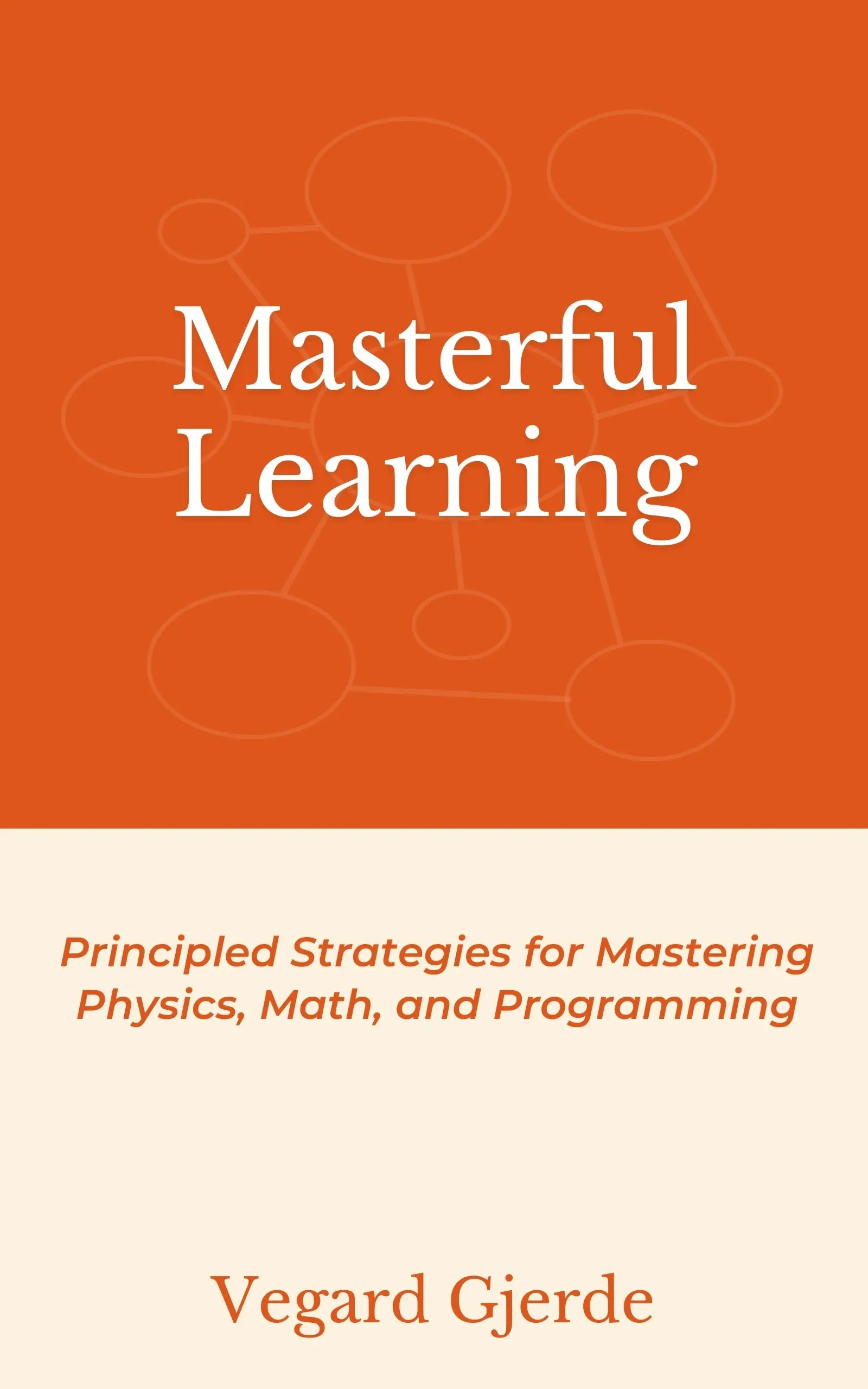
For a complete system that integrates note-taking with deep practice, see the Masterful Learning course. If you’re keeping outlines, treat them as capture only—conversion is non-negotiable.
Masterful Learning
The book behind these guides: a study system for physics, math, & programming built on retrieval, connection, explanation, and problem solving.
Ready to apply this strategy?
Unisium turns these evidence-based techniques into guided study sessions for math and physics. Places are limited during early access. Check current availability to start a trial; joining the mailing list is optional.
See plans and availability Read More GuidesAlready have access? Sign in