Logarithm Model: The Inverse Relationship to Exponentiation
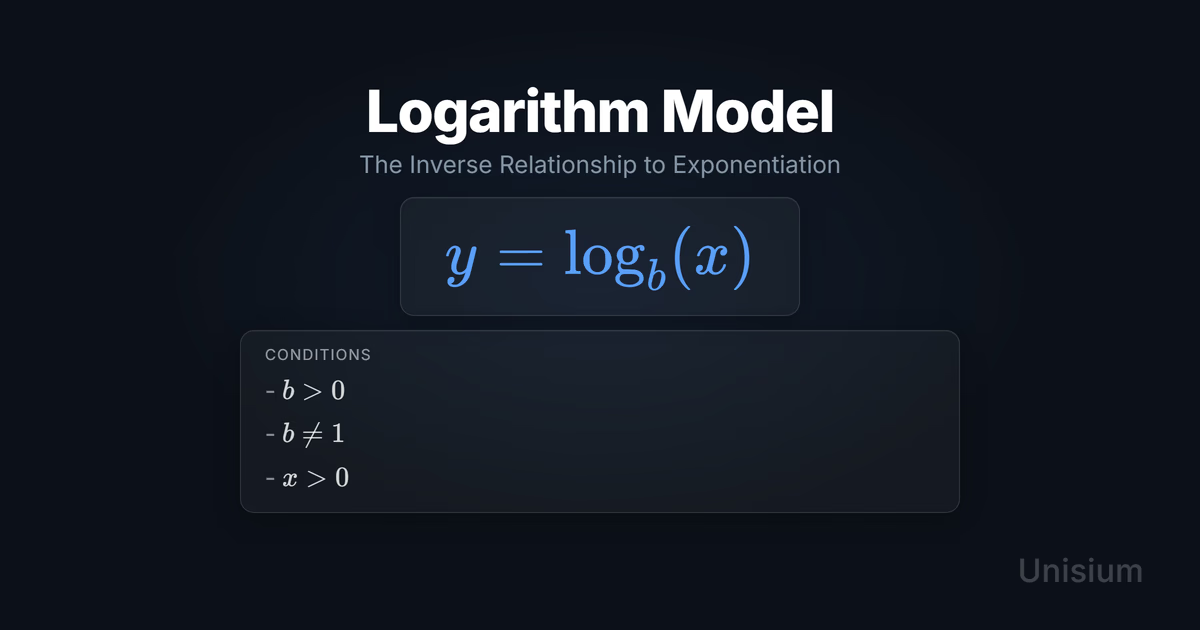
The Logarithm Model defines as the exponent to which base must be raised to equal —equivalently, . It applies when , , and , capturing the precise inverse relationship to exponentiation. Recognizing the logarithm as an exponent is the foundation for all algebraic work with exponentials and logarithms.
On this page: The Principle | Conditions | Misconceptions | EE Questions | Retrieval Practice | Worked Example | Solve a Problem | FAQ
The Principle
Statement
The Logarithm Model says that is the unique exponent to which base must be raised to produce . The notation does not denote a product—it names the output of a function that inverts exponentiation with base .
Mathematical Form
Where:
- = the base; must satisfy and
- = the argument; must satisfy
- = the logarithm (the exponent); any real number
Alternative Forms
- Exponential form: (the biconditional equivalent—same relationship, rearranged)
- Change-of-base: (evaluates any base- logarithm using the natural logarithm)
Conditions of Applicability
Condition: ; ;
Practical modeling notes
- The strictest condition is : if , then for all , so no unique exponent corresponds to any argument—the mapping is constant and non-invertible.
- The restriction follows from the range of exponentiation: for all real , so the domain of is exactly .
- Common bases in practice: (common log, written ), (natural log, written ), (binary log, used in computer science and information theory).
When It Doesn’t Apply
- : The logarithm is undefined for non-positive arguments; extending to complex numbers requires a different definition.
- : The base-1 exponential maps every exponent to 1, so no unique exponent exists.
- : Negative-base and zero-base exponentiation is not defined for all real exponents.
Want the complete framework behind this guide? Read Masterful Learning.
Common Misconceptions
Misconception 1: ” is a product of , , and ”
The truth: The subscript is the base parameter of a function; is the single output of the logarithm function applied to . There is no multiplication.
Why this matters: Treating as produces nonsensical algebraic moves such as “canceling” from both sides of an equation.
Misconception 2: “The base can be any positive number”
The truth: The base must satisfy and . Base 1 fails because for every —there is no way to assign a unique exponent, so is not defined.
Why this matters: Writing or treating as a valid case leads to contradictions when converting to exponential form.
Elaborative Encoding
Use these questions to build deep understanding. (See Elaborative Encoding for the full method.)
Within the Principle
- In , what does measure, and why is it an exponent rather than a product or ratio? What happens to the value of as increases without bound?
- The model requires . Without any computation, explain why no value of could satisfy for a positive base .
For the Principle
- How would you decide whether to apply the Logarithm Model or the Exponential Model to a given problem? What feature of the problem statement tells you which quantity is the exponent and which is the argument?
- If the condition fails for an input, what can you conclude about the output of , and what alternative framework would you need?
Between Principles
- The Inverse Definition states that for a one-to-one function. Is the Logarithm Model a special case of the Inverse Definition, and if so, what plays the role of and ?
Generate an Example
- Describe a real-world quantity that follows a logarithmic relationship—identify , , and in that context, and explain why the conditions , , and are satisfied.
Retrieval Practice
Answer from memory, then click to reveal and check. (See Retrieval Practice for the full method.)
State the principle in words: _____The logarithm y = log_b(x) is the exponent to which base b must be raised to produce x; equivalently, b^y = x.
Write the canonical equation: _____
State the canonical condition: _____
Worked Example
Use this worked example to practice Self-Explanation.
Problem
Evaluate .
Step 1: Verbal Decoding
Target:
Given: ,
Constraints: positive base not equal to 1; positive argument
Step 2: Visual Decoding
Sketch a two-column table labeled ‘exponent ’ and ‘value ’, with rows for small non-negative integers left blank. Place an arrow at the target 64 in the value column. (So the logarithm reads off a row index—the exponent—from an exponential table; no arithmetic yet.)
Step 3: Mathematical Modeling
Step 4: Mathematical Procedures
Step 5: Reflection
- Verification: ✓ — the answer satisfies the exponential form.
- Interpretation: The logarithm counts how many times 4 must be used as a factor to reach 64.
- Limiting case: since ; since . The result 3 is consistent with .
Before moving on: self-explain the model
Try explaining Step 3 out loud or in writing: how the Logarithm Model—by defining as the exponent satisfying —licenses the equation , and what the Log-Exponential Rewrite adds as the procedural move that activates that definition as a solvable equation.
Mathematical model with explanation (what “good” sounds like)
Principle: Logarithm Model — means ; instantiated with , .
Conditions: satisfies and ; ; all three conditions hold.
Relevance: asks “to what power must 4 be raised to give 64?”—the exact question the exponential form encodes.
Description: Converting to exponential form gives . Recognizing and equating exponents yields .
Goal: Find ; the solution is the value of in its original notation.
Procedural note: Converting to the exponential form is the Log-Exponential Rewrite—the transformational counterpart to this representational principle. The model defines what the logarithm means; the rewrite converts that definition into an equation ready to solve.
Solve a Problem
Apply what you’ve learned with Problem Solving.
Problem
Evaluate .
Hint (if needed): Express both and as powers of a common base, then convert to exponential form using the Log-Exponential Rewrite ().
Show Solution
Step 1: Verbal Decoding
Target:
Given: ,
Constraints: base is a proper fraction (positive, not equal to 1); positive argument
Step 2: Visual Decoding
Sketch a number line of values for integer : values grow beyond 1 as decreases (goes negative) and shrink toward 0 as increases. Place a marker at target value 8, noting it lies in the region. (So the logarithm output is negative whenever the argument exceeds 1 and the base is less than 1.)
Step 3: Mathematical Modeling
Step 4: Mathematical Procedures
Step 5: Reflection
- Verification: ✓
- Interpretation: A base less than 1 produces a negative logarithm for ; the model reflects that larger arguments require a more negative exponent to “undo” the shrinking base.
- Domain check: , , ; all conditions hold ✓.
Related Principles
| Principle | Relationship to the Logarithm Model |
|---|---|
| Exponential Model | The exponential is the function the logarithm inverts; each model is the other written with the roles of input and output swapped. |
| Inverse Definition | The Logarithm Model is the Inverse Definition applied to exponentiation: is exactly when . |
| Log-Exponential Rewrite | The transformational move — the procedural counterpart that converts between logarithmic and exponential form. Its prerequisite is this model. |
See Principle Structures for how to organize these relationships visually.
FAQ
What is the Logarithm Model?
The Logarithm Model defines as the exponent to which base must be raised to produce . Equivalently, . It applies when , , and .
Why must the base satisfy and ?
The base must be positive so that is defined for all real . The base cannot equal 1 because for every , leaving no unique exponent—the function is constant and non-invertible.
Why must the argument be positive?
Exponentiation with a positive base always produces a positive result: for all real . The logarithm asks which exponent produces , so must lie in the range of the exponential—that is, .
What is the difference between , , and ?
states the base explicitly. means , the natural logarithm with base . without a written base is context-dependent: many school texts use base 10, but conventions vary—computer science often uses base 2, and some pure-mathematics texts use . Always check the source.
How do I convert between exponential and logarithmic form?
The two forms represent the same relationship. In Unisium’s structure, the Logarithm Model gives the meaning of as an exponent; the Log-Exponential Rewrite () is the transformational move that converts between the two written forms. To switch from one form to the other in a worked problem, you are applying the rewrite, not just the definition.
What is the change-of-base formula?
. It follows from the Logarithm Model and allows any base- logarithm to be computed from natural (or common) logarithms—useful when a calculator provides only or .
Related Guides
- Functions Subdomain Map — Return to the functions hub to see where logarithms sit relative to inverse work and composition
- Calculus Subdomain Map — Follow the forward path into exponential and logarithmic calculus once the functions foundation is stable
- Principle Structures — See how the Logarithm Model fits into the functions subdomain hierarchy
- Self-Explanation — Use the worked example to practice the five-step explanation method
- Retrieval Practice — Build long-term recall of the equation and conditions
- Problem Solving — Apply the Logarithm Model systematically to new problems
How This Fits in Unisium
Unisium presents the Logarithm Model as a representational principle—one that names a relationship rather than prescribing a move. Practice cards prompt you to recall the definition from memory (retrieval practice), explain why each condition is necessary (elaborative encoding), and walk through worked examples step by step (self-explanation). The platform also surfaces Log-Exponential Rewrite as the complementary transformational move, so you learn to distinguish understanding what the logarithm means from the procedure of converting between forms—a boundary that matters when diagnosing your own mistakes.
Ready to master the Logarithm Model? See Unisium’s 14-day free trial or explore the full learning framework in Masterful Learning.
Masterful Learning
The book behind these guides: a study system for physics, math, & programming built on retrieval, connection, explanation, and problem solving.
Ready to apply this strategy?
Unisium turns these evidence-based techniques into guided study sessions for math and physics. Places are limited during early access. Check current availability to start a trial; joining the mailing list is optional.
See plans and availability Read More GuidesAlready have access? Sign in