Inverse Definition: Reversing a Function's Input and Output
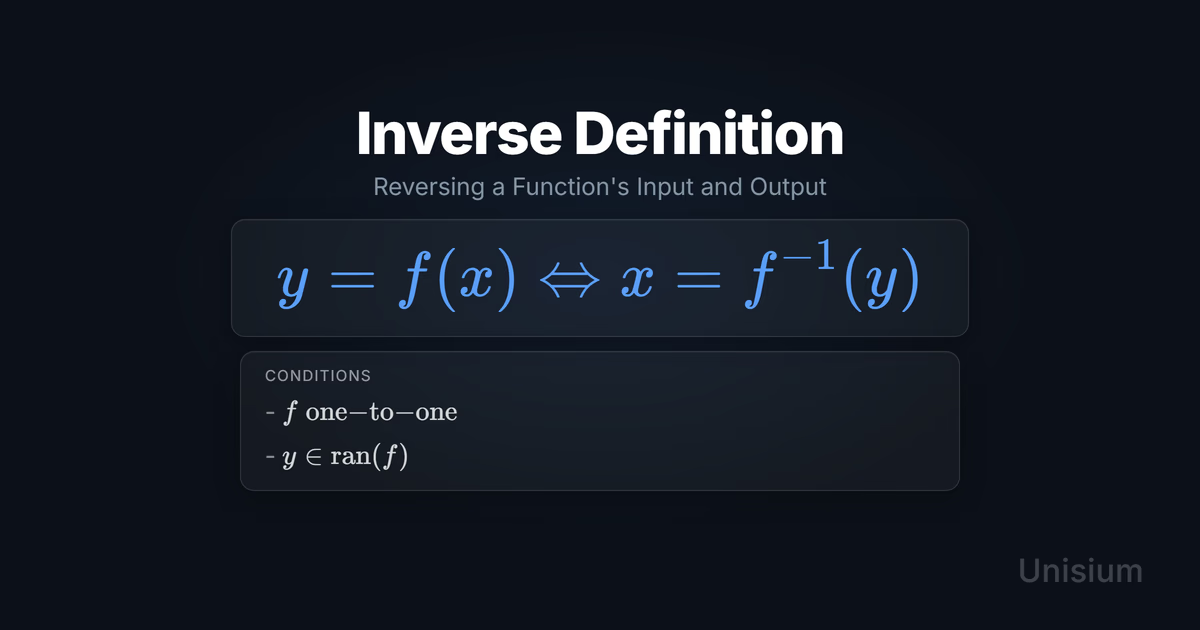
The Inverse Definition states that, for a one-to-one function , the equation holds if and only if . This biconditional is the precise meaning of “undoing” a function: it captures the exact symmetry between and its inverse, and explains why reverses input–output roles rather than computing a reciprocal. Mastering it requires elaboration, retrieval practice, self-explanation, and problem solving — core strategies in the Unisium Study System.
On this page: The Principle | Conditions | Misconceptions | EE Questions | Retrieval Practice | Worked Example | Solve a Problem | FAQ
The Principle
Statement
The Inverse Definition says that, for a one-to-one function : an output comes from input under if and only if the inverse maps back to . The biconditional runs in both directions — you can always exchange the roles of input and output when crossing between and .
Mathematical Form
Where:
- = a one-to-one function with a specified domain
- = the inverse function of , defined on the range of
- = an element of the domain of (equivalently, the range of )
- = an element of the range of (equivalently, the domain of )
Alternative Forms
In different contexts, this appears as:
- Coordinate form: if lies on the graph of , then lies on the graph of .
- Solved form: whenever .
Conditions of Applicability
Condition: ;
Practical modeling notes
- A function is one-to-one (injective) when distinct inputs always map to distinct outputs: .
- If a function is not one-to-one on its full domain, restrict the domain to a region where it is — as is done with (restricted to ) to define .
- The condition ensures is defined. Applying the definition outside the range of has no meaning.
When It Doesn’t Apply
The definition fails in two situations:
- is not one-to-one: a shared output for means cannot be uniquely assigned. For example, on satisfies ; without a domain restriction, the inverse is not a function.
- is outside the range of : the inverse definition yields no solution; is undefined for that .
Want the complete framework behind this guide? Read Masterful Learning.
Common Misconceptions
Misconception 1: ” means ”
The truth: The notation denotes the inverse function, not the reciprocal. For example, , not — these are completely different objects.
Why this matters: Treating as leads to wrong evaluations across trigonometry, logarithms, and any context where inverse functions appear.
Misconception 2: “Every function has an inverse”
The truth: Only one-to-one functions have an inverse function. If for , there is no single output that can assign to the shared value — the inverse fails to be a function.
Why this matters: Skipping the one-to-one check and writing for a non-injective function generates contradictions such as and simultaneously.
Misconception 3: “Finding the inverse means negating each operation”
The truth: The inverse is found by swapping the roles of and per the biconditional and then solving algebraically. Mechanically negating operations does not follow from the definition and gives the wrong answer in general.
Why this matters: Students who negate operations bypass the formal derivation and produce functions that fail to satisfy .
Elaborative Encoding
Use these questions to build deep understanding. (See Elaborative Encoding for the full method.)
Within the Principle
- In , which quantity is the input to and which is the output? When you cross to , how do the roles of and switch?
- If , what is ? Which property of the biconditional lets you read off the answer without solving any equation?
For the Principle
- How would you decide whether a given function has an inverse? What test would you run, and why is it necessary before applying the definition?
- If the condition ” one-to-one” fails for on , what goes wrong when you try to apply the inverse definition — and what change would restore an inverse?
Between Principles
- The Inverse Definition says . How does this connect to the composition identity ? Is the cancellation identity a consequence of the biconditional, or a separate claim?
Generate an Example
- Describe a real-world process that is not reversible on its natural domain, then explain how restricting the domain could make it invertible and what the inverse definition would then say about the restricted function.
Retrieval Practice
Answer from memory, then click to reveal and check. (See Retrieval Practice for the full method.)
State the principle in words: _____For a one-to-one function f, the output y comes from input x if and only if the inverse maps y back to x.
Write the canonical equation: _____
State the canonical condition: _____
Worked Example
Use this worked example to practice Self-Explanation.
Problem
Given restricted to , evaluate .
Step 1: Verbal Decoding
Target:
Given: ,
Constraints: domain restricted to so is one-to-one;
Step 2: Visual Decoding
Sketch on . Draw a horizontal line at height and mark its intersection with the curve. Label the corresponding -value on the horizontal axis. (So the unique non-negative intersection point is what the inverse maps back to the input axis.)
Step 3: Mathematical Modeling
Step 4: Mathematical Procedures
Step 5: Reflection
- Verification: ✓ — the answer satisfies the original equation.
- Domain check: lies in the restricted domain, confirming the one-to-one condition holds for this output.
- Connection to concept: The domain restriction forces the unique answer ; on the unrestricted , both and satisfy and the inverse definition would not yield a single output.
Before moving on: self-explain the model
Try explaining Step 3 out loud or in writing: why restricting to makes it one-to-one, how the biconditional turns the equation into the statement , and why the domain restriction determines which root to select.
Mathematical model with explanation (what “good” sounds like)
Principle: Inverse Definition —
Conditions: is one-to-one on (each non-negative output comes from exactly one non-negative input); since .
Relevance: The goal is to find the input that produces output under — the exact reversal the inverse definition computes.
Description: Setting in the biconditional gives , so equals the unique satisfying .
Goal: Solve ; this yields , but the domain restriction eliminates , so .
Solve a Problem
Apply what you’ve learned with Problem Solving.
Problem
If the point lies on the graph of a one-to-one function , what point lies on the graph of ?
Hint (if needed): Apply the inverse definition directly to the coordinate pair — no algebra required.
Show Solution
Step 1: Verbal Decoding
Target: a point on the graph of
Given: ,
Constraints: lies on the graph of ; one-to-one;
Step 2: Visual Decoding
Sketch a coordinate plane and draw the line . Plot on the graph of . Reflect this point across to locate . (So every point on is the coordinate-swap of the corresponding point on .)
Step 3: Mathematical Modeling
Step 4: Mathematical Procedures
Step 5: Reflection
- Verification: and satisfy the biconditional ✓.
- Graphical meaning: is the reflection of across the line , confirming that the graph of is the reflection of the graph of .
- Domain check: since , so the second condition of the inverse definition holds.
Related Principles
| Principle | Relationship to the Inverse Definition |
|---|---|
| Composition Definition | Composition chains after ; the inverse definition reverses this chaining for a single function by swapping input and output roles. |
| Apply Inverse to Both Sides | The transformational move that applies the inverse definition to both sides of an equation to isolate an argument — the procedural counterpart to this representational identity. |
| Inverse Cancellation | The paired cleanup step that simplifies a valid inverse composition once the inverse has been introduced or applied. |
| Logarithm Model | A concrete inverse-family example: logarithms are defined by inverting an exponential relationship under the same one-to-one logic. |
See Principle Structures for how to organize these relationships visually.
FAQ
What is the Inverse Definition?
The Inverse Definition is the biconditional : for a one-to-one function , an output coming from input is exactly equivalent to mapping back to .
When does the Inverse Definition apply?
It applies when is one-to-one (no two distinct inputs share the same output) and the output value lies in the range of . If either condition fails, the inverse definition does not hold.
What is the difference between and ?
is the inverse function — it reverses by swapping inputs and outputs. is the reciprocal of the function’s value, an unrelated operation. For instance, if , then , while .
What happens if is not one-to-one?
The inverse definition breaks down. If for , then would need to equal both and , making not a function. The standard fix is to restrict to a domain where it is one-to-one before defining an inverse.
How does the Inverse Definition relate to the graph of ?
Swapping the roles of and corresponds geometrically to reflecting the graph of across the line . The result is the graph of , and every point on gives the reflected point on — a direct reading of the biconditional in coordinate terms.
Related Guides
- Functions Subdomain Map — Return to the functions hub to see where inverse work sits relative to composition, logarithms, and later calculus preparation
- Principle Structures — Organize the Inverse Definition in a hierarchical functions framework
- Self-Explanation — Walk through the worked example using the five-step format
- Retrieval Practice — Strengthen long-term recall of the biconditional and its conditions
- Problem Solving — Apply the inverse definition systematically to new problems
How This Fits in Unisium
The Inverse Definition is a core representational principle in the functions subdomain. In Unisium, you encounter it through EE questions that probe the input–output role swap and the domain–range reversal between and , retrieval prompts that test the biconditional and its conditions from memory, and self-explanation exercises on worked examples that foreground graph reflection and invertibility conditions. Working through all four stages builds the structural understanding that lets you recognize when an inverse exists, what the coordinate symmetry across means, and how the domain of becomes the range of and vice versa.
Ready to master the Inverse Definition? See Unisium’s 14-day free trial or explore the full learning framework in Masterful Learning.
Masterful Learning
The book behind these guides: a study system for physics, math, & programming built on retrieval, connection, explanation, and problem solving.
Ready to apply this strategy?
Unisium turns these evidence-based techniques into guided study sessions for math and physics. Places are limited during early access. Check current availability to start a trial; joining the mailing list is optional.
See plans and availability Read More GuidesAlready have access? Sign in