Evaluate by Substitution: Plug an Input into a Function Rule
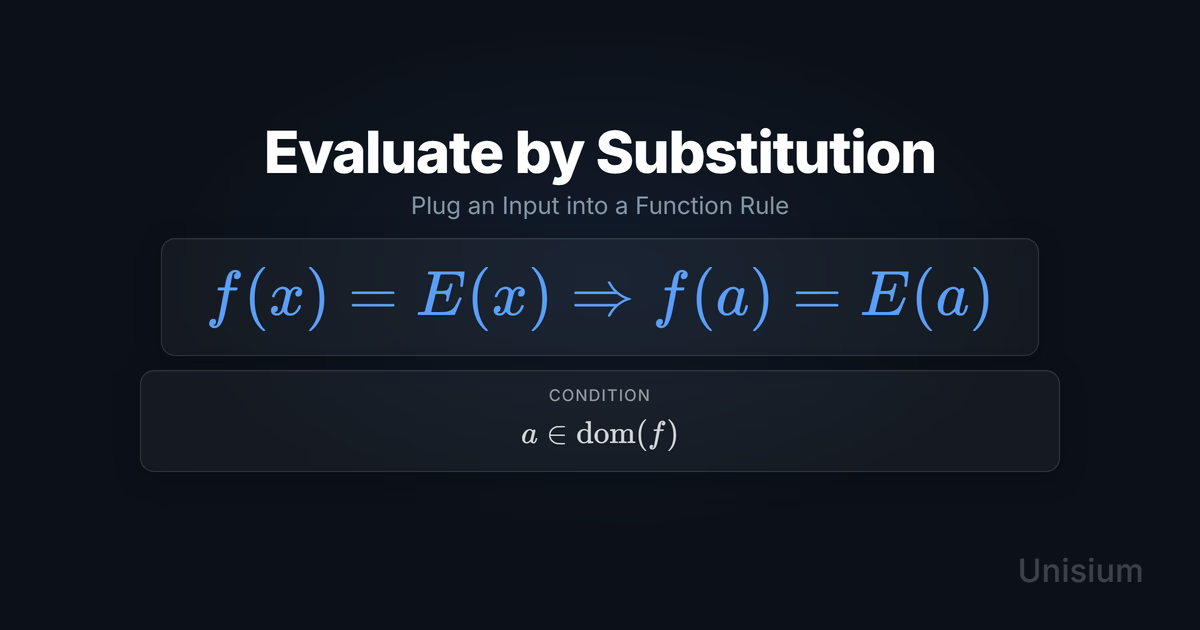
Evaluate by Substitution is the move that computes a function’s output at a specific input: if , then — replace with throughout the rule. It applies when is in the domain of . Checking the domain condition before substituting — and recognizing when it fails — is a foundational functions fluency skill practiced in the Unisium Study System.
On this page: The Principle | Conditions | Failure Modes | EE Questions | Retrieval Practice | Practice Ground | Solve a Problem | FAQ
The Principle
The move: Replace the input variable with a specific value in the function’s rule to compute the output.
The invariant: For any input in the domain of , substituting into the rule gives the correct output: .
Pattern:
| Legal ✓ | Illegal ✗ |
|---|---|
| (undefined: ) |
In the legal case satisfies (), so the move applies. In the illegal case violates the domain condition () — the expression is not defined, and the move cannot be applied.
Conditions of Applicability
Condition:
Before applying, check: verify that satisfies every restriction of the rule — no zero denominator, no even root of a negative, no logarithm of a non-positive value.
- If is outside the domain, the expression is undefined and the move cannot be applied.
- For functions with implied domains, check whether the rule produces a defined real number at .
Want the complete framework behind this guide? Read Masterful Learning.
Common Failure Modes
Failure mode: substitute a value without verifying it is in the domain (e.g., evaluating at ) → is undefined; the result is a non-real or meaningless expression.
Debug: before substituting, identify every domain restriction in the rule and confirm satisfies each one.
Elaborative Encoding
Use these questions to build deep understanding. (See Elaborative Encoding for the full method.)
Within the Principle
- What does “replacing with in the rule ” mean, and why does equal the function’s output at ?
- What does "" require in concrete terms — what are you checking before substituting?
For the Principle
- How do you identify the domain of a function whose rule involves a square root, a denominator, or a logarithm?
- What would change about your check if the domain were restricted explicitly (e.g., for only) rather than implied by the rule?
Between Principles
- How does Evaluate by Substitution relate to Piecewise Branch Selection? When must you determine the correct branch before you can substitute?
Generate an Example
- Describe a function and an input value where substituting without checking the domain produces an undefined result. What would you see, and how would you catch the error before computing?
Retrieval Practice
Answer from memory, then click to reveal and check. (See Retrieval Practice for the full method.)
State the move in one sentence: _____Replace the input variable x with the value a in the function rule E(x) to obtain f(a) = E(a).
Write the canonical pattern: _____
State the canonical condition: _____
Practice Ground
Use these exercises to build move-selection fluency. (See Self-Explanation for how to use worked examples effectively.)
Procedure Walkthrough
Starting from , evaluate .
| Step | Expression | Operation |
|---|---|---|
| 0 | ; domain restriction: | — |
| 1 | , so | Verify condition before substituting |
| 2 | Substitute: replace with in | |
| 3 | Evaluate inside the radical | |
| 4 | Simplify: |
Drills
Format A — Forward step
Apply the principle once.
. Evaluate .
Reveal
; substitute:
Apply the principle once.
. Evaluate .
Reveal
; substitute:
Can you apply the principle here? Justify your answer.
. Evaluate .
Reveal
No. The domain of is . Since , we have — the move does not apply. is undefined.
Apply the principle once.
. Evaluate .
Reveal
; substitute:
Near-miss: Is this application valid?
. Evaluate .
Reveal
No. when , so . Since , substitution is invalid — the denominator is zero and is undefined.
looks like a valid input at a glance, but the domain check catches the singularity.
Format B — Action label
What principle was applied, and why is it valid?
Reveal
Evaluate by Substitution: , so . The domain condition holds; the move is valid.
What was done between these two steps?
Reveal
Evaluate by Substitution: replaced with in the rule . Since , the move is valid. The result: .
Valid application or domain violation?
. Someone writes and claims Evaluate by Substitution was applied correctly. Is this valid?
Reveal
No. . Since , we have — the domain condition fails. The result is not a real number. The domain check must be performed before any substitution.
Format C — Transition identification
Which step in the chain below applies Evaluate by Substitution?
Chain: define choose write simplify to .
Reveal
The third arrow — from “choose ” to “write ” — applies Evaluate by Substitution: it replaces with in the rule . The condition holds, so the move is valid.
Which of the following inputs can be substituted into ?
Reveal
— the denominator at .
Valid inputs: .
Invalid: and — both make the denominator zero; the move cannot be applied.
Solve a Problem
Apply what you’ve learned with Problem Solving.
Problem: Starting from , reach the value .
Full solution
| Step | Expression | Move |
|---|---|---|
| 0 | ; domain restriction: | — |
| 1 | , so | Verify condition: argument of must be positive |
| 2 | Substitute: replace with in | |
| 3 | Evaluate: | |
| 4 | since |
FAQ
What is Evaluate by Substitution?
Evaluate by Substitution is the principle that if a function is given by the rule , then its value at an input is — obtained by replacing every occurrence of in the rule with . The move is valid when is in the domain of .
When is Evaluate by Substitution valid?
The move is valid exactly when : the input must satisfy all domain restrictions of the rule — no zero in a denominator, no negative under an even radical, no non-positive argument to a logarithm.
What goes wrong if I forget the condition?
If , the expression is undefined. You might produce a square root of a negative number, a division by zero, or a logarithm of a non-positive value — each of which is not a real number.
How is Evaluate by Substitution different from Piecewise Branch Selection?
Both involve substituting a value into a piece of the function’s rule. Evaluate by Substitution applies when is given by a single rule and is in its domain. Piecewise Branch Selection adds a prior step: first determine which branch of the piecewise definition governs , then substitute into that branch using Evaluate by Substitution.
Does Evaluate by Substitution apply to any rule form?
Yes, to any function given by a rule . The domain restriction depends on the rule: polynomials have no exclusions, rationals exclude zeros in the denominator, even radicals require non-negative arguments, and logarithms require positive arguments. In all cases the substitution step itself is the same.
This principle does not cover other representation forms. Reading a value from a graph, looking it up in a table, or evaluating a recursive definition each requires its own procedure. For a piecewise-defined function, you must select the correct branch first (Piecewise Branch Selection), then apply Evaluate by Substitution to that branch’s rule.
How This Fits in Unisium
Evaluate by Substitution is the core move for turning a Function Rule Definition into a value: check the domain, substitute the input, then simplify. Within the functions subdomain, condition-recognition drills build the habit of checking first, so domain errors are caught before they spread into affine transforms, piecewise, composition, and inverse work.
Explore further:
- Functions Subdomain Map — Return to the functions hub to see how direct evaluation sits between explicit rules and later multi-rule moves
- Function Rule Definition — The representational prerequisite: substitution only makes sense once the rule and its domain are specified
- Affine Transform Form — Transformed functions still get evaluated by tracing the inner input map and then substituting into the base rule
- Piecewise Branch Selection — When different rules govern different regions, choose the correct branch before substituting
- Composition Expansion — After direct substitution is fluent, extend the same input-to-output logic to nested function values
- Principle Structures — See how Evaluate by Substitution anchors the functions transformational hierarchy
- Elaborative Encoding — Deepen your sense of why the domain condition is not merely a formality
- Retrieval Practice — Make the pattern and its condition instantly recallable
Ready to master Evaluate by Substitution? See Unisium’s 14-day free trial or explore the full learning framework in Masterful Learning.
Masterful Learning
The book behind these guides: a study system for physics, math, & programming built on retrieval, connection, explanation, and problem solving.
Ready to apply this strategy?
Unisium turns these evidence-based techniques into guided study sessions for math and physics. Places are limited during early access. Check current availability to start a trial; joining the mailing list is optional.
See plans and availability Read More GuidesAlready have access? Sign in