Function Rule Definition: What It Means to Define a Function by a Rule
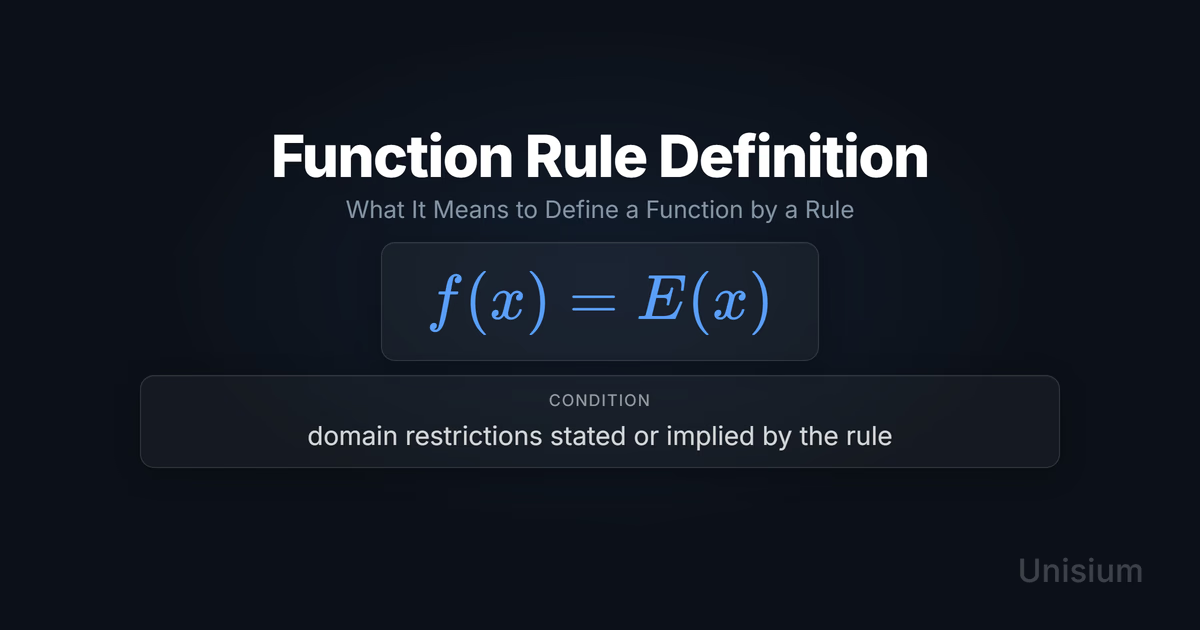
Function Rule Definition is the principle that a function can be given by an explicit rule: , where is an expression in the input variable. The rule assigns one output to each valid input, so you must also check the domain restrictions implied by denominators, roots, logarithms, or a stated problem domain.
The rule form captures what it means to assign an output to each input: write down the rule , and for every valid the function’s value is determined. Identifying which inputs the rule accepts—the domain—is one concrete consequence of that specification, not the whole story.
On this page: The Principle | Conditions | Misconceptions | EE Questions | Retrieval Practice | Worked Example | Solve a Problem | FAQ
The Principle
Statement
A function can be specified by giving a rule that assigns an output to each input: , where is an expression in the input variable . The domain—the set of valid inputs—is either stated explicitly or implied by the restrictions of the rule.
Mathematical Form
Where:
- = the function (a mapping from inputs to outputs)
- = the input variable (argument)
- = an expression in the input variable (e.g., , , or )
Alternative Forms
In different contexts, this appears as:
- Named form: (any letter can serve as the function name or variable)
- Output-only notation: (when is implicit; common in graphing contexts)
Conditions of Applicability
Condition: domain restrictions stated or implied by the rule
Practical modeling notes
- The natural domain is the largest set of real inputs for which produces a real output.
- Common implicit restrictions: denominator ; radicand for even roots; argument for logarithms.
- When a problem declares a domain (e.g., ), that stated domain overrides the natural domain—even if the formula could accept more inputs.
When It Doesn’t Apply
- Relation, not a function: If one input maps to two or more outputs (e.g., solved for ), a single rule cannot represent the whole relation without splitting it.
- Piecewise behavior: When different formulas govern different input regions, use the Piecewise Definition instead.
- Implicit definition: If the function is defined by an equation like rather than an explicit expression, the rule form does not directly apply.
Want the complete framework behind this guide? Read Masterful Learning.
Common Misconceptions
Misconception 1: The variable must be
The truth: Any variable name works. and are perfectly valid function rule definitions; the letter is just a label for the input slot.
Why this matters: Students freeze when a problem uses , , or instead of , treating it as a different kind of object.
Misconception 2: The domain is always “all real numbers”
The truth: The domain is the set of inputs for which the rule produces a real output. Division by zero or a negative radicand can shrink the natural domain significantly.
Why this matters: Missing domain restrictions leads to incorrect range calculations and invalid substitutions when evaluating or composing functions.
Misconception 3: means ” times ”
The truth: is a notation for the output of function at input —it is not multiplication. is the value of the rule at , not .
Why this matters: The multiplication misread cascades into errors in composition and inverse notation.
Elaborative Encoding
Use these questions to build deep understanding. (See Elaborative Encoding for the full method.)
Within the Principle
- In , what role does play—is it a specific number, a variable, or something else?
- If , which input value is excluded from the domain, and why?
For the Principle
- How do you decide whether a given mathematical rule qualifies as a function rather than a general relation?
- What two pieces of information do you always need to fully specify a function using this principle: the rule and what else?
Between Principles
- The Piecewise Definition also defines a function by rules—how does it differ from a single function rule definition, and when would you choose one over the other?
Generate an Example
- Construct a rule whose natural domain excludes exactly two input values, and explain why those inputs are excluded.
Retrieval Practice
Answer from memory, then click to reveal and check. (See Retrieval Practice for the full method.)
State the principle in words: _____A function can be given by an explicit rule: for any allowed input x, the output is the value of the expression E(x).
Write the canonical equation: _____
State the canonical condition: _____domain restrictions stated or implied by the rule
Worked Example
Use this worked example to practice Self-Explanation.
Problem
Let . Find the natural domain of .
Step 1: Verbal Decoding
Target:
Given: ,
Constraints: real-valued output; even root requires non-negative radicand; denominator nonzero
Step 2: Visual Decoding
Draw a number line for . Mark the boundary candidates at and . (At the radicand equals zero — a closed boundary candidate; at the denominator equals zero — an exclusion.)
Step 3: Mathematical Modeling
Step 4: Mathematical Procedures
Step 5: Reflection
- Verification: At : — real ✓. At : denominator is — excluded ✓.
- Domain check: makes the radicand zero, not negative — the boundary is closed; is open.
Before moving on: self-explain the model
Try explaining Step 3 out loud (or in writing): why the Function Rule Definition applies here, what restriction each component of imposes, and how the two constraints combine.
Mathematical model with explanation (what “good” sounds like)
Principle: Function Rule Definition — specifies one output for each valid input.
Conditions: Domain restrictions are implied by the rule: the radicand must be non-negative () and the denominator nonzero ().
Relevance: Any input outside the domain produces no real output, so identifying the domain is prerequisite to using the rule.
Description: The square root constrains ; the denominator excludes . Combining both leaves .
Goal: Find all for which the rule yields a real, well-defined output.
Solve a Problem
Apply what you’ve learned with Problem Solving.
Problem
Let . Find the natural domain of .
Hint (if needed): What does each component require of its input?
Show Solution
Step 1: Verbal Decoding
Target:
Given: ,
Constraints: real-valued output; log argument strictly positive; even root non-negative
Step 2: Visual Decoding
Draw a number line for . Mark the boundary candidates at and . (The log is valid strictly to the right of ; the square root closes at .)
Step 3: Mathematical Modeling
Step 4: Mathematical Procedures
Step 5: Reflection
- Verification: At : — real ✓. At : — real ✓. At : — undefined ✓.
- Domain check: is included because is defined; is excluded because is undefined.
Related Principles
| Principle | Relationship to Function Rule Definition |
|---|---|
| Evaluate by Substitution | Immediate operational successor: once a rule is defined, substitution is the direct move for computing a value at a valid input |
| Affine Transform Form | Representational specialization: a transformed function is still defined by an explicit rule, but one built from a base function plus structured input/output affine maps |
| Piecewise Definition | Extends the rule form to functions defined by different expressions on different input regions |
| Composition Definition | Chains two rule-defined functions: builds a new rule from existing ones |
| Inverse Definition | Reverses a one-to-one rule-defined function; swaps domain and range |
See Principle Structures for how to organize these relationships visually.
FAQ
What is the Function Rule Definition?
The Function Rule Definition is the principle that a function can be specified by an explicit rule , so that for every valid input . It sets the foundation for evaluating, composing, and transforming functions throughout algebra and calculus.
When does the Function Rule Definition apply?
It applies whenever you have a single explicit rule that assigns exactly one output to each valid input. The domain is either stated explicitly or read off from the natural restrictions of the expression (no division by zero, no even root of a negative number, etc.).
What’s the difference between the Function Rule Definition and a piecewise definition?
A single function rule uses one expression for all inputs in the domain. A piecewise definition uses different expressions on different regions of the domain. If one formula covers the whole domain, use the rule form; if behavior changes at a boundary, use piecewise.
What are the most common mistakes with the Function Rule Definition?
- Treating as multiplication — is the output of at , not .
- Forgetting domain restrictions — assuming the domain is all real numbers when the expression excludes some inputs.
- Confusing function name and variable — any letter names both; the choice doesn’t change what the function does.
How do I find the domain from a rule?
Identify every operation in that restricts inputs: set each denominator , each even-root radicand , each logarithm argument . The domain is the intersection of all those constraints over .
Related Guides
- Functions Subdomain Map — Return to the functions hub to see where explicit rule definition sits relative to evaluation, piecewise structure, and later composition work
- Principle Structures — Organize this principle in a hierarchical framework
- Elaborative Encoding — Build deep understanding of any principle or concept
- Self-Explanation — Learn to explain worked examples step by step
- Retrieval Practice — Make this principle instantly accessible
How This Fits in Unisium
The Function Rule Definition is the representational backbone of the functions subdomain in Unisium. Once it’s secure, the app builds on it through Evaluate by Substitution when a specific input is given and through Affine Transform Form when a new rule is built by transforming a base function. Retrieval practice cloze prompts reinforce the canonical equation, while self-explanation and problem-solving extend the same rule language into piecewise, composition, inverse, and transformed-function problems.
Ready to master the Function Rule Definition? See Unisium’s 14-day free trial or explore the full learning framework in Masterful Learning.

Masterful Learning
The book behind these guides: a study system for physics, math, & programming built on retrieval, connection, explanation, and problem solving.
Ready to apply this strategy?
Unisium turns these evidence-based techniques into guided study sessions for math and physics. Places are limited during early access. Check current availability to start a trial; joining the mailing list is optional.
See plans and availability Read More GuidesAlready have access? Sign in