Composition Definition: Feeding One Function's Output into Another
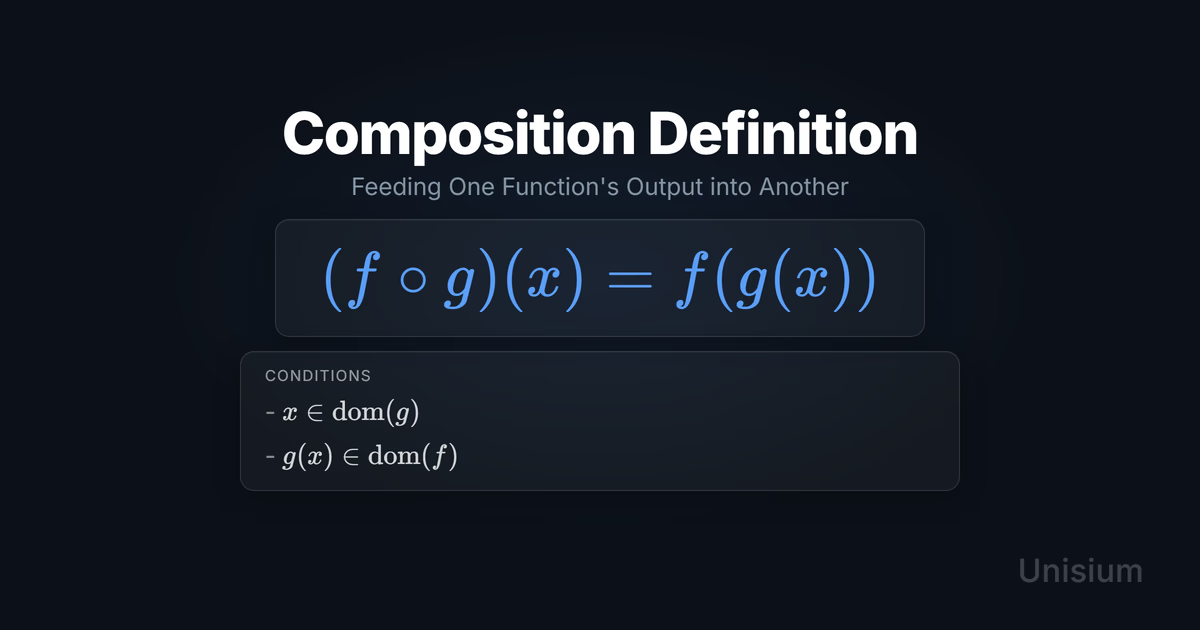
Composition Definition is the representational principle that a composition feeds one function’s output directly into another: the inner function transforms first, then the outer function acts on that result. It is valid exactly when lies in the domain of and lies in the domain of . Mastering it requires elaboration, retrieval practice, self-explanation, and problem solving—the core strategies in the Unisium Study System.
The composition operator is not commutative: and are generally different functions. Identifying which function is inner and which is outer—before writing any algebra—is the single most important modeling decision in composition problems.
On this page: The Principle | Conditions | Misconceptions | EE Questions | Retrieval Practice | Worked Example | Solve a Problem | FAQ
The Principle
Statement
A composition is a new function defined by piping the output of one function into the input of another function . Formally, for every where both evaluations succeed. The order matters: always acts first, and acts on whatever produces.
Mathematical Form
Where:
- = the outer function (acts second, on )
- = the inner function (acts first, on )
- = the input to the composition (must lie in the domain of )
- = the composed function (a new function that chains then )
Alternative Forms
In different contexts, this appears as:
- Without operator notation: — write the composition as a single rule with nested inside
- At a specific input: — evaluate by substituting into first, then feeding the result to
Conditions of Applicability
Condition: ;
Practical modeling notes
- Check the inner function’s domain restriction first. Any excluded from is automatically excluded from the composition.
- Then check whether satisfies the outer function’s input restriction. This second filter can shrink the domain further.
- If both and accept all real numbers, both conditions are satisfied for every and no restriction arises.
- The domain of is the set .
When It Doesn’t Apply
- Inner domain gap: If is outside , then is not defined so cannot be computed. For example, requires ; negative inputs cannot enter the composition.
- Outer domain gap: Even when is defined, it may fall outside . For example, requires ; any for which must be excluded.
- Wrong order: is a different composition with potentially different domain and formula. Applying first when the problem requires first is a modeling error, not a domain failure.
Want the complete framework behind this guide? Read Masterful Learning.
Common Misconceptions
Misconception 1: means
The truth: The notation is function composition, not multiplication. means evaluate at and feed that result to . The product is a completely different operation.
Why this matters: For and , the composition gives , while the product gives . Confusing the two produces a wrong formula on every problem.
Misconception 2: Composition is commutative —
The truth: Function composition is not commutative in general. The order of evaluation matters: evaluates first, while evaluates first.
Why this matters: Students who treat composition as commutative may occasionally get the same result on specially constructed pairs, but in general the order changes both the formula and potentially the domain. Swapping the order without checking produces a systematic error.
Misconception 3: The domain of equals the domain of
The truth: The domain of the composition is a subset of : it includes only those inputs for which also lies in . Outputs of can fall outside , shrinking the effective domain further.
Why this matters: Taking the domain to be all of overstates where the composition is defined, leading to claims that values exist at inputs where the outer function cannot act.
Elaborative Encoding
Use these questions to build deep understanding. (See Elaborative Encoding for the full method.)
Within the Principle
- In , which function acts on first, and which acts on the result? What would the notation mean by the same logic?
- If , what type of object is the argument that receives—a variable, a specific number, or an expression in ?
For the Principle
- Given a composite rule such as , how would you decompose into an inner function and an outer function using the Composition Definition?
- When does the domain of equal the full domain of , with no further restriction imposed by ?
Between Principles
- The Function Rule Definition uses a single expression to define a function. How does the Composition Definition extend this: is itself a function rule definition, and what is its expression ?
Generate an Example
- Construct two functions and such that yet the domain of is a proper subset of . Identify which domain condition fails for the excluded inputs.
Retrieval Practice
Answer from memory, then click to reveal and check. (See Retrieval Practice for the full method.)
State the Composition Definition in words: _____A composition (f ∘ g)(x) = f(g(x)) feeds x into the inner function g first, then feeds g(x) into the outer function f. It is valid when x is in the domain of g and g(x) is in the domain of f.
Write the canonical equation for function composition: _____
State the canonical condition: _____
Worked Example
Use this worked example to practice Self-Explanation.
Problem
Let and . Find the formula for .
Step 1: Verbal Decoding
Target: formula for
Given: , ,
Constraints: composition definition; both functions accept all real numbers
Step 2: Visual Decoding
Sketch a two-step pipeline: input flows into , producing ; that output flows into , producing .
Step 3: Mathematical Modeling
Step 4: Mathematical Procedures
Step 5: Reflection
- Verification: At : , then ; the formula gives ✓.
- Parameter dependence: Reversing the order gives , a different formula — confirming composition is not commutative.
- Graphical meaning: The composition shifts the scaled linear function upward by 3; the outer function’s additive rule applies after doubles the input.
Before moving on: self-explain the model
Try explaining Step 3 out loud (or in writing): why the Composition Definition licenses replacing in ‘s rule with , what that instantiated equation encodes, and why the substitution is valid even though was originally written in terms of .
Mathematical model with explanation (what “good” sounds like)
Principle: Composition Definition — chains the two functions: acts first, acts on the result.
Conditions: , so the first condition holds for every . , so the second condition holds as well.
Relevance: The problem asks for a single rule that achieves the same output as applying then in sequence. The Composition Definition is precisely that single-rule encoding.
Description: Substitute into the rule for : wherever expects an input , replace it with , giving .
Goal: Find the explicit expression for .
Solve a Problem
Apply what you’ve learned with Problem Solving.
Problem
Let and . Find the formula for and state its domain.
Hint (if needed): Which values of make ?
Show Solution
Step 1: Verbal Decoding
Target: formula and domain for
Given: , ,
Constraints: composition definition; requires non-negative input; the second domain condition restricts
Step 2: Visual Decoding
Draw a number line. Mark (where ). Inputs to the right satisfy ; inputs to the left are excluded.
Step 3: Mathematical Modeling
Step 4: Mathematical Procedures
Step 5: Reflection
- Verification: At : , ; formula gives ✓. At : , is undefined ✓ (correctly excluded).
- Domain check: gives and — the boundary is closed; is excluded because lies outside .
- Graphical meaning: The formula is the square-root curve shifted 4 units to the right; the domain aligns with the right endpoint of this shift.
Related Principles
| Principle | Relationship to Composition Definition |
|---|---|
| Function Rule Definition | Foundation: the composed rule is itself computed by applying each function’s rule in turn |
| Composition Expansion | Direct computational counterpart: after you know what means, this is the move that evaluates it at a specific input |
| Piecewise Definition | Sibling: composing with a piecewise inner function requires selecting the active branch before applying the outer function |
| Inverse Definition | Counterpart: is characterized by and — composition is the language of invertibility |
See Principle Structures for how to organize these relationships visually.
FAQ
What is the Composition Definition?
The Composition Definition states that composing two functions creates a new function that pipes the output of the inner function into the outer function . It is valid when lies in the domain of and lies in the domain of .
When does the Composition Definition apply?
It applies whenever two functions are chained so that the output of one serves as the input of the other. The two domain conditions must both hold: the starting input must be valid for , and the intermediate output must be valid for .
What is the domain of a composed function?
The domain of is the set of all in for which . It is always a subset of , and can be strictly smaller if some outputs of fall outside .
What is the difference between and ?
In , acts first. In , acts first. These are generally different functions with different formulas and domains. They are equal in special cases—for instance, when and both give —but in general the two compositions produce different formulas.
What are the most common mistakes with function composition?
The top three: (1) reading as multiplication — the symbol means chaining, not multiplying; (2) swapping the order without checking, because composition is not commutative; (3) taking the domain of the composition to be all of without checking whether ‘s outputs lie in .
Related Guides
- Functions Subdomain Map — Return to the functions hub to see how composition connects to inverse work, logarithms, and later calculus prerequisites
- Derivative Chain Rule — The first calculus successor that turns composition structure into a derivative move
- Principle Structures — Organize the Composition Definition within the broader functions hierarchy
- Self-Explanation — Learn to explain the inner/outer function identification step by step
- Retrieval Practice — Make the composition notation and domain conditions instantly accessible
- Problem Solving — Apply the Five-Step Strategy to composition problems systematically
How This Fits in Unisium
Unisium’s functions track introduces composition as the third representational principle, after the Function Rule Definition and Piecewise Definition. Practice sessions use elaborative encoding questions to anchor the inner/outer distinction, spaced retrieval prompts to keep the notation fluent, and structured Five-Step worked examples to build the domain-checking habit. Students who can decompose an unfamiliar expression into inner and outer parts transfer directly to chain-rule problems in calculus.
Ready to master function composition? See Unisium’s 14-day free trial or explore the complete learning framework in Masterful Learning.

Masterful Learning
The book behind these guides: a study system for physics, math, & programming built on retrieval, connection, explanation, and problem solving.
Ready to apply this strategy?
Unisium turns these evidence-based techniques into guided study sessions for math and physics. Places are limited during early access. Check current availability to start a trial; joining the mailing list is optional.
See plans and availability Read More GuidesAlready have access? Sign in