Affine Transform Form: Parameters of a Transformed Function
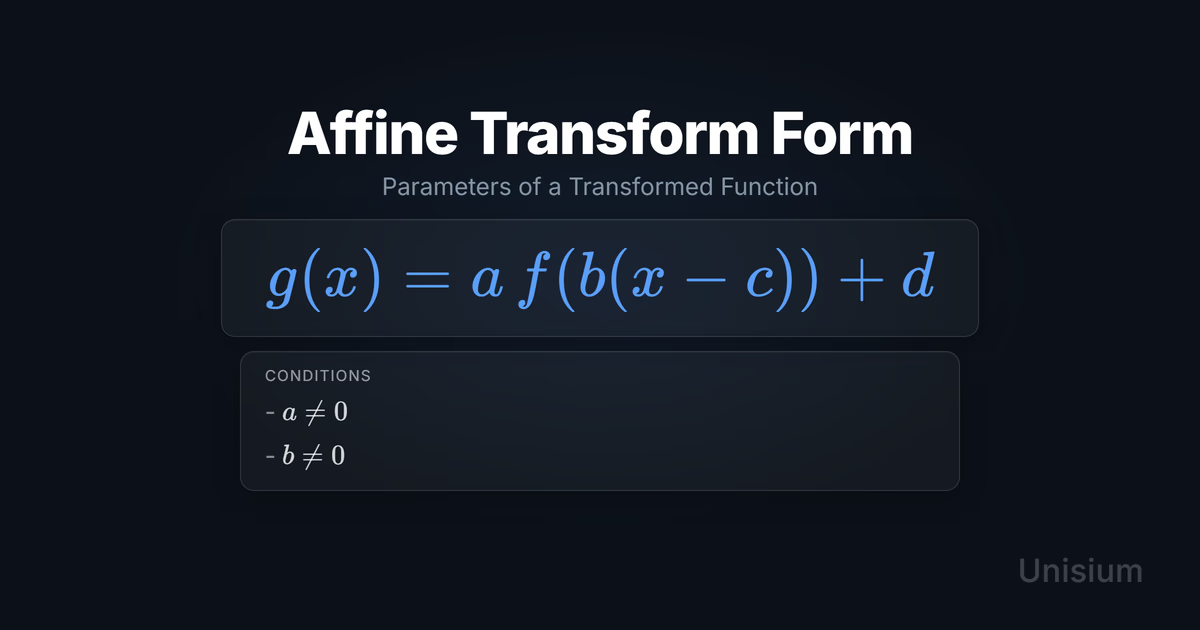
Affine Transform Form writes a transformed function as , where scales and reflects the output, scales and reflects the input, shifts the input horizontally, and shifts the output vertically. This single representation unifies all four standard transformations of a base function , provided and . It is the foundation for reading, writing, and evaluating transformed functions in the Unisium Study System.
On this page: The Principle | Conditions | Misconceptions | EE Questions | Retrieval Practice | Worked Example | Solve a Problem | FAQ
The Principle
Statement
A function is in affine transform form when it takes the shape , where is a known base function and the four real-number parameters describe every standard transformation of ‘s graph. The parameter controls the horizontal shift, controls horizontal scaling and reflection, controls vertical scaling and reflection, and controls the vertical shift. Any function formed by applying an affine map to the input and an affine map to the output of can be written in this form, provided and .
Mathematical Form
Where:
- = transformed function built from
- = base function
- = output scale factor; stretches or compresses vertically; reflects over the -axis;
- = input scale factor; compresses or stretches horizontally; reflects over the -axis;
- = horizontal shift; positive shifts right, negative shifts left
- = vertical shift; positive shifts up, negative shifts down
Alternative Form
Expanding the inner expression gives the equivalent form where . This notation appears in many textbooks, but it hides the horizontal shift: to recover from , divide by , giving .
Conditions of Applicability
Condition: ;
Practical modeling notes
- If , the output of is multiplied by zero and collapses to the constant , discarding all information about .
- If , the input to is frozen at for every , again collapsing to a constant.
- When , the input is scaled and reflected simultaneously; these effects cannot be separated within the formula.
- For a restricted-domain base function , verify that the transformed input lands inside for every you intend to evaluate.
When It Doesn’t Apply
Affine transform form describes in terms of a single base function . It does not cover:
- Sums or products of two distinct functions: cannot be written as a single unless is also a scaled/shifted copy of .
- Compositions beyond one outer function: is not in affine transform form because no single input affine map produces the nesting.
Want the complete framework behind this guide? Read Masterful Learning.
Common Misconceptions
Misconception 1: “The sign of gives the shift direction directly from the written expression”
The truth: The shift direction is opposite to the sign visible in the written formula. Because the form is , a formula written as equals , so and the graph shifts left, not right.
Why this matters: Mixing up shift direction is the most common parameter-reading error. Always rewrite the inner expression as before reading .
Misconception 2: ” stretches the graph horizontally by a factor of ”
The truth: The horizontal scale factor is . When , the input is doubled before entering , which compresses the graph horizontally by a factor of (width is halved). A stretch by requires .
Why this matters: Confusing the reciprocal relationship leads to inverted stretch/compression conclusions whenever .
Misconception 3: “The expanded form has horizontal shift ”
The truth: In the expanded form, the horizontal shift is , not . Only the factored form lets you read directly.
Why this matters: Switching between factored and expanded forms without dividing by produces the wrong shift by a factor of .
Elaborative Encoding
Use these questions to build deep understanding. (See Elaborative Encoding for the full method.)
Within the Principle
- What role does each of the four parameters play in the formula? Which parameters act on the input before is applied, and which act on the output after?
- If you double while keeping , , fixed, what happens to the graph of ? What if you double instead?
For the Principle
- Given a formula , how do you decide which symbol plays the role of , , , before reading parameters? What structural check confirms the formula is already in canonical form?
- If the condition fails, why can you no longer call the result a transformation of ?
Between Principles
- Composition Definition states for any inner function . How does Affine Transform Form relate to this when you choose ? What extra structure does Affine Transform Form add beyond composition in general?
Generate an Example
- Describe in words what happens to when you replace with while holding , , fixed. Does the answer change depending on whether is positive or negative?
Retrieval Practice
Answer from memory, then click to reveal and check. (See Retrieval Practice for the full method.)
State the principle in words: _____A transformed function g is expressed as g(x) = a f(b(x-c)) + d, where a scales and reflects output, b scales and reflects input, c shifts input horizontally, and d shifts output vertically.
Write the canonical equation: _____
State the canonical condition: _____
Worked Example
Use this worked example to practice Self-Explanation.
Problem
Given , write in canonical affine transform form and identify the parameters , , , .
Step 1: Verbal Decoding
Target: , , ,
Given:
Constraints: inner expression is in expanded form; factor to match ; outer expression directly yields and
Step 2: Visual Decoding
Draw a function pipeline with three labeled stages: input , inner map , base function , outer map , output . Label the expanded inner expression and mark the outer multiplier and additive constant. (The inner expression is in expanded form; factoring it will expose the canonical and .)
Step 3: Mathematical Modeling
Step 4: Mathematical Procedures
Step 5: Reflection
- Verification: and — both conditions for affine transform form hold.
- Connection to concept: the shift emerges only after factoring; reading directly from the unexpanded constant (getting ) is the most common error here.
- Graphical meaning: compresses the graph of horizontally by a factor of ; reflects it over the -axis and stretches it vertically by .
Before moving on: self-explain the model
Try explaining Step 3 out loud (or in writing): why the canonical form is the model you are matching, what the factoring step in Step 4 achieves, and how you would read incorrectly if you skipped factoring.
Mathematical model with explanation
Principle: Affine Transform Form — .
Conditions: , — both canonical conditions hold after factoring.
Relevance: The formula is given in expanded inner form ; the canonical form requires factoring the inner expression to expose directly.
Description: Factoring rewrites the inner expression from the pattern to . With the canonical form in place, each parameter is read by direct comparison: outer multiplier gives , inner scale gives , inner shift gives , and additive constant gives .
Goal: Identify the four affine-transform parameters by converting the inner expression from expanded form to the canonical factored form.
Solve a Problem
Apply what you’ve learned with Problem Solving.
Problem
Let . Given , identify the parameters , , , and compute .
Hint (if needed): Read parameters directly from the formula, then trace through the input pipeline.
Show Solution
Step 1: Verbal Decoding
Target: , , , ;
Given: ,
Constraints: is already in canonical affine transform form; the value of at input is given as ; is negative
Step 2: Visual Decoding
Draw a function pipeline with three labeled stages: input , inner map , base function , outer map , output . Mark the reference point on the input axis and label the remaining pipeline slots. (The inner expression is already in factored form ; parameters can be read by direct comparison.)
Step 3: Mathematical Modeling
Step 4: Mathematical Procedures
Step 5: Reflection
- Verification: ; ; ✓; , ✓
- Graphical meaning: reflects the input gap around ; at the gap is but the reflected inner input is , matching the given -value.
- Connection to concept: a negative causes horizontal reflection; recognizing this prevents confusing with a simple leftward shift.
Related Principles
| Principle | Relationship to Affine Transform Form |
|---|---|
| Function Rule Definition | Foundation: affine transform form gives an explicit rule for from ; once written, is itself a well-defined function rule |
| Composition Definition | Structural prerequisite: affine transform form is a composition of with the inner linear map |
| Evaluate by Substitution | Operational successor: to compute in affine form, evaluate the transformed input first, then substitute through the base rule and outer scaling |
See Principle Structures for how these relationships fit hierarchically.
FAQ
What is the affine transform form of a function?
The affine transform form writes a transformed function as , where is the base function and , , , are real parameters that control vertical scaling, horizontal scaling, horizontal shift, and vertical shift respectively.
What do the four parameters in do?
shifts the graph horizontally ( right, left). scales and/or reflects horizontally (horizontal scale is ; adds a horizontal reflection). scales and/or reflects vertically ( is the vertical scale; reflects over the -axis). shifts the graph vertically.
Why must and ?
If , the entire -term vanishes and becomes the constant , dropping all dependence on . If , the input to is always regardless of , again reducing to a constant. Neither represents a genuine transformation of .
How is affine transform form different from the expanded form ?
The two forms are algebraically equivalent when , but they read differently. In the factored canonical form , the horizontal shift is directly visible. In the expanded form , the shift is —you must divide by to recover it. When reading parameters, always factor first.
Why is the horizontal scale factor rather than ?
When , the input to receives a doubled value: evaluating at gives , not . The feature that used to appear at input in now appears at input in —the graph is compressed by . The general rule: horizontal scale is , so larger compresses the graph and close to stretches it.
How do I read the parameters when the formula isn’t yet in canonical form?
Factor the inner expression into : if written as , rewrite as to see , . Then match the outer expression to .
Related Guides
- Functions Subdomain Map — Return to the functions hub to see where transformed-function form sits relative to rule definition, evaluation, and composition
- Principle Structures — See how affine transform form sits in the functions hierarchy alongside composition and evaluation
- Self-Explanation — Practice explaining each parameter’s role while working through transformed-function problems
- Retrieval Practice — Build instant recall of the four-parameter form before exams
- Problem Solving — Apply the Five-Step Strategy to evaluate transformed functions systematically
How This Fits in Unisium
Within the functions subdomain, Unisium structures the affine transform form as a representational principle: is the object form you identify and write, and tracing the inner and outer parameters is the procedure. The platform surfaces this principle in elaborative encoding exercises that probe each parameter’s meaning, retrieval prompts that strengthen recall of the canonical formula, and problem sets that require Evaluate by Substitution on transformed inputs. Because this form underpins graph transformations across all function families—polynomial, exponential, trigonometric—it reappears in nearly every functions topic that follows.
Ready to master the affine transform form? See Unisium’s 14-day free trial or explore the full learning framework in Masterful Learning.

Masterful Learning
The book behind these guides: a study system for physics, math, & programming built on retrieval, connection, explanation, and problem solving.
Ready to apply this strategy?
Unisium turns these evidence-based techniques into guided study sessions for math and physics. Places are limited during early access. Check current availability to start a trial; joining the mailing list is optional.
See plans and availability Read More GuidesAlready have access? Sign in