Apply Inverse to Both Sides: Isolate a Variable Inside a Function
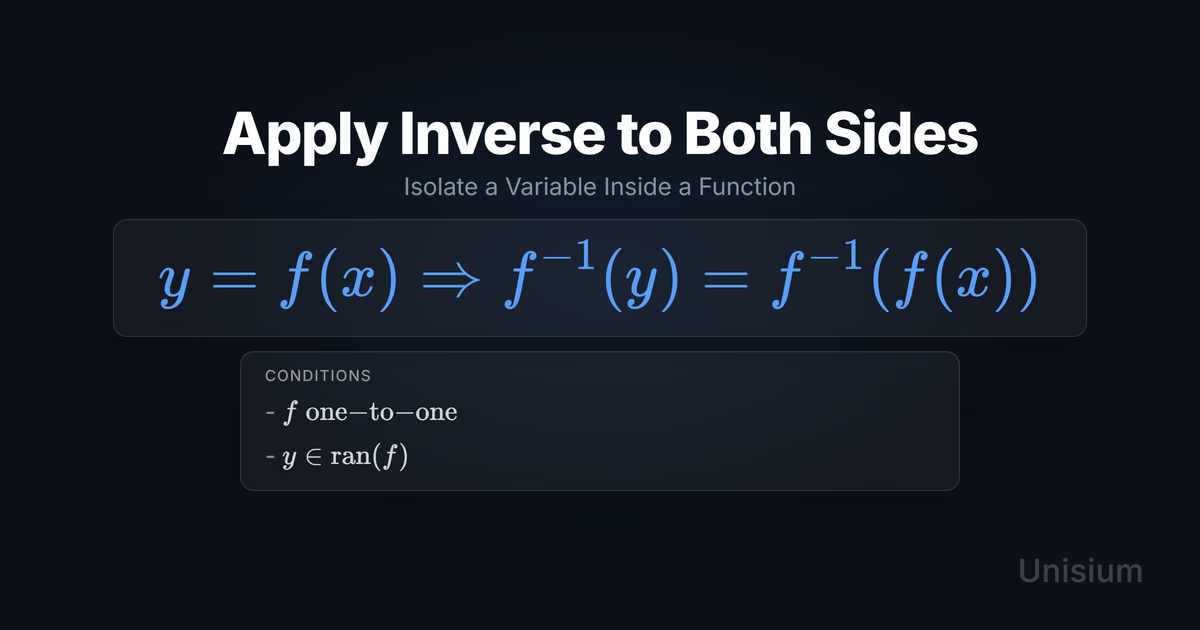
Apply Inverse to Both Sides is the move that wraps both sides of in , producing — and stops there. The move is legal only when is one-to-one and is in the range of . Building the habit of checking these two conditions before inverting is a core fluency skill in the Unisium Study System.
On this page: The Principle | Conditions | Failure Modes | EE Questions | Retrieval Practice | Practice Ground | Solve a Problem | Related Principles | FAQ | How This Fits
The Principle
The move: When a function is one-to-one and is in the range of , apply to both sides of , producing .
The invariant: This preserves the solution set.
Pattern:
The two conditions must both hold. Compare a valid application against an invalid attempted one:
| Legal ✓ | Illegal ✗ |
|---|---|
| — is one-to-one; | on — is not one-to-one; the correct result is $\sqrt(x^2) = |
Conditions of Applicability
Condition: ;
In plain language: every output of must come from exactly one input, and must be a value that can produce.
Before applying, check: (1) Is one-to-one — does every output value come from exactly one input? (2) Is the right-hand side value in the range of — could have a solution at all?
If either condition is violated: Applying may produce an extraneous solution, a multi-valued result, or an undefined expression. The equation that results is not equivalent to the original.
- If is not one-to-one (e.g., on ): the inverse function does not exist as a single-valued map. You must first restrict the domain of to a region where it is one-to-one, or handle both solution branches explicitly.
- If (e.g., asking ): the equation has no solution. Applying to is undefined; the move produces a domain error rather than a solution.
Want the complete framework behind this guide? Read Masterful Learning.
Common Failure Modes
Failure mode: Apply to both sides of without restricting the domain → , not . The student writes and misses the solution branch .
Debug: Ask “Is one-to-one?” Graph mentally or recall its symmetry: if any horizontal line crosses the graph more than once, is not one-to-one on that domain. For on , the answer is no: every positive has two preimages.
Failure mode: Attempt to apply with a -value outside (e.g., solving ) → the expression is undefined in the reals; the step fails silently if the author does not recognize the range violation.
Debug: Ask “Can equal this -value?” For exponentials: always — any is outside the range and the equation has no real solution.
Elaborative Encoding
Use these questions to build deep understanding. (See Elaborative Encoding for the full method.)
Within the Principle
- Why does — what property of one-to-one functions guarantees this simplification works?
- What changes in the move if is one-to-one only on a restricted domain (e.g., on )? Is the move still valid under that restriction?
For the Principle
- Suppose is one-to-one and . After applying to both sides and obtaining , what does it mean to say the two equations and are equivalent?
- How would you verify that a given function is one-to-one before deciding to apply this move?
Between Principles
- How does Apply Inverse to Both Sides relate to the input-recovery form of Inverse Cancellation ()? Which principle cleans up the right side after the move is made?
Generate an Example
- Construct an equation of the form where is one-to-one on a restricted domain only, and show explicitly why simply applying without stating the domain restriction leads to a missing solution.
Retrieval Practice
Answer from memory, then click to reveal and check. (See Retrieval Practice for the full method.)
State the apply-inverse move in one sentence: _____If f is one-to-one and y is in the range of f, apply f-inverse to both sides of y = f(x) to get f-inverse(y) = f-inverse(f(x)).
Write the canonical move pattern: _____
State the canonical condition: _____
Practice Ground
Use these exercises to build move-selection fluency. (See Self-Explanation for how to use worked examples effectively.)
Procedure Walkthrough
Starting from , isolate using the apply-inverse move.
Assume (one-to-one on ) and since .
| Step | Expression | Operation |
|---|---|---|
| 0 | — | |
| 1 | Apply to both sides; valid — is one-to-one and | |
| 2 | Inverse cancellation: | |
| 3 | Evaluate (since ) |
Drills
Goal micro-chain — reach the isolated variable form
For each equation, check both conditions (one-to-one and ), then apply to both sides and simplify to isolate .
Assume is one-to-one and . Apply to both sides and isolate .
Reveal
. Apply to both sides:
Check both conditions, then apply to both sides and isolate .
Reveal
is one-to-one (non-zero slope); . .
Check both conditions, then apply to isolate .
Reveal
is one-to-one; . .
Check both conditions, then apply to isolate .
Write the equation in the form first, identifying .
Reveal
Rewrite: , . is one-to-one; . .
Forward step — apply the move once and state the result
Identify and , verify the two conditions, then write the transformed equation after applying to both sides. (Do not yet simplify the right side with inverse cancellation.)
State and , verify both conditions, and write the transformed equation (one step only).
Reveal
on — one-to-one; so . .
The right side simplifies via Inverse Cancellation — a separate move.
State and , verify both conditions, and write the transformed equation (one step only).
Reveal
on — one-to-one; . .
The right side simplifies via Inverse Cancellation — a separate move.
Condition failure — domain violation. Verify whether both conditions hold before attempting the move.
Reveal
is one-to-one ✓. But : since for all real , we have ✗.
The second condition fails. The move cannot be applied — there is no real satisfying . Applying is undefined in .
Correct conclusion: no real solution.
Near-miss — condition failure: not one-to-one. A student writes ”, so .” What condition is violated?
Reveal
on is not one-to-one — both and satisfy . Condition 1 fails; does not exist as a single-valued map on .
To recover both solutions: write , giving or . Or restrict to .
Eligibility check: From the list below, identify which equations are eligible for the apply-inverse move as stated (with unrestricted domain), and which are not. For each ineligible case, state which condition fails.
- (domain )
Reveal
| Equation | one-to-one? | ? | Eligible? |
|---|---|---|---|
| ✓ ( strictly increasing) | ✓ () | Yes — apply to both sides | |
| , | ✗ (not one-to-one on ) | — | No — condition 1 fails |
| ✓ ( one-to-one on ) | ✓ () | Yes — apply to both sides | |
| ✓ | ✗ (; ) | No — condition 2 fails; no real solution | |
| ✓ ( strictly increasing) | ✓ () | Yes — apply to both sides |
Canonicalization — simplify after applying the inverse
After applying to both sides, the right side contains . Simplify to the standard form using inverse cancellation.
What is the canonical simplified form of the right side?
Reveal
— inverse cancellation with , .
(Valid because is one-to-one and .)
What is the canonical simplified form of the right side?
Reveal
— inverse cancellation with , .
Solve a Problem
Apply what you’ve learned with Problem Solving.
Problem: Starting from , isolate using the apply-inverse move. Verify both conditions before applying .
Condition check: is one-to-one (strictly increasing); so . Both conditions hold.
Full solution
| Step | Expression | Move |
|---|---|---|
| 0 | — | |
| 1 | Apply to both sides | |
| 2 | Inverse cancellation: | |
| 3 | Add to both sides | |
| 4 | Divide both sides by |
Related Principles
| Principle | Relationship |
|---|---|
| Inverse Definition | Prerequisite — defines what makes one-to-one and what is as a relation; Apply Inverse to Both Sides operationalizes that relation as a move |
| Inverse Cancellation | Follow-on step — in this solve-chain context, uses the input-recovery form to simplify to after the apply-inverse move; the two principles typically appear together |
| Composition Expansion | Structural complement — both involve domain conditions and a two-step evaluation chain; composition chains functions forward while inverse application unwinds them |
| Log-Exponential Rewrite | Concrete successor — once a logarithmic equation is isolated, this is the specific rewrite move that often follows inverse-style reasoning in practice |
FAQ
What does “Apply Inverse to Both Sides” mean?
It means: if you have an equation and has an inverse, you apply to the left side and to the right side simultaneously, producing . That is the move. Simplifying to is a subsequent step governed by Inverse Cancellation.
When is the apply-inverse move valid?
Two conditions must hold: (1) must be one-to-one — every output comes from exactly one input, so exists as a single-valued function. (2) must be in the range of — the equation must have a solution at all. If either condition fails, the move is not valid as stated.
What goes wrong if is not one-to-one?
If is not one-to-one, it has no single-valued inverse. Applying "" picks only one of the preimages and silently discards the others — producing a missing-solution error. For example, “solving” by writing misses the solution .
What goes wrong if is not in the range of ?
The equation has no solution. The expression is not defined in the intended real setting — there is no valid input for to act on. The result is a domain error rather than a solution.
How does this move relate to log-exponential rewriting?
The log-exponential rewrite () is a specific instance of the apply-inverse pattern: with (or vice versa). The general apply-inverse principle covers any one-to-one function, including trigonometric inverses, cube roots, and custom function inverses.
Do I need to include the condition check every time?
Yes — explicitly, especially when there is any risk the condition could fail (e.g., squaring, exponential, piecewise functions). For elementary linear functions (, ) the one-to-one check is trivial, but stating it once builds the habit that catches harder cases.
How This Fits in Unisium
Unisium treats Apply Inverse to Both Sides as a condition-critical move — one where skipping the one-to-one check causes silent errors that look like valid algebra. Practice sessions in the Unisium Study System embed the condition verification as the first required step in every drill and use near-miss cases (like on ) to build the checking habit.
The move ends the moment both sides are wrapped in : the equation is now . The subsequent step that collapses to is Inverse Cancellation — a distinct principle. This guide covers the first half of that two-step sequence.
Explore further:
- Functions Subdomain Map — Return to the functions hub to see how inverse moves, logarithms, and composition are grouped together in the release-prep cluster
- Inverse Definition — The representational prerequisite: what a one-to-one function is and why the inverse relation becomes a function
- Inverse Cancellation — The cleanup step that typically follows the apply-inverse move in a standard solve chain, using the input-recovery form
- Log-Exponential Rewrite — A common specialized follow-on when the inverse relationship is logarithmic or exponential
- Elaborative Encoding — Build deep understanding of why both conditions are necessary, not just convenient
Ready to master Apply Inverse to Both Sides? See Unisium’s 14-day free trial or explore the full learning framework in Masterful Learning.
Masterful Learning
The book behind these guides: a study system for physics, math, & programming built on retrieval, connection, explanation, and problem solving.
Ready to apply this strategy?
Unisium turns these evidence-based techniques into guided study sessions for math and physics. Places are limited during early access. Check current availability to start a trial; joining the mailing list is optional.
See plans and availability Read More GuidesAlready have access? Sign in