Piecewise Definition: Define Functions with Multiple Rules Across Regions
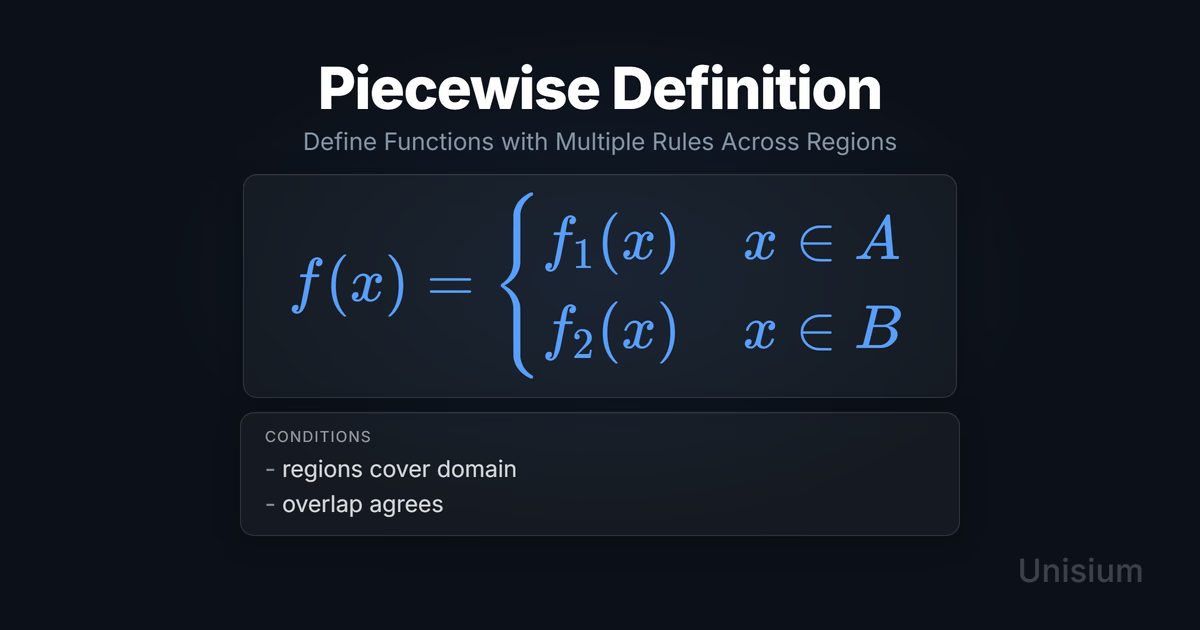
Piecewise Definition is the principle that a function can be defined by assigning different rules to different regions of its domain: on region , on region , and so on. Two conditions make the definition valid: the regions must collectively cover the entire domain (so no input is left undefined), and any rules that apply to the same input must assign the same output. The Unisium Study System builds mastery through elaborative encoding, retrieval practice, and problem solving.
The piecewise form is not limited to a single switching threshold: the regions can be any subsets of the domain, and they may overlap. When regions are disjoint the overlap condition is vacuously satisfied; when they share points, agreement must be checked explicitly. If one expression suffices for the whole domain, the Function Rule Definition applies. Choosing the wrong form, or writing a piecewise specification without verifying both conditions, creates silent errors that surface only when an input falls in an unclaimed gap or lands in an overlap where the formulas disagree.
On this page: The Principle | Conditions | Misconceptions | EE Questions | Retrieval Practice | Worked Example | Solve a Problem | FAQ
The Principle
Statement
A function can be defined by assigning different rules to different regions of its domain. The definition is valid when the regions collectively cover the domain (so every input is handled) and every input to which more than one rule applies receives the same output from each applicable rule. When regions are disjoint, that second condition is trivially satisfied; when regions overlap on a point or interval, agreement must hold on the entire overlap.
Mathematical Form
Where:
- = the function being defined
- = the rule expressions on each region (e.g., , )
- = the input regions (intervals or other subsets of the domain)
The notation extends naturally to three or more pieces by adding rows inside the braces.
Alternative Forms
In different contexts, this appears as:
- Explicit intervals: for and for
- Absolute value decomposition: (the canonical two-piece example)
Conditions of Applicability
Condition: regions cover domain; overlap agrees
Practical modeling notes
- “Regions cover domain” means . Every input must fall in at least one piece; a gap in coverage leaves some inputs undefined.
- “Overlap agrees” means: for every input , the two rules must assign the same value: . The overlap can be a single point, an interval, or any other set; the requirement holds over the entire shared region, not only at isolated boundary points.
- A common pattern avoids overlap entirely by making regions disjoint (e.g., and ). Disjoint regions satisfy “overlap agrees” trivially.
- Overlapping regions are also valid. For example, if and , then and both rules must agree on that whole interval—not merely at 3 or 5.
- When regions are disjoint, boundary points must be assigned to exactly one side; the common convention is to close one side and open the other (e.g., and ).
When a piecewise form is unnecessary
- Single rule suffices: If one expression works for the entire domain without any regional distinction, the Function Rule Definition is the right—and simpler—representation.
When a piecewise specification is invalid
- Gap in coverage: If the regions fail to cover the full domain, some inputs are simply undefined. The specification is incomplete, not a valid function.
- Disagrees at overlap: If two pieces are both defined on some input but assign different values, the specification describes a relation (one input, two outputs), not a function.
Want the complete framework behind this guide? Read Masterful Learning.
Common Misconceptions
Misconception 1: A piecewise function assigns two outputs to any input in an overlap
The truth: A piecewise function assigns exactly one output to each input. An input may lie in more than one region, but only if the applicable formulas agree on that input’s output. The overlap condition ensures the assignment is unique.
Why this matters: Students sometimes evaluate a piecewise function at a shared input using both formulas and report two answers. Doing so as a check is correct—if both formulas give the same value ✓, the definition is valid; if they differ, it is not a function.
Misconception 2: The pieces are separate functions that don’t need to tile the domain
The truth: A piecewise definition creates one function with one domain. Each piece contributes the rule for its region, and together they must cover every input. A definition like ” for and for ” leaves inputs in undefined—that is not a complete piecewise function on .
Why this matters: Missing inputs produce undefined outputs, which cause silent errors when evaluating or composing.
Misconception 3: Any function with “cases” is automatically valid
The truth: Writing a brace notation is not sufficient. You must verify both structural conditions: coverage and overlap agreement. A brace notation with a gap or a disagreement on any shared input is not a valid piecewise definition.
Elaborative Encoding
Use these questions to build deep understanding. (See Elaborative Encoding for the full method.)
Within the Principle
- In , what does “regions cover domain” mean in plain terms? Could there be a value of in the domain that no region captures?
- What does “overlap agrees” require when and share a set of inputs? What happens to the definition if there is any input where ?
For the Principle
- How do you decide whether a function needs a piecewise definition rather than a single function rule definition? What feature in a verbal description signals a piecewise form?
- When writing a piecewise definition, what are the two structural requirements you must verify before concluding the definition is valid?
Between Principles
- The Function Rule Definition uses one expression for the whole domain; the Piecewise Definition uses multiple. When, if ever, could a piecewise definition reduce to a single rule definition?
Generate an Example
- Describe a real-world quantity—shipping costs, income tax, or a speed-tier internet plan—that requires a piecewise definition because one expression cannot describe the whole domain. Identify the pieces, state what the regions are, and verify that your specification satisfies both the coverage condition and the overlap-agreement condition.
Retrieval Practice
Answer from memory, then click to reveal and check. (See Retrieval Practice for the full method.)
State the principle in words: _____A function can be defined by assigning different rules to different input regions; the regions must cover the domain, and formulas must agree wherever regions overlap.
Write the piecewise equation form (two pieces): _____
State the canonical condition: _____regions cover domain; overlap agrees
Worked Example
Use this worked example to practice Self-Explanation.
Problem
A function is defined by:
Find the value of so that is a valid piecewise definition.
Step 1: Verbal Decoding
Target:
Given: , , , ,
Constraints: domain ; both regions closed at so ; piecewise definition requires overlap agreement
Step 2: Visual Decoding
Draw a number line. Mark . Label (closed at 2) and (closed at 2). (So lies in both regions; the overlap is the single point .)
Step 3: Mathematical Modeling
Step 4: Mathematical Procedures
Step 5: Reflection
- Verification: ; ✓ — the formulas agree at the shared overlap point.
- Domain check: — domain fully covered.
- Interpretation: Any assigns two different outputs to , violating the function requirement; the overlap condition uniquely pins .
Before moving on: self-explain the model
Try explaining Step 3 out loud (or in writing): why the Piecewise Definition applies here, what the regions and are, and why the overlap condition produces a single equation in .
Mathematical model with explanation (what “good” sounds like)
Principle: Piecewise Definition — uses two different rules assigned to two overlapping regions.
Conditions: Domain is covered by . The regions share the point , so the overlap condition applies: must equal .
Relevance: The piecewise form is valid only when both structural conditions hold. Coverage is automatic here; the overlap condition is the constraint that determines .
Description: Setting gives , solved by . With , the formula in region is , which passes through —the same point as .
Goal: Find that makes the shared overlap point uniquely defined—one output assigned.
Solve a Problem
Apply what you’ve learned with Problem Solving.
Problem
Determine whether the following specification defines a valid function on , and if not, identify which condition it violates.
Hint (if needed): List the two regions, form their union, and compare it to .
Show Solution
Step 1: Verbal Decoding
Target: Is a valid piecewise function on ? If not, which condition fails?
Given: , , , ,
Constraints: claimed domain ; regions and ; piecewise definition requires coverage and overlap agreement
Step 2: Visual Decoding
Draw a number line. Mark and . Label and . (The interval has no region assigned to it.)
Step 3: Mathematical Modeling
Step 4: Mathematical Procedures
Step 5: Reflection
- Verification: Pick : no piece applies — is undefined, confirming the gap.
- Overlap check: , so the overlap condition is vacuously satisfied — the only failing condition is coverage.
- Interpretation: Adding a third piece (e.g., for ) would repair coverage; the overlap condition would then apply only at and to whatever piece is added there.
Related Principles
| Principle | Relationship to Piecewise Definition |
|---|---|
| Function Rule Definition | Foundation: piecewise extends the single-rule form to multiple input regions |
| Piecewise Branch Selection | Evaluation move: uses the piecewise definition to select the correct piece for a given input |
| Composition Definition | Related structure: composing a piecewise function with another can produce a new piecewise function |
| Continuity at a Point | Forward calculus check: once a function is defined piecewise, continuity at the boundary depends on matching the one-sided approach behavior and function value |
See Principle Structures for how to organize these relationships visually.
FAQ
What is the Piecewise Definition?
The Piecewise Definition is the principle that a function can assign different rules to different input regions. Instead of one formula for the entire domain, each region has its own rule: for and for . The definition is valid when the regions collectively cover the domain and any rules that apply to the same input assign the same output.
When does the Piecewise Definition apply?
Use it whenever different input regions require different rules—a flat fee that scales above a cutoff, an absolute value whose formula depends on the sign of the input, a graph with a corner or a jump discontinuity. The regions need not be split at a single threshold; any collection of subsets that covers the domain can serve, provided the overlap-agreement condition holds on any shared inputs. If one expression works for the entire domain, the Function Rule Definition is sufficient.
What’s the difference between a piecewise definition and a single function rule definition?
A single rule uses one expression for every valid input. A piecewise definition uses a separate expression for each input region of the domain. If the output formula never changes across inputs, the single-rule form is simpler and preferred. If the formula genuinely differs in different regions of the domain, the piecewise form is necessary.
What are the most common mistakes with piecewise definitions?
- Leaving a gap: A region is missing, so some inputs land in no piece and are undefined.
- Disagreeing on an overlap: Two overlapping regions assign different values to the same input, making the output ambiguous.
- Omitting region specifications: Writing with no domain clause leaves the region unstated, so the definition is incomplete.
How do I verify that a piecewise definition is valid?
Two checks: (1) Confirm that the union of all regions equals the full domain—every input must fall in at least one piece. (2) For any two regions that share a point or interval, confirm that their formulas assign the same output on the overlap.
Related Guides
- Functions Subdomain Map — Return to the functions hub to see where piecewise structure sits relative to rule-based evaluation and later calculus prerequisites
- Continuity at a Point — Follow the next calculus check that uses piecewise boundary structure directly
- Principle Structures — Organize this principle in a hierarchical framework
- Self-Explanation — Learn to explain worked examples step by step
- Retrieval Practice — Make this principle instantly accessible
- Problem Solving — Apply principles systematically to new problems
How This Fits in Unisium
The Piecewise Definition is a core representational principle in the functions subdomain of Unisium. After mastering the Function Rule Definition, the app builds piecewise competency through elaborative encoding questions that probe coverage and overlap-agreement conditions, cloze retrieval prompts that reinforce the piecewise form, self-explanation practice on overlap-agreement problems, and problem-solving sessions drawn from the Unisium problem bank.
Ready to master the Piecewise Definition? See Unisium’s 14-day free trial or explore the full learning framework in Masterful Learning.

Masterful Learning
The book behind these guides: a study system for physics, math, & programming built on retrieval, connection, explanation, and problem solving.
Ready to apply this strategy?
Unisium turns these evidence-based techniques into guided study sessions for math and physics. Places are limited during early access. Check current availability to start a trial; joining the mailing list is optional.
See plans and availability Read More GuidesAlready have access? Sign in