Log-Exponential Rewrite: Convert Between Log and Exponential Forms
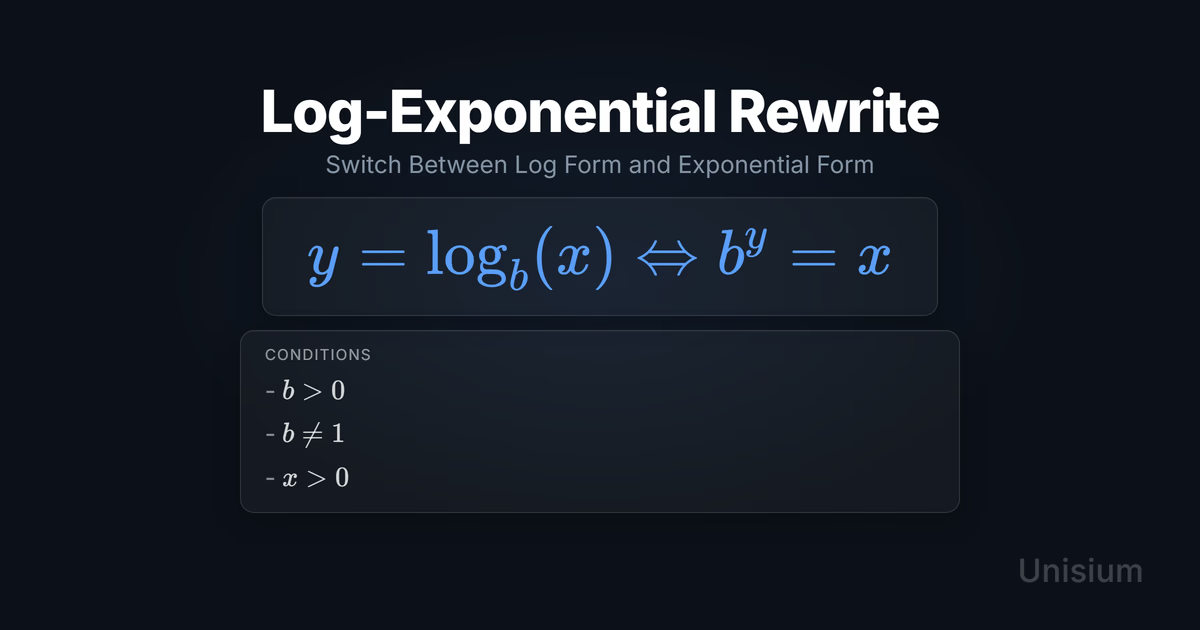
Log-Exponential Rewrite is the move that switches between the logarithmic statement and the exponential statement — the two forms say exactly the same thing. The move is legal only when , , and — the base-validity and domain conditions must hold for the logarithmic form involved in the rewrite. Recognizing when the equation is already in isolated log form and all conditions are met — versus when a preliminary algebraic step is still needed — is a core fluency skill in the Unisium Study System.
On this page: The Principle | Conditions | Failure Modes | EE Questions | Retrieval Practice | Practice Ground | Solve a Problem | Related Principles | FAQ | How This Fits
The Principle
The move: When , , and , exchange the logarithmic form for the exponential form , or vice versa.
The invariant: This produces an equivalent equation with the same solution set — the two forms express the identical relationship among , , and .
Pattern:
The base-validity and domain conditions must all hold. Compare a valid application against an invalid one:
| Legal ✓ | Illegal ✗ |
|---|---|
| — , , ✓ | — violates ; for every , so no solution exists |
Conditions of Applicability
Condition: ; ;
Before applying, check:
-
Is the statement already in isolated form — or ?
-
If so, is the base positive and not equal to , and is the logarithm argument strictly positive?
-
If : the exponential is not real-valued for all (e.g., is undefined for non-integer ). No logarithm base can be negative.
-
If : for every real , so the exponential function is constant — no value of can satisfy unless , and even then every works. The function is not invertible.
-
If : since for all real when , the exponential side can never equal a non-positive number. The logarithm is undefined for .
Want the complete framework behind this guide? Read Masterful Learning.
Common Failure Modes
Failure mode: Apply the rewrite when the argument is negative or zero (e.g., write and convert to ) → the equation has no real solution; the rewrite was performed on an undefined expression.
Debug: Before rewriting, confirm the original argument is strictly positive. This is a precondition on the log statement itself — if the argument is already known to be non-positive, the logarithm is undefined and there is nothing valid to convert.
Elaborative Encoding
Use these questions to build deep understanding. (See Elaborative Encoding for the full method.)
Within the Principle
- The condition follows from the fact that for all real when . What does this say about the range of any exponential function with a positive base, and why does it force the restriction on ?
- The condition rules out the constant function . Try to define : what equation would it have to satisfy, and why can no real value of satisfy it?
For the Principle
- When solving a logarithmic equation, how do you decide whether to rewrite to exponential form or stay in log form? What is the goal state that guides the choice?
- The Log-Exponential Rewrite requires the equation to be in isolated log form: . If you encounter instead, what algebraic step must come first, and what goes wrong if you try to rewrite without isolating?
Between Principles
- How does Log-Exponential Rewrite relate to Apply Inverse to Both Sides? After isolating by applying inverses, which principle handles the next simplification step?
Generate an Example
- Construct a logarithmic equation where a student applies the Log-Exponential Rewrite before the logarithm is isolated. Show what form the equation must be in for the rewrite to apply, and identify what algebraic step must come first.
Retrieval Practice
Answer from memory, then click to reveal and check. (See Retrieval Practice for the full method.)
State the log-exponential rewrite in one sentence: _____When b > 0, b ≠ 1, and x > 0, the logarithmic form y = log base b of x is equivalent to the exponential form b to the y equals x.
Write the canonical pattern: _____
State the canonical condition: _____
Practice Ground
Use these exercises to build move-selection fluency. (See Self-Explanation for how to use worked examples effectively.)
Procedure Walkthrough
Solve for .
Before rewriting: the equation is already in isolated log form ✓; ✓; ✓. Once the rewrite is applied, the right-hand side is automatically positive by construction — any solution will leave the argument positive.
| Step | Expression | Operation |
|---|---|---|
| 0 | — | |
| 1 | Log-Exp Rewrite: isolated form ✓, , ✓ — exchange log form for exponential form | |
| 2 | Evaluate | |
| 3 | Add to both sides | |
| 4 | Divide both sides by |
The right-hand side by the rewrite itself, so is positive by construction.
Drills
Goal micro-chain — reach the target form and evaluate
Solve . Show the rewriting step and give the exact value of .
Reveal
Conditions: ✓, ✓.
Log-Exp Rewrite:
The right-hand side by construction — positivity of the argument is guaranteed by the rewrite.
Solve for . State why the resulting argument is positive by construction.
Reveal
Conditions: ✓, ✓.
Log-Exp Rewrite:
The right-hand side by construction, so is a positive argument — guaranteed by the rewrite.
Write in exponential form. Identify , , and , then confirm.
Reveal
, , . Conditions: ✓, ✓, ✓.
Confirm: ✓.
Find the base : given , write the exponential form and solve for .
Reveal
Log-Exp Rewrite:
Verify conditions on the found base: ✓, ✓.
Condition failure — is the Log-Exp Rewrite valid for ? State which condition is violated.
Reveal
Not valid. The base violates .
Attempting the rewrite gives . But for every real , so the equation has no real solution. The function is constant — it cannot define a logarithm because it is not one-to-one and its range is just .
Near-miss — domain failure: a student writes ”, so .” What is wrong?
Reveal
The argument violates . The condition fails before the rewrite is even defined.
Since , the exponential is always strictly positive for any real . The equation has no real solution — the rewrite produced a nonsensical equation because the input to the logarithm was outside its domain.
The rule: Confirm the argument is strictly positive before applying the rewrite. The argument’s positivity is a precondition on the original log statement — if it fails, the log is undefined and there is nothing valid to convert.
Move selection — is the Log-Exp Rewrite the right next step here?
Reveal
Not yet. The equation is not in isolated log form — the sits outside the logarithm. Applying the rewrite now would treat the entire left side as a single log expression, which it is not.
First, isolate the logarithm:
Now the equation is in the required form. Apply the Log-Exp Rewrite:
Forward step — apply the rewrite once
Rewrite as exponential form: . Write only the result of the rewrite step.
Reveal
Conditions: ✓, ✓.
(Stop here — the prompt asks for one rewrite step only.)
Rewrite as logarithmic form: . Write only the result of the rewrite step.
Reveal
Conditions: ✓, ✓, ✓.
Evaluate by rewriting to exponential form.
Reveal
Let . Log-Exp Rewrite: .
Find : , , ✓.
Eligibility check — which forms are valid?
For each expression, state whether the Log-Exp Rewrite applies as written. If it does not, state which condition fails.
Reveal
| Expression | ? | ? | ? | Eligible? |
|---|---|---|---|---|
| ✓ () | ✓ | ✓ () | Yes → | |
| ✗ () | — | — | No — must be positive | |
| ✓ | ✓ | ✗ (, not ) | No — argument must be strictly positive | |
| ✓ () | ✓ | ✓ ( in log form) | Yes → | |
| ✓ | ✗ () | — | No — is not a valid logarithm base |
Canonicalization — simplify to standard form
Starting from , rewrite in logarithmic form and identify .
Reveal
Conditions: ✓, ✓, ✓.
Evaluate: , so .
Solve . Apply the rewrite and evaluate.
Reveal
Conditions: ✓, ✓; equation in isolated form ✓.
Log-Exp Rewrite:
Solve a Problem
Apply what you’ve learned with Problem Solving.
Problem: Starting from , solve for using the Log-Exponential Rewrite. State why the original argument is valid once the rewrite is applied.
Full solution
| Step | Expression | Move |
|---|---|---|
| 0 | — | |
| 1 | Log-Exp Rewrite: isolated form ✓, , ✓ — exchange log form for exponential form | |
| 2 | Evaluate | |
| 3 | Subtract from both sides | |
| 4 | Divide both sides by |
The rewrite produces , so the argument is positive in the solved equation by construction.
Related Principles
| Principle | Key | Relationship |
|---|---|---|
| Logarithm Model | logarithmModel | Representational backbone — defines the log-exp equivalence as a model; this guide applies it as a rewrite move |
| Apply Inverse to Both Sides | inverseApply | Paired move — isolates ; Log-Exp Rewrite converts that isolated form to exponential |
| Inverse Cancellation | inverseCancel | Simplification complement — simplifies or after a rewrite step |
FAQ
What is the Log-Exponential Rewrite?
The Log-Exponential Rewrite is the equivalence . It lets you convert a logarithmic equation into exponential form (or vice versa) to make it easier to solve. The two forms say exactly the same thing — they are two ways of writing the relationship among the base , the exponent , and the result .
When is the Log-Exponential Rewrite valid?
The rewrite requires all three conditions: (the base must be a positive real number), (the base must not equal , because is constant and non-invertible), and (the logarithm argument must be strictly positive, because an exponential with a positive base is always positive).
What goes wrong if I forget the condition ?
If the argument is negative or zero, is undefined in the real numbers. Converting it anyway produces an equation () that has no real solution — but the rewrite was never legal to begin with.
For equations already in isolated log form , the right-hand side after rewriting is automatically, so any solution will satisfy the positivity constraint by construction. The real danger is applying the rewrite to a log argument that is already known to be non-positive, or attempting the rewrite before the equation is in isolated form.
How is the Log-Exponential Rewrite different from Inverse Cancellation?
Log-Exponential Rewrite converts between two forms of the same relation: and . Inverse Cancellation simplifies a composed expression like or directly to the original value. They are complementary moves: rewrite first to put the equation in exponential form, then use cancellation to simplify nested compositions if they appear.
Does the Log-Exponential Rewrite work in both directions?
Yes. You can convert to , and you can convert to . The direction depends on which form is more useful next — converting to exponential form typically helps when solving for , and converting to logarithmic form typically helps when solving for an exponent.
How This Fits in Unisium
In Unisium, the Log-Exponential Rewrite appears in practice problems that ask you to solve logarithmic and exponential equations. The system surfaces this principle at the exact moment you need to select the rewrite move, and tracks whether you verified all three conditions correctly. The most common errors drilled against are applying the rewrite to an invalid base ( or ), applying it to an undefined log argument (non-positive), or attempting the rewrite before the log form is isolated — the three preconditions are front-loaded and must be met on the original statement. Repeated drill-yard practice builds automatic condition checking so it becomes part of how you read a logarithm, not a separate step you have to remember.
Explore further:
- Functions Subdomain Map — See where this move sits in the functions principle hierarchy
- Calculus Subdomain Map — Follow the next subdomain layer where logarithmic and exponential families become derivative and integral targets
- Logarithm Model — The representational backbone that defines the log-exp relationship
- Elaborative Encoding — Build deep understanding of why all three conditions are necessary
Ready to master the Log-Exponential Rewrite? See Unisium’s 14-day free trial or explore the full learning framework in Masterful Learning.

Masterful Learning
The book behind these guides: a study system for physics, math, & programming built on retrieval, connection, explanation, and problem solving.
Ready to apply this strategy?
Unisium turns these evidence-based techniques into guided study sessions for math and physics. Places are limited during early access. Check current availability to start a trial; joining the mailing list is optional.
See plans and availability Read More GuidesAlready have access? Sign in