Piecewise Branch Selection: Evaluating the Right Rule
Piecewise branch selection is the move that evaluates a piecewise-defined function at a specific input by identifying a branch condition satisfied by the input, then substituting into that branch’s rule. It applies when the input lies in the declared domain region of a branch — written . Recognizing a valid applicable branch before substituting is a core fluency skill practiced in the Unisium Study System.
On this page: The Principle | Conditions | Failure Modes | EE Questions | Retrieval Practice | Practice Ground | Solve a Problem | FAQ
The Principle
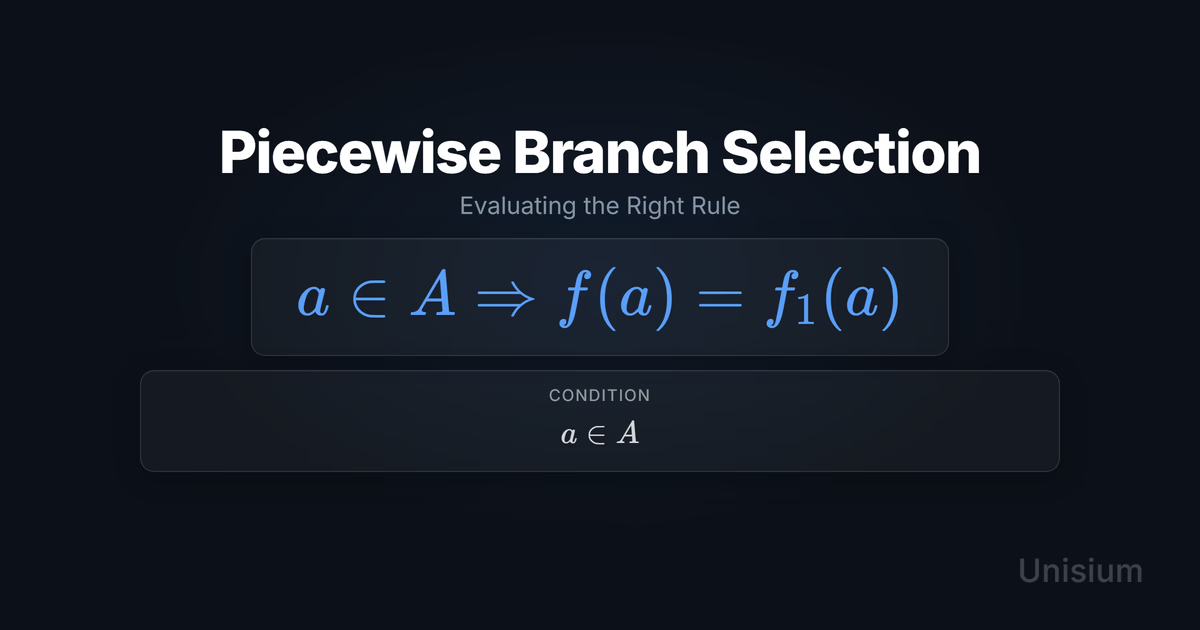
The move: When a piecewise function assigns rule to inputs in region , and the input satisfies , evaluate using that branch: .
The invariant: This applies the rule assigned to region in accordance with the piecewise definition — valid precisely because the input satisfies the branch condition .
Pattern:
Let . Compare a valid and an invalid branch application:
| Legal ✓ | Illegal ✗ |
|---|---|
| — condition fails; branch 1 does not apply |
The illegal column shows a broken applicability step: the condition fails, so the implication does not hold, yet the substitution proceeds anyway. The result () is computable but wrong. The correct value comes from branch 2, whose condition does hold.
Conditions of Applicability
Condition:
Before applying, check: Verify that the input satisfies the branch condition — is ? The mathematical check is whether belongs to the branch region, not which condition is listed first. In practice you can test the listed conditions one by one, but the goal is to identify a valid applicable branch.
If the condition is violated: Substituting into the wrong branch rule produces a plausible but incorrect value. The condition check must precede substitution.
- If , branch rule does not apply; identify a branch with and apply instead.
- At a boundary : a strict condition () excludes the endpoint; a non-strict condition () includes it. A well-formed piecewise definition ensures a consistent output at boundaries — either a single branch condition applies there, or overlapping branches agree there.
Want the complete framework behind this guide? Read Masterful Learning.
Common Failure Modes
Failure mode: Apply the first branch rule without verifying its condition → incorrect function value whenever the input satisfies a later branch instead.
Debug: Write the condition check before substituting: “Is ?” If no, move to the next branch. Never substitute first.
Failure mode: Confuse a strict boundary () with a non-strict one () and assign a boundary input to the wrong branch → boundary input evaluated with the wrong rule, producing an off-by-one error at the seam.
Debug: At a boundary , check the inequality character precisely. For branch condition : is true (non-strict includes the endpoint). For : is false (strict excludes the endpoint).
Elaborative Encoding
Use these questions to build deep understanding. (See Elaborative Encoding for the full method.)
Within the Principle
- What does mean specifically when is the region ? What value is on the boundary, and which branch condition is satisfied there?
- Why must the condition check happen before substitution — what would go wrong if you substituted first and checked afterward?
For the Principle
- Suppose two branch conditions both hold for the same input , but the corresponding rules give the same value at . Is the selection move still valid? What property of the piecewise definition makes that possible?
- How do you apply branch selection when the input is an expression (e.g., ) rather than a specific number?
Between Principles
- How does piecewise branch selection extend Evaluate by Substitution? What does the branch-selection condition add to the direct move that the single-rule case does not require?
Generate an Example
- Construct a piecewise function with three branches where an input at the seam between two regions is a near-miss for one branch: it looks like it satisfies the condition but the strictness of the inequality excludes it. State explicitly which branch the input belongs to and why.
Retrieval Practice
Answer from memory, then click to reveal and check. (See Retrieval Practice for the full method.)
State the piecewise branch selection move in one sentence: _____If a is in region A, evaluate f(a) using the rule assigned to A.
Write the canonical move pattern: _____
State the canonical condition: _____
Practice Ground
Use these exercises to build move-selection fluency. (See Self-Explanation for how to use worked examples effectively.)
Procedure Walkthrough
Let . Evaluate .
| Step | Expression | Operation |
|---|---|---|
| 0 | has branches | — |
| 1 | ; select | Check condition : satisfied |
| 2 | Substitute into | |
| 3 | Simplify |
Drills
Forward step — identify the branch and evaluate
Check the condition for the given input, select the matching branch, then substitute and simplify.
Check condition and evaluate .
Reveal
Check: ✓ → (branch 2 condition holds).
Check condition and evaluate .
Reveal
Check: ✓ → (branch 1 condition holds).
Check condition and evaluate . Pay attention to the boundary.
Reveal
Check branch 1: ✓ → (non-strict inequality includes the boundary).
Check branch 2: is false — branch 2 does not apply to .
Near-miss: Check condition and evaluate . Which branch condition is satisfied at the boundary?
Reveal
Branch 2 condition: ? False — strict inequality fails at the boundary.
Branch 1 condition: ✓ → .
, not .
The near-miss is using the middle branch (constant rule ). Middle branch requires strict ; the boundary belongs to branch 1 because branch 1 uses a non-strict .
Overlap agreement: Both branch conditions hold at . Verify that using either branch gives the same value, and explain why the selection move is still valid.
Reveal
Branch 1 condition: ✓ → .
Branch 2 condition: ✓ → .
Both conditions hold and both rules give . The selection move is valid using either branch. The move does not require that be the unique region containing — it only requires that satisfy and that the definition be consistent there. Because the rules agree on the overlap, consistency holds.
Applicability check: A student claims the middle branch of applies at and writes . Identify the condition failure and find the correct value.
Reveal
Middle branch condition: ? False — fails. Condition is not satisfied.
Branch 3 condition: ✓ → .
The move “use branch 2 at ” is invalid because . The student applied a rule whose condition was not met.
Action label — identify what was done
These drills show two steps in a chain. Name the operation, including the condition check that justifies the branch selected.
What operation was applied?
Reveal
Confirmed (condition for branch 2 holds); substituted into .
What operation was applied?
Let .
Reveal
Confirmed (condition for branch 1 holds); evaluated .
Error identification: A student evaluates . What went wrong?
Reveal
Branch 1 condition: ? False. Branch 1 does not apply to .
Branch 2 condition: ✓ → .
Correct value: .
The student substituted into branch 1 () without checking its condition. The condition check must precede substitution.
Eligibility check: Which inputs from satisfy the condition for branch 1 of (the branch)?
Reveal
Branch 1 condition: .
| Input | ? | Branch 1 eligible? |
|---|---|---|
| ✓ | Yes | |
| ✓ | Yes | |
| ✗ | No | |
| ✗ | No | |
| ✗ | No | |
| ✗ | No |
Eligible inputs: .
Solve a Problem
Apply what you’ve learned with Problem Solving.
Problem: Let
Evaluate . Verify which branch condition satisfies before substituting.
Full solution
| Step | Expression | Move |
|---|---|---|
| 0 | has | — |
| 1 | ? No → , branch 1 eliminated | Check : fails |
| 2 | ? Yes ✓ → ; select | Check : satisfied; branch selected |
| 3 | Substitute into | |
| 4 | Simplify |
Related Principles
| Principle | Relationship |
|---|---|
| Piecewise Definition | Prerequisite: defines the branch structure (regions, rules, coverage, overlap agreement) that branch selection operates on |
| Function Rule Definition | The single-rule representational form that branch selection builds on |
| Evaluate by Substitution | The direct evaluation move that executes once the correct branch has been identified: applied inside the selected branch |
| Left-hand limit statement | Forward calculus sibling: one-sided limit checks on piecewise functions reuse the same branch-selection logic, but with approach direction instead of direct substitution |
FAQ
What is piecewise branch selection?
Piecewise branch selection is the rule for evaluating a piecewise-defined function: identify a branch condition satisfied by the input , then substitute into that branch’s rule. Without the condition check, substituting into the wrong branch produces a plausible but wrong value with no algebraic warning.
When is piecewise branch selection valid?
The move is valid when — the input satisfies the branch condition. For each input in the function’s domain, the piecewise definition is constructed so that the assigned value is consistent: the branch conditions may be disjoint, or they may overlap provided the overlapping rules agree. Either way, when holds, applying is consistent with the piecewise definition.
What goes wrong if I pick the wrong branch?
You get a numerically computable but incorrect value. The computation succeeds regardless of which branch rule you use, so there is no error signal from the algebra itself. This is the defining hazard of the move: the condition check must be explicit and must precede substitution.
How do I handle boundary points?
Check whether the boundary condition is strict ( or ) or non-strict ( or ). A boundary input like satisfies (non-strict, endpoint included) but does not satisfy (strict, endpoint excluded). Write the inequality test out explicitly — do not infer from visual proximity.
Does piecewise branch selection apply only to numeric intervals?
No. The condition can describe any regional criterion: half-open intervals, equality conditions (), or symbolic domains. The same selection logic applies as long as you can verify whether satisfies the branch condition.
How This Fits in Unisium
Unisium trains piecewise branch selection as a move-selection skill, not just a computation. Practice sessions emphasize the condition check as the first step, build fluency with boundary cases, and return to near-miss scenarios at spaced intervals to prevent wrong-branch errors from becoming automatic. The drill-yard format in this guide — forward steps, action labels, and eligibility checks — maps directly to how Unisium sequences condition-critical practice.
Explore further:
- Functions Subdomain Map — Return to the functions hub to see how piecewise evaluation connects to the broader functions cluster
- Left-hand limit statement — One-sided limit work on piecewise functions starts by choosing the branch valid from the left
- Right-hand limit statement — The same branch-selection logic applies from the right when checking a boundary from the opposite side
- Piecewise Definition — The structural prerequisite: what a piecewise function is and what the branch domain contract requires
- Function Rule Definition — The single-rule representational form that the piecewise case extends
- Elaborative Encoding — Build deep understanding of why the condition check must come first
Ready to master Piecewise Branch Selection? See Unisium’s 14-day free trial or explore the full learning framework in Masterful Learning.
Masterful Learning
The book behind these guides: a study system for physics, math, & programming built on retrieval, connection, explanation, and problem solving.
Ready to apply this strategy?
Unisium turns these evidence-based techniques into guided study sessions for math and physics. Places are limited during early access. Check current availability to start a trial; joining the mailing list is optional.
See plans and availability Read More GuidesAlready have access? Sign in