Inverse Cancellation: Recover the Original Input or Output
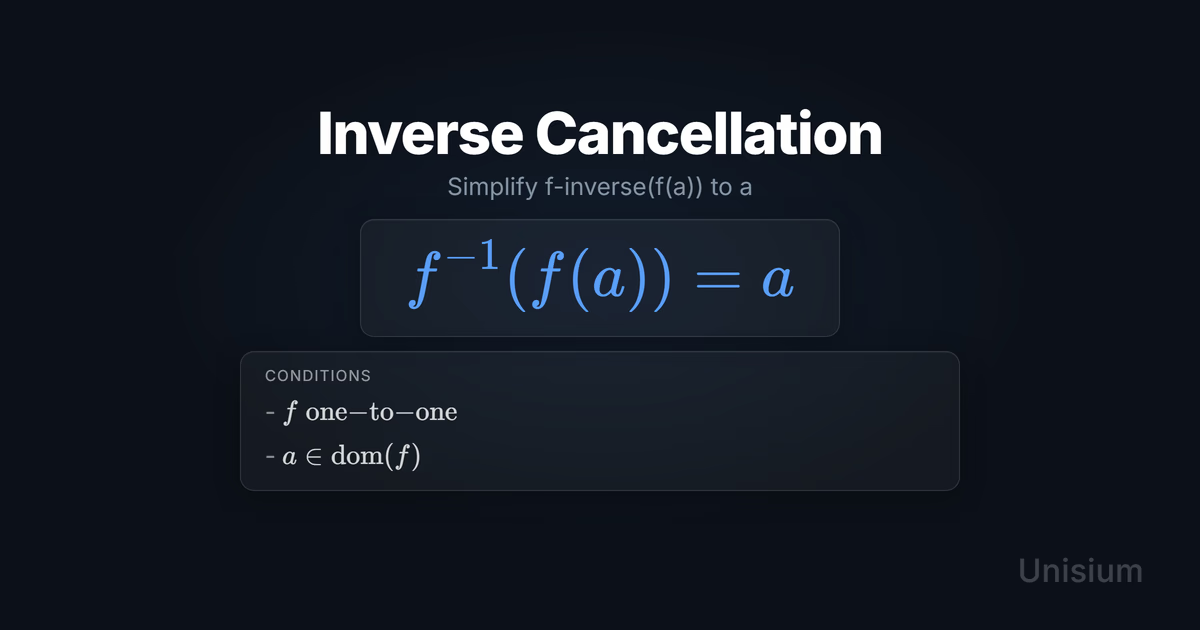
Inverse Cancellation collapses a valid inverse composition in either direction. The input-recovery form is valid when . The output-recovery form is valid when . In both cases, must be one-to-one. Recognizing which direction you have, and therefore which side condition to check, is a core fluency skill practiced in the Unisium Study System.
On this page: The Principle | Conditions | Failure Modes | EE Questions | Retrieval Practice | Practice Ground | Solve a Problem | Related Principles | FAQ | How This Fits
The Principle
The move: When is one-to-one, cancel a valid inverse composition by recovering the original quantity that entered the chain.
The invariant: Input recovery and output recovery are both part of the same principle, but they use different side conditions.
Pattern:
With (one-to-one on , , ):
| Direction | Legal ✓ | Illegal ✗ |
|---|---|---|
| Input recovery | because | fails because is not one-to-one on |
| Output recovery | because | fails because |
Conditions of Applicability
Condition: ; ;
Before applying, check: Which composition direction do you have? Then verify the matching side condition.
If the condition is violated: If is not one-to-one, the inverse is not a single-valued function, so either composition can collapse incorrectly. If you have but , then is undefined. If you have but , then is not defined as a real inverse output.
- If is not one-to-one on the stated domain (e.g., on ): does not exist as a single-valued function on all of . Cancellation can fail: , not , for inputs where .
- If the composition is and : is undefined, so there is no valid output for to act on.
- If the composition is and : is undefined, so there is no legal inverse output for to receive.
Want the complete framework behind this guide? Read Masterful Learning.
Common Failure Modes
Failure mode: Apply cancellation with on , writing -> the rule gives , not ; the cancellation silently drops the branch.
Debug: Ask “Is one-to-one?” For on : every positive output has two preimages, so the condition fails. Restrict to first, or handle both square root branches explicitly.
Failure mode: Treat as automatically legal because “exponential and logarithm cancel” -> this is the output-recovery form with , but is not in .
Debug: Ask “Which direction is this composition, and what is the matching side condition?” For , the relevant check is , equivalently . Since is not an allowed output of , the move is illegal.
Elaborative Encoding
Use these questions to build deep understanding. (See Elaborative Encoding for the full method.)
Within the Principle
- Why do and belong to the same principle even though they require different side conditions?
- Why does the input-recovery form check while the output-recovery form checks ?
For the Principle
- How would you verify which direction of inverse cancellation is present before simplifying a specific expression?
- If is one-to-one only on a restricted domain (e.g., on ), how does that restriction affect both and ?
Between Principles
- How does Inverse Cancellation relate to Apply Inverse to Both Sides? Which direction usually appears immediately after the apply-inverse move, and what other direction still belongs to the same principle?
Generate an Example
- Construct one legal example and one legal example for the same function. Then construct a near-miss where you checked the wrong side condition and explain why the cancellation fails.
Retrieval Practice
Answer from memory, then click to reveal and check. (See Retrieval Practice for the full method.)
State the inverse cancellation move in one sentence: _____When f is one-to-one, inverse cancellation recovers the original input in f-inverse(f(a)) and the original output in f(f-inverse(y)), provided the matching domain or range condition holds.
Write the two canonical patterns: _____
State the canonical condition: _____
Practice Ground
Use these exercises to build move-selection fluency. (See Self-Explanation for how to use worked examples effectively.)
Procedure Walkthrough
Starting from , simplify to a linear expression in .
Direction check: this is the output-recovery form with , , and .
Verify both conditions: is one-to-one on ✓; provided ✓.
| Step | Expression | Operation |
|---|---|---|
| 0 | - | |
| 1 | Inverse cancellation: with ; require | |
| 2 | Distribute | |
| 3 | Combine constants |
Drills
Goal micro-chain - reach the simplified form
For each expression, identify the direction first. Then name and , verify the matching condition, and simplify using inverse cancellation.
Assume is one-to-one and the input is in . Simplify.
Reveal
, . Direction: input recovery. Condition check: ✓
Assume is one-to-one and the output is in . Simplify.
Reveal
, . Direction: output recovery. Condition check: ✓
Assume is one-to-one and the input is in . Simplify.
Reveal
, . Direction: input recovery. Condition check: ✓ for any real .
Verify both conditions, then simplify.
Identify the direction, name and , check conditions, and write the simplified result.
Reveal
, . Direction: input recovery. is one-to-one on ✓; ✓.
Note the contrast with : since is not one-to-one on , that gives , not .
Near-miss - condition failure: not one-to-one. A student writes ”.” What condition is violated?
Reveal
on is not one-to-one - both and map to . Condition 1 fails; is not single-valued on all of .
The correct result is , not .
To apply cancellation, restrict to where it is one-to-one, or work with explicitly.
Eligibility check: For each expression below, identify the direction, state whether inverse cancellation applies as written, and if it does not, state which condition fails.
- , domain
- with
Reveal
| Expression | Direction | Matching side check | Eligible? |
|---|---|---|---|
| Input recovery | ✓ | Yes -> | |
| , | Input recovery | is not one-to-one on ✗ | No - one-to-one condition fails; result is , not |
| Output recovery | ✓ | Yes -> | |
| Output recovery | ✗ | No - range condition fails; is not defined in | |
| , | Input recovery | restricted is one-to-one and is in its domain ✓ | Yes -> |
Forward step - apply the cancellation once
Identify the direction first, then name , , and the original quantity ( or ). Verify the matching condition, then write only the result of the cancellation step - do not simplify further.
State the direction, then name , , and the original quantity. Verify the matching condition, then write the simplified expression.
Reveal
, , . One-to-one ✓; ✓ for all real .
Result: .
State the direction, then name , , and the original quantity. Verify the matching condition, then write the simplified expression.
Careful: here the expression uses the output-recovery direction, so the relevant side condition is about the range of the outer function.
Reveal
The outer function is and the inner is . View the composition as with , , and .
Condition check: ✓. The expression has the form .
Result: .
Condition failure - one-to-one violation. Determine whether the cancellation is valid.
Reveal
for all - is not one-to-one (every input maps to ). Condition 1 fails.
is not defined (base must satisfy , ). The move cannot be applied.
Canonicalization - identify the result of inverse cancellation in a solve chain
In each step pair, name the principle used and state the simplified output.
What principle was applied and what is the result?
Reveal
Inverse Cancellation with , , . Both conditions hold ( one-to-one; ).
Result: .
What principle was applied and what is the result?
Reveal
Inverse Cancellation in the output-recovery direction with , , and .
Condition check: for all real ✓ - so ✓.
Result: .
Solve a Problem
Apply what you’ve learned with Problem Solving.
Problem: Starting from , isolate using inverse cancellation as the first simplification step. Verify both conditions before applying the move.
Condition check: is one-to-one (strictly increasing) ✓; requires ✓.
Full solution
| Step | Expression | Move |
|---|---|---|
| 0 | - | |
| 1 | Inverse cancellation: with | |
| 2 | Add to both sides | |
| 3 | Divide both sides by |
Related Principles
| Principle | Relationship |
|---|---|
| Inverse Definition | Prerequisite - defines what makes one-to-one and establishes the inverse relation that this cancellation rule depends on |
| Apply Inverse to Both Sides | Paired move - Apply Inverse usually produces the input-recovery form , which Inverse Cancellation then cleans up; the broader cancellation principle also includes the companion output-recovery form |
| Composition Expansion | Structural sibling - both work with two-function chains; Composition Expansion expands the chain forward, while Inverse Cancellation collapses a valid inverse pair in either direction |
| Log-Exponential Rewrite | Common application family - logarithmic and exponential equations often rely on cancellation identities such as or |
FAQ
What is Inverse Cancellation?
Inverse Cancellation is the rule that a valid inverse composition collapses to the original quantity. The two canonical forms are and . Both require to be one-to-one, but the side condition changes with the composition direction.
When is Inverse Cancellation valid?
Two checks always matter: (1) must be one-to-one on its domain so that exists as a single-valued function. (2) you must use the side condition that matches the direction you have. For , check . For , check .
What goes wrong if is not one-to-one?
If is not one-to-one, it has no single-valued inverse. Applying an inverse-like operation picks only one preimage and silently discards others. For example, “simplifying” using gives but the correct answer is .
How is Inverse Cancellation different from Apply Inverse to Both Sides?
Apply Inverse to Both Sides is the move that wraps both sides of in , producing . Inverse Cancellation is the separate follow-on step that simplifies the valid inverse composition. In standard solve chains, that usually means the input-recovery form , but the same principle also covers the companion output-recovery form in standalone simplifications.
Does Inverse Cancellation work in both directions?
Yes. The input-recovery form is and requires . The output-recovery form is and requires . Both also require to be one-to-one. The key is to match the condition to the direction you have.
Does the base matter for ?
Yes. The base must satisfy and . When , the function is not one-to-one (it maps every input to ), and is undefined. Inverse cancellation does not apply.
How This Fits in Unisium
Unisium treats Inverse Cancellation as a condition-critical move - one that looks like a trivial symbolic shortcut but silently fails when the one-to-one condition or the matching domain/range condition is not met. The Unisium Study System builds fluency through drills that mix valid cancellations with tempting near-misses (like on or ) so that the condition check becomes automatic rather than an afterthought.
In a standard solve chain, the move typically appears after Apply Inverse to Both Sides executes the wrap - that is the input-recovery form. But cancellation also appears in standalone simplification contexts, where the output-recovery form is often the one that matters. Practicing both directions, and learning to name the matching condition in each case, is how solve chains become reliable.
Explore further:
- Functions Subdomain Map - Return to the functions hub to see how inverse moves and logarithmic rewrites sit inside the same solve-chain cluster
- Apply Inverse to Both Sides - The preceding move in a standard solve chain: wrapping both sides in before cancellation applies
- Elaborative Encoding - Build deep understanding of why the one-to-one condition is essential, not optional
- Retrieval Practice - Make the cancellation pattern and its condition instantly accessible
Ready to master Inverse Cancellation? See Unisium’s 14-day free trial or explore the full learning framework in Masterful Learning.
Masterful Learning
The book behind these guides: a study system for physics, math, & programming built on retrieval, connection, explanation, and problem solving.
Ready to apply this strategy?
Unisium turns these evidence-based techniques into guided study sessions for math and physics. Places are limited during early access. Check current availability to start a trial; joining the mailing list is optional.
See plans and availability Read More GuidesAlready have access? Sign in