Are keyword mnemonics effective for math & physics? Rarely
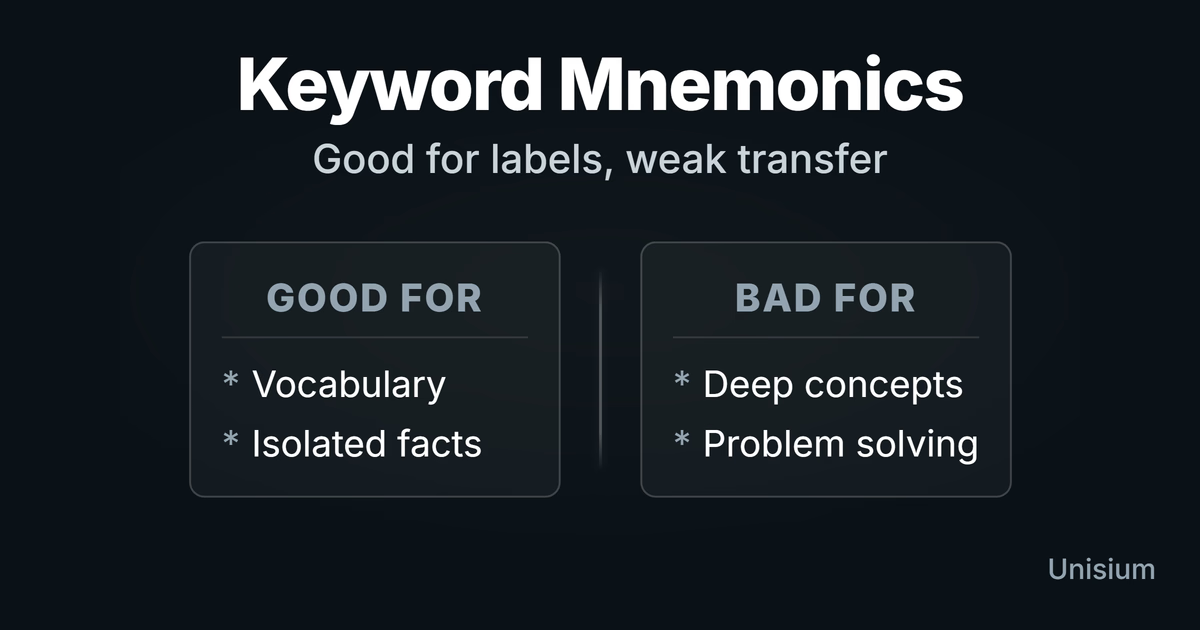
Keyword mnemonics pair a new term with a familiar-sounding keyword and a vivid image to cue recall. They can help with labels and arbitrary definitions, but they don’t build the relational structure you need to choose principles, set up models, and solve problems in math and physics. Use them sparingly for vocabulary, then move quickly to self-explanation, retrieval practice, and worked problem solving to make the idea usable.
On this page: The Mechanism · Can It Be Salvaged? · Better Alternatives · Common Mistakes · FAQ · How This Fits
The Mechanism (and Why It Fails for Math & Physics)
Keyword mnemonics work by creating a “bridge” between a new term and a known concept using acoustic similarity and visual imagery. For example, to remember “abscissa” (the x-coordinate), you might imagine an abs muscle resting on the horizontal axis. This dual-coding approach creates a strong retrieval cue for the label itself.
However, this technique fails for math and physics because these subjects rely on relational understanding, not arbitrary definitions. Knowing that “torque” sounds like “turkey” doesn’t help you understand how force and lever arm interact to cause rotation. Mnemonics bypass the logical derivation that makes the concept stick.
The catch is that the cue you build is about the word-form, not the concept. In math and physics, success depends on mapping conditions to principles and models, and a sound-alike image doesn’t provide that mapping. At best, the mnemonic becomes extra clutter you must retrieve before the reasoning can even start.
Want the complete framework behind this guide? Read Masterful Learning.
Can It Be Salvaged?
Keyword mnemonics have a narrow use case. They are tools for arbitrary data, not logical systems. Like the Memory Palace, they excel when there is no underlying logic to help you remember.
| Feature | Keyword Mnemonics | Relational understanding |
|---|---|---|
| Best for | Vocabulary, names, lists | Principles, derivations, models |
| Retention | High for specific cue | High for application |
| Transfer | Low (rigid) | High (flexible) |
| Effort | Low (creative visualization) | High (logical processing) |
When to Use Them
- Vocabulary: Memorizing the names of Greek letters (, , ).
- Arbitrary Constants: Remembering that the speed of light is approx m/s.
- Biology/Anatomy: Memorizing bone names or taxonomy (where logic is less immediate).
When to Avoid Them
- Principles: Avoid using them for Newton’s Laws or conservation principles.
- Formulas: Don’t memorize with a story; derive it or understand the causal link.
- Derivations: If you need a mnemonic to remember a step, you don’t understand the step.
Better Alternatives for Math & Physics
Instead of gluing arbitrary images to concepts, use strategies that build logical connections.
1. Elaborative Encoding
Elaborative encoding involves asking “why” and “how” questions to connect new information to what you already know. Instead of a keyword for “momentum,” ask: “How is this different from kinetic energy? Why is it a vector?” This builds a web of knowledge.
2. Self-Explanation
Self-explanation forces you to articulate the logic of a step or definition in your own words. If you can explain why a formula works, you don’t need a mnemonic to remember it.
3. Retrieval Practice
Retrieval practice strengthens memory by pulling information out of your brain. It is more robust than mnemonics because it strengthens the neural pathways used for actual application, not just the artificial “bridge” created by the keyword.
Common Mistakes
| Mistake | Why it hurts | The Fix |
|---|---|---|
| Mnemonic Overload | You spend more energy remembering the story than the physics. | Use concept maps to structure the logic. |
| Formula Stories | ”SOH CAH TOA” is fine, but complex formula stories confuse variables. | Derive the formula from first principles. |
| Ignoring Context | You recall the term but don’t know when to apply it. | Solve problems using interleaving. |
FAQ
Are keyword mnemonics ever good for math?
Yes, but only for arbitrary definitions or vocabulary. For example, remembering the difference between “abscissa” and “ordinate” might benefit from a mnemonic because the names are historical accidents, not logical consequences.
What about “SOH CAH TOA”?
Acronyms like SOH CAH TOA are a form of mnemonic (First Letter Mnemonic), not strictly keyword mnemonics. They are acceptable for quick retrieval of definitions, provided you understand the underlying geometry of the unit circle.
Can I use them for constants?
Yes. Constants like Avogadro’s number or the gravitational constant are arbitrary values. Mnemonics are excellent for holding these in memory until they become second nature through practice.
How do they differ from the Method of Loci?
The Method of Loci (Memory Palace) uses spatial memory to store ordered lists. Keyword mnemonics use acoustic links for individual terms. Both are surface-level strategies compared to deep processing.
How This Fits in Unisium
The Unisium Study System is built on the premise that deep understanding beats surface memorization. While we acknowledge mnemonics have a place for arbitrary facts, our tools focus on problem solving and logical encoding to ensure you can apply what you learn.
Ready to go deeper? Check access and join the Unisium waitlist or explore the full framework in Masterful Learning.
Next Steps
- Do instead: Elaborative Encoding
- Big picture: Ineffective Study Techniques
Masterful Learning
The book behind these guides: a study system for physics, math, & programming built on retrieval, connection, explanation, and problem solving.
Ready to apply this strategy?
Unisium turns these evidence-based techniques into guided study sessions for math and physics. Places are limited during early access. Check current availability to start a trial; joining the mailing list is optional.
See plans and availability Read More GuidesAlready have access? Sign in