Spacing vs Cramming: Why Distributed Practice Wins (and Exactly How to Do It)
Spacing means spreading study of the same concepts over time instead of massing it in one burst. It feels harder and looks worse today, but it beats cramming for retention, transfer, and sanity — this is spaced repetition done right.
Bottom line: Cramming lifts short-term performance. Spacing wins the exam you care about a week (or a year) from now. And it potentiates all four primary strategies—especially retrieval practice and problem solving, with spillover to elaborative encoding and self-explanation.
Spacing beats cramming. Spread reviews over days and weeks to build durable memory and calmer test performance. Here’s why it works—and how to schedule it.
On this page: TL;DR · What it is · Why it works · How to schedule it · Optimal gaps · Templates · FAQ
TL;DR
- Spacing = distribute reviews across days/weeks. Cramming = mass it now.
- Short-term vs long-term: Cramming boosts today’s quiz; spacing wins delayed tests.
- Core mechanisms: effortful retrieval, sleep consolidation, reduced context-dependence, and desirable difficulty.
- Simple rule: Aim for 2–4 spaced touches per concept before the exam; finish each session with no-notes retrieval.
- First session: ~3 successive correct recalls; after that, stop at first clean pass and space it.
- Use with: Retrieval practice (add spacing to retrieval), Interleaving (mix topics inside sessions).
What Is Spacing?
Spacing (distributed practice) is when you purposely insert time between study sessions of the same idea. Instead of three hours tonight, you do 45–60 minutes across 3–4 days. You’ll feel rust at the start of each session—that’s signal, not failure. It forces the brain to retrieve from long-term memory rather than leaning on short-term traces.
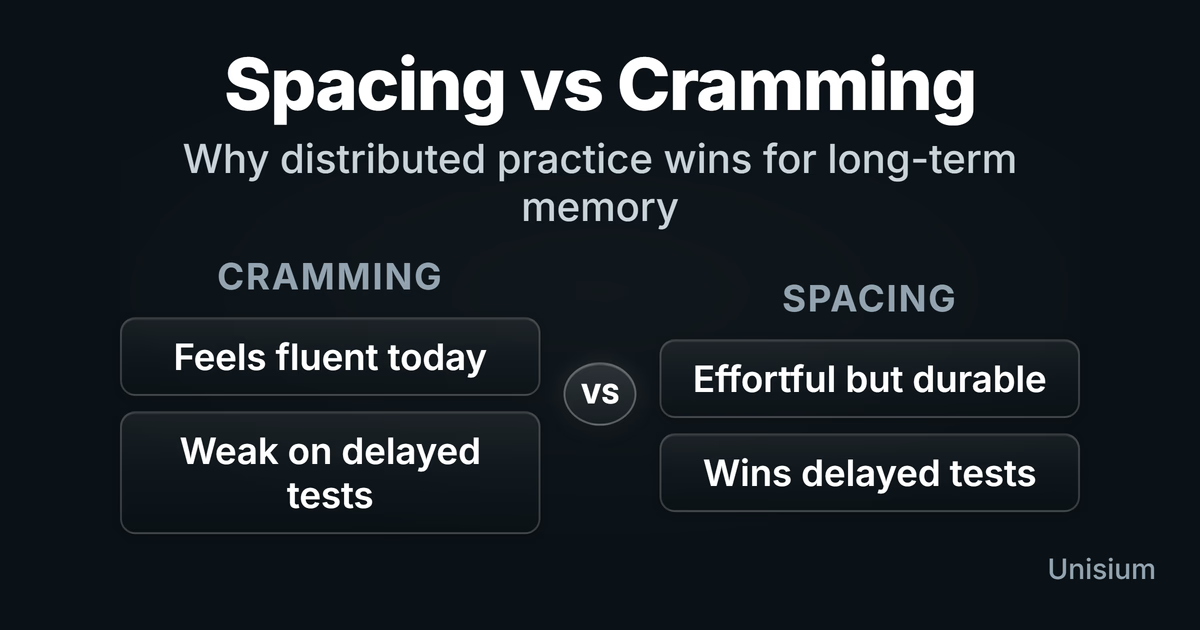
Spacing vs Cramming (Quick view)
| Aspect | Cramming (massed) | Spacing (distributed) |
|---|---|---|
| Practice feel | Fluent, “I’ve got this” | Disfluent, effortful |
| Short-term score | Higher | Lower |
| Delayed test | Weaker | Stronger |
| Stress profile | Spikes near exam | Flatter, calmer |
| Synergy with retrieval | Weak | Strong |
Why Spacing Works
1) Effortful Retrieval (the engine)
Time gaps push knowledge out of short-term memory. Reconstructing it strengthens the memory trace and speeds later recall.
2) Sleep-Driven Consolidation
Spacing creates more sleep cycles between touches—prime time for stabilization and re-indexing of memories.
3) Desirable Difficulty
A little forgetting is useful. The challenge thickens storage strength and makes knowledge less cue-dependent. (See Interleaving for how context variation compounds this effect.)
4) Better Transfer
With spaced retrieval, memories become context-robust—you can find them under exam pressure and apply them to new problems.
5) ACT-R / Base-Level Learning
In ACT-R, each successful recall adds to a memory’s base-level activation; each contribution then decays as a power function of time. Two details explain spacing:
- Activation-dependent decay: gains made when activation is already high decay faster; gains made when activation is low decay slower. Wider gaps lower activation before the next trial, so each new success is more durable.
- Psychological time / interference: decay reflects not just clock time but interference from other events between sessions, which is typically lower between study days than within a single cram session.
Net effect: fewer, well-spaced correct recalls beat many massed repeats—especially over longer delays.
Principle: You learn what you practice. Cramming practices recognition in the same context; spacing practices recall across contexts.
Evidence, fast: Large meta-analyses and controlled studies show robust spacing gains on delayed tests; ACT-R models reproduce the crossover: the longer the delay, the bigger the spacing advantage. Translation: spacing matters more when you care about remembering.
How to Use Spacing
Step 1: Define “Touches” per concept
- Minimum effective dose: 3–4 touches per key principle before the exam.
Step 2: End every touch with no-notes retrieval
- 2–5 quick prompts: Name → Form → Conditions → Example.
- This combination of spacing + retrieval is where learning accelerates.
- For a first retrieval session on a new concept, aim for ~3 successive correct recalls in one sitting (then stop). On later days, stop at the first clean pass.
Step 3: Track with lightweight logs
- Tag misses as Recall, Condition, or Procedure. Fix the right failure.
Step 4: Combine with Interleaving
- Within a session, mix neighbors (e.g., momentum vs energy). Spacing across days + interleaving inside days = compounding gains.
Optimal Gaps: Rules of Thumb
You don’t need perfection—just avoid “all at once.” Use these pragmatic targets:
- Remember for 1 week: review every 1–2 days
- Remember for 1 month: review every 3–5 days
- Remember for 1 semester (3–4 months): review every 10–14 days
- Remember for 1 year: review every 4–6 weeks
Use a simple spaced repetition schedule: 1–2d → 3–5d → 7–14d; then extend to 4–6 weeks for year-long retention.
Heuristic: Gap ≈ 10–20% of the time until the test. Too short = easy (weak learning). Too long = re-learning (wasteful). The band is wide; hit it roughly and move on.
Expanding intervals (e.g., 1d → 3d → 7d → 14d) often feel best and reduce admin overhead.
Start Early: Curriculum Sweep with Past Exams
Goal: cover the whole syllabus fast, then let spacing + interleaving do the heavy lifting.
- Week 1–2: light skim of all chapters/principles; capture a 1-line “name + condition” per principle.
- Weekly: solve 2–4 past-exam items from different topics (interleave).
- Tag mistakes: Recall (can’t state it), Condition (don’t know when it applies), Procedure (can’t execute). Use tags to pick what to retrieve next week.
- Principle ledger: Keep a single-page “principle ledger” (Name → Conditions → One canonical example). Update only this sheet; everything else is retrieval.
- Result: automatic spacing across the curriculum, exam-relevant practice, and earlier detection of blind spots.
Templates and Schedules
A) 2-Week Exam Ramp (per concept)
- Day 0: Learn + brief elaborative encoding
- Day 1: first retrieval (aim for 3 successive correct recalls to overlearn once)
- Day 3: Mixed set with interleaving
- Day 7: Cumulative retrieval set
- Day 12: Final check (2–3 prompts)
B) STEM Weekly Cadence (durable learning)
- Mon: New material (elaborate + 1–2 retrieval prompts)
- Wed/Thu: Retrieval mini-set from Mon + last week
- Sun: Mixed past-paper items (interleave 3 topics)
C) Flashcards (Anki-style)
Convert principles to type + condition cards. Let the SRS schedule the gaps; tag hard cards for an extra ad-hoc review.
This approach, sometimes called successive relearning, ensures that harder items get more touches while easier ones space further apart—maximizing efficiency.
Common Pitfalls
- Only cramming at the end: Great for tomorrow, bad for next month. Add two earlier spaced touches.
- Spacing without retrieval: Passive review ≠ spacing. Always finish with recall.
- Same-day loops: Multiple repeats today don’t replace tomorrow’s touch.
- Overlearning policy:
- First retrieval session on a concept: do ~3 successive correct recalls (overlearn once).
- After that: stop at the first clean pass and move the next rep to another day. Don’t burn time polishing today what spacing will cement tomorrow.
Start Now (5-Minute Kickoff)
- Pick 3 principles that matter this week.
- For each, write one condition and one example.
- Schedule 3 touches (1d, 3d, 7d).
- At each touch, do no-notes recall: Name → Conditions → Example.
Related Guides
- Retrieval Practice — The engine of spacing. Add spacing to retrieval for exponential gains.
- Interleaving — Mix topics inside sessions for better classification.
- Elaborative Encoding — Build the links that make spacing + retrieval easier.
- Problem Solving — Apply spaced knowledge to problems, systematically.
- Five-Step Strategy — Physics-specific problem-solving framework.
← Prev: Interleaving | Next → Retrieval Practice
Spacing is domain-general. Spacing works because of how memory consolidates and decays. After a successful retrieval, the gain fades with time; waiting lets activation drop so the next success produces a bigger, more durable update (and you get sleep cycles between reps). Those dynamics don’t care about the subject; they’re properties of memory. Result: fewer, well-timed recalls beat many massed ones, and the advantage grows with longer delays.
FAQ
Does cramming ever work?
Yes— for immediate tests, cramming boosts short-term performance. For anything beyond a few days, spacing wins decisively. Use cramming only as a supplement to spaced study, not a replacement.
How many spaced reviews do I need?
Plan 3–4 spaced touches per key concept before the exam. End each touch with no-notes retrieval to lock it in.
What gap should I use between sessions?
Rule of thumb: 10–20% of the time until the test. Practically: 1–2 days for a weekly quiz; 3–5 days for monthly retention; 4–6 weeks for year-long retention.
Is spacing the same as interleaving?
No. Spacing spreads reviews across days/weeks. Interleaving mixes topics inside a session. They stack—use both for maximum effect.
Do I have to use flashcards?
No, but an SRS tool automates the gaps. You can space with a calendar and end every session with short no-notes recall.
What if I miss a scheduled review?
Don’t panic. A missed review is fine—just resume. Spacing is about the pattern, not perfection. If you miss several in a row, you’ll need more reviews before the exam, but a single miss won’t tank you.
Is expanding better than equal intervals?
Usually, yes for humans. Start with shorter gaps (1–2 days), then expand (3–5, 7–14). The expanding pattern reduces admin overhead and fits how activation-dependent decay works. Don’t obsess over exact numbers; hit the pattern.
How This Fits in Unisium
Unisium applies spacing by scheduling retrieval and problem-solving prompts at expanding intervals, so you revisit principles right as they start to fade. That’s the Unisium Study System in practice: you focus on the work (retrieve, explain, solve), and the schedule handles the timing. Ready to try it? Check access and join the Unisium waitlist or explore the full framework in Masterful Learning.
Ready to apply this strategy?
Unisium turns these evidence-based techniques into guided study sessions for math and physics. Places are limited during early access. Check current availability to start a trial; joining the mailing list is optional.
See plans and availability Read More GuidesAlready have access? Sign in