The Testing Effect: How to Supercharge Your Learning by Testing Yourself
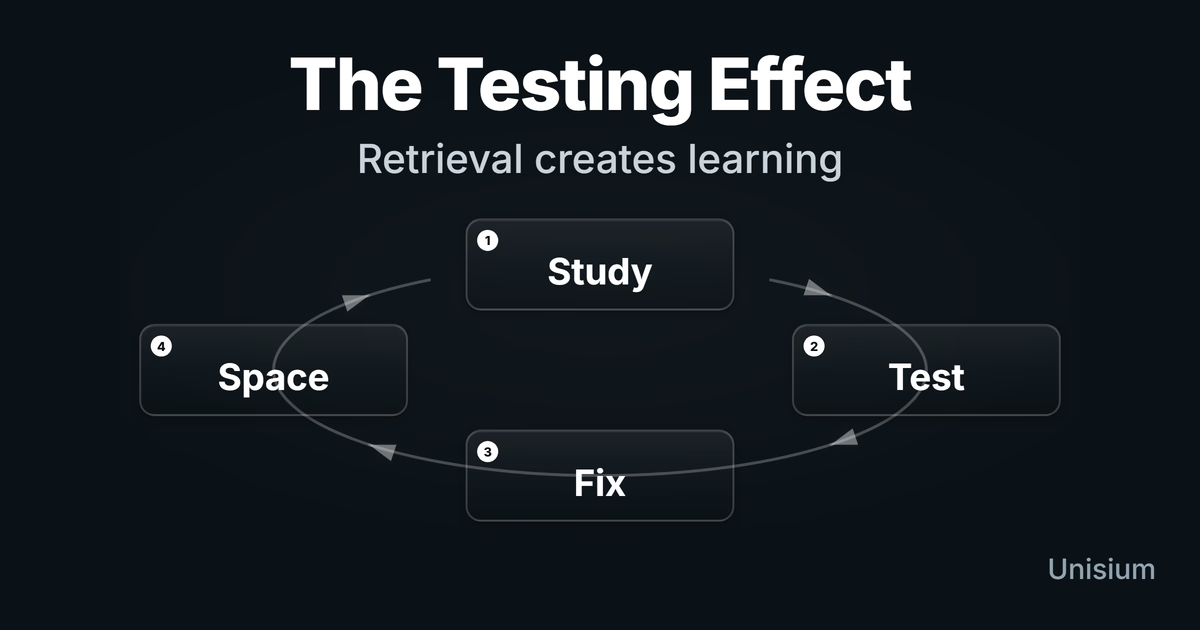
Posttesting = testing yourself after study. Done right, it’s not assessment—it’s the learning event. Retrieval drives consolidation; spacing makes those gains durable; interleaving trains selection.
Bottom line: If you’re not regularly producing answers from memory, you’re optimizing for the wrong game.
This is for math and physics students who can follow worked examples while reading but freeze when they have to produce the principle, condition, or next step from memory. Testing works best when it’s tied to elaborative encoding, self-explanation, retrieval practice, and problem solving—the core study moves you’ll use on exams.
Key Takeaways
- Retrieval creates learning (doesn’t just measure it). Each successful recall rewires memory pathways.
- Small, spaced sets beat massed cramming. Short-term fluency is a liar; durability comes from spacing.
- Use testing to drive the four core strategies—elaborative encoding, self-explanation, retrieval practice, and problem solving.
Quick spec: 3–6 prompts, closed book, stop at first clean pass, schedule (1–2d → 3–5d → 7–14d).
Why Testing Creates Learning
Testing works because producing answers from memory reconstructs the path you’ll need on exams; spaced recalls then stabilize those paths better than extra reading.
Effortful success beats easy repeats
Retrieval helps because it’s hard and successful: producing an answer forces reconstruction; spacing those successes slows decay. Re-reading feels fluent but doesn’t build durability—a classic example of the hidden myth that easy study = effective study.
Calibration
Scores reveal what to study next. You target elaborative encoding and self-explanation where they help.
Transfer
With interleaving, testing forces you to choose the right tool before executing.
Principle: Study → Posttest → Feedback → Schedule beats Study → Re-read every time.
Research Snapshot: The Testing Effect
Posttesting reliably boosts retention and transfer once basics are in place (Dunlosky et al., 2013; Roediger & Karpicke, 2006; Rowland, 2014; Yang et al., 2021). Durability comes from spaced successful recalls; massed repeats inflate short-term fluency without stability.
Complementary roles. Evidence converges on an additive loop: pretesting improves encoding, posttesting improves consolidation—together they outperform either alone (Pan & Carpenter, 2023; Pan & Sana, 2021).
Do both, in order. Short pretest to focus study → study → posttest to build strength → space the recalls.
Works across domains. Testing effect is domain-general because it’s about memory consolidation, not subject matter. It works in sciences, humanities, languages, music, and professional skills.
Posttesting vs Pretesting
| Aspect | Pretesting | Posttesting |
|---|---|---|
| When | Before study | After study |
| Primary job | Prime encoding | Drive consolidation |
| Memory phase | Activation + encoding | Reconsolidation + spacing |
| Best for | New, confusing content | Locking in & long-term retention |
Use both: Pretest to aim the spotlight, posttest to build strength over time.
Two-Gear Loop (Plug and Play)
- Pretest (3–6 min) — Try before you study
- Study (20–30 min) — With elaborative encoding + self-explanation
- Posttest (5–10 min) — Closed book; recall from memory
- Schedule spacing (1–2d → 3–5d → 7–14d)
- Optional: Interleave neighbors on the next set
How Testing Connects to the Four Primary Strategies
(Elaborative Encoding, Self-Explanation, Retrieval Practice, Problem Solving)
Testing isn’t separate from the four core strategies—it’s how you use them.
Elaborative Encoding (EE) ↔ “EE-testing”
Goal: Strengthen connections.
Prompt: “Link this principle to two neighbors and one counter-example.”
Stop rule: 1 crisp link per neighbor, no fluff.
See: Elaborative Encoding.
Retrieval Practice (RP) ↔ “RP-testing”
Goal: Recall key memories (name → form → conditions → example).
Prompt: “State the principle, one condition, and a canonical example—closed book.”
Stop rule: Stop at first clean pass; space it.
See: Retrieval Practice.
Self-Explanation (SE) ↔ “SE-testing”
Goal: Explain why each step is valid before reading the solution.
Prompt: “For this worked example, justify each step: principle + condition + goal link.”
Stop rule: One sentence per step; then compare to the expert solution.
See: Self-Explanation.
Problem Solving (PS) ↔ “PS-testing”
Goal: Act on the model under constraints.
Prompt: “Decode givens/goals → select principles → do the first two transformations.”
Stop rule: 5–10 minutes max; log miss type (Recall / Condition / Procedure), then fix.
See: Five-Step Strategy.
How to use: Start with a tiny RP-test, do SE-testing on one worked example you just missed, add one EE-test link, then run a PS-test micro-problem. Space the whole set (1–2d → 3–5d → 7–14d).
How to Posttest
Step 1: Close Notes (signal: this is retrieval, not review)
You’re testing your memory, not checking your book. Closed book is non-negotiable. Short-term confidence is a liar.
Step 2: Run a Fast Set (5–10 min)
- Definitions (no notes): Name → Form → Conditions
- Short derivations (show your work, but from memory)
- Micro-problems (one skill per problem, not “kitchen sink”)
- Mixed sets across confusable neighbors to force interleaving
Step 3: Grade Immediately and Tag
Mark each miss: Recall / Condition / Procedure (use the same tags everywhere—in pretests, posttests, and across all guides).
Step 4: One Focused Fix (2–5 min)
Pick the highest-impact miss. Re-elaborate it, self-explain a worked step, or rework one variant. Don’t try to fix everything.
Step 5: Schedule the Next Recall
Mark your calendar: (1–2d → 3–5d → 7–14d). Treat this like a commitment.
Practical stop-rule: One clean recall per item in a session is enough for concepts; complex problems rarely justify more than 1 clean pass now + 2–3 spaced replays later (≈ 1+3). For bite-size facts, you can push to 3 clean recalls once, then space (≈ 3+3). Don’t grind—space.
Posttesting in Unisium (Immediate or Spaced)
Delayed is normal—and better. You don’t have to posttest immediately. Unisium schedules follow-ups based on the quality of your answer and your likelihood of retrieval.
Retrieval cards auto-reschedule. Retrieval practice (RP) cards always come back at increasing intervals.
Non-RP cards still test you. Elaborative Encoding (EE), Self-Explanation (SE), and Problem Solving (PS) cards offer a later retry when needed.
Stop rule built-in. Perfect scores let you move on to new material. Missed items surface again for retrieval scheduling.
Formats That Punch Above Their Weight
Match the exam (minimal viable fidelity)
Train the thing you’ll be graded on. If the exam is short-answer, include short-answer. If it’s MCQ, include MCQ—then upgrade to short-answer to learn. This is transfer-appropriate processing and encoding specificity in practice.
Principle Cards
Front: Name (or cue)
Back: Form + Conditions + Example
Keep it ultra-brief (3–5 words per field).
Prompt Variability
Ask the same principle three ways (definition → condition check → tiny example). Different cues create extra retrieval routes.
One-Step Derivations
“Derive acceleration from force and mass (show work).” No multi-step chains. Isolates the principle.
Micro-Problems
5–10 minutes, one focused skill. If you’re spending 20 minutes on one item, it’s not a posttest—it’s a homework problem.
Mixed Sets (Interleaving)
Alternate between confusable neighbors: Newton’s Laws vs Energy, Product Rule vs Chain Rule, DRY vs SOLID. Force classification before execution.
Implementation Patterns
Daily 10
End your study session with 10 quick recalls (closed book, 5–10 min). Log misses; resurface them on your spaced schedule.
Past-Paper Loop
Solve 2–3 old exam items each study day. Log misses by type. Resurface high-miss items at 1–2d, then 3–5d.
For the complete exam-prep loop that pairs these posttests with retrieval, Hint & Try, and self-explanation, see Why You’re Not Ready for the Math and Physics Exam (and What to Do Instead).
Flashcard SRS (Spaced Repetition System)
Convert principles to cards (Name → Form + Conditions). Use Anki or similar. Tag “Hard” cards for an extra ad-hoc review outside the algorithm.
Weekly Cumulative Retrieval
Every Friday (or end of week): 20 mixed recalls covering all topics from the past 1–2 weeks. No notes.
For Teachers (2-Minute Loop)
-
Warm-up (90–135s total):
- 3 closed-book prompts at slide 1 (30–45s each).
-
Teach the content.
-
Quick posttest (60–90s):
- 2 closed-book variants that target the same concepts.
-
Post an answer key with exact locations (slide numbers/timecodes or page/figure refs).
- Add a one-line “top misses” summary tagged with:
Recall (couldn’t state it) / Condition (applied in wrong context) / Procedure (step/derivation error).
- Add a one-line “top misses” summary tagged with:
When Testing Can Hurt (Short-Term)
Immediate quizzes. Posttesting can lower same-day scores if you spend too long testing or give students no time to study afterward. Keep the pretest set tiny (2 items), study focused, then a quick posttest.
No feedback. Guessing without fast correction risks cementing errors. Always check your answers and see where they lived in the material.
Massed retesting. Repeating the same items in one sitting fakes fluency but doesn’t build durability. Space the next recall (1–2d → 3–5d).
Note: Posttesting is more effective for long-term retention and transfer. For immediate, same-day quizzes of recognition-based material (e.g., multiple-choice), regular study may feel smoother. But for anything beyond 48 hours, testing wins decisively.
You don’t have to posttest immediately. Waiting a day is normal—and often better. What matters is spaced successful recalls, not instant retakes.
If you only have 5 minutes today, run Daily 10 with just 3 items—still closed-book.
See also: When Pretesting Backfires (the complement section in the Pretesting guide).
Common Objections
- “Tests make me look foolish.” — Practice is where you earn mistakes cheaply. Save “looking good” for the exam.
- “I should read more first.” — Reading without retrieval fakes fluency; retrieval exposes what to read.
- “I don’t have time.” — You don’t need marathons. 5–10 minute sets, spaced, beat cram blocks.
Common Failure Modes
Testing only easy items. You’re training confidence, not competence. Mix in near-misses and confusables.
Endless re-reading after a low score. Recognition fluency is a liar. Test first; read targeted fixes after.
No schedule. Posttesting without spacing is spinning wheels. Put dates on the calendar.
All multiple-choice. Use MCQ to diagnose, then require short-answer or derivation to learn.
Cramming posttests. Massed testing (same day, same items 3 times) gives short-term fluency, not durable memory. Space it.
Quick Workflow (15 minutes)
5 min: Mixed recall set (closed book).
5 min: Grade + tag + one fix per miss.
5 min: New mixed set that includes one variant of each miss (forces interleaving).
Log and schedule: 1–2d revisit.
FAQ
How often should I posttest?
Every serious study block (daily for priority subjects). Small, frequent sets beat marathons.
What if I keep failing the same item?
Shrink the task. Test sub-skills. Insert one worked example → brief self-explanation → try again. Use elaborative encoding to rebuild missing connections.
Where do notes fit?
After the test, to repair a specific weakness. Not before. Notes before a posttest defeat the purpose.
Does format matter (MCQ vs short-answer)?
For learning, generation matters. Short-answer > MCQ. Use both: MCQ to diagnose quickly, short-answer to learn.
If time is tight, pretest or posttest?
- Brand-new, confusing content: Micro-pretest (3 min) to prime, then study, then one posttest item.
- Familiar but slippery on exams: Skip pretest; go straight to a posttest set and space it.
Does posttesting have to be immediate?
No. Delayed is normal—and often better. What matters is spaced successful recalls (e.g., 1–2d → 3–5d → 7–14d), not instant retakes.
Can I rely on posttesting alone?
No. Posttesting strengthens what’s already in memory and reveals gaps. It works best paired with elaborative encoding, self-explanation, and spacing.
Start Now (10 minutes)
- Pick 8–12 principles you need this week.
- Create a posttest set (name → form → conditions; one example per item).
- Close your notes. Retrieve for 5 minutes.
- Grade + tag. Mark miss types.
- Fix one high-impact miss with elaborative encoding (2–3 min).
- Schedule the next touch: 1–2 days out.
The Full Chain
You don’t learn from input alone. Effective studying chains strategies:
- Pretesting — Prime encoding with targeted guessing
- Input (read, watch, lecture) — Take it in
- Elaborative Encoding — Build meaningful connections
- Retrieval Practice — Posttest to consolidate
- Spacing — Schedule spaced recalls
- Self-Explanation — Explain the gaps
- Problem Solving — Apply to real problems (use Five-Step Strategy in physics)
- Interleaving — Mix confusables on next round
Pretest primes. Encoding and explanation build. Posttest locks in. Spacing makes it last.
Related Guides
- Pretesting — The complement: prime encoding before you study.
- Retrieval Practice — The core mechanics of why testing works.
- Spacing — Schedule posttests over time for maximum durability.
- Interleaving — Mix confusables in your posttest sets to train selection.
- Elaborative Encoding — Build the links that make retrieval easier.
- Self-Explanation — Explain worked examples to understand the gaps.
← Prev: Pretesting | Next → Spacing
Evidence at a Glance
Robust across domains; stronger than re-study for long-term retention and transfer.
All effect sizes, moderators, and citations: see Learning Literature.
How This Fits in Unisium
Unisium turns posttesting into a default end-cap for study: you attempt recall first, get fast feedback, then the app schedules the next revisit with spacing and interleaving. That’s the Unisium Study System applied to the testing effect—test to learn, tag the miss type, then revisit when it will compound. Ready to try it? Check access and join the Unisium waitlist or explore the full framework in Masterful Learning.
Ready to apply this strategy?
Unisium turns these evidence-based techniques into guided study sessions for math and physics. Places are limited during early access. Check current availability to start a trial; joining the mailing list is optional.
See plans and availability Read More GuidesAlready have access? Sign in