How to Interleave Your Studying for Better Recall, Transfer, and Test Scores
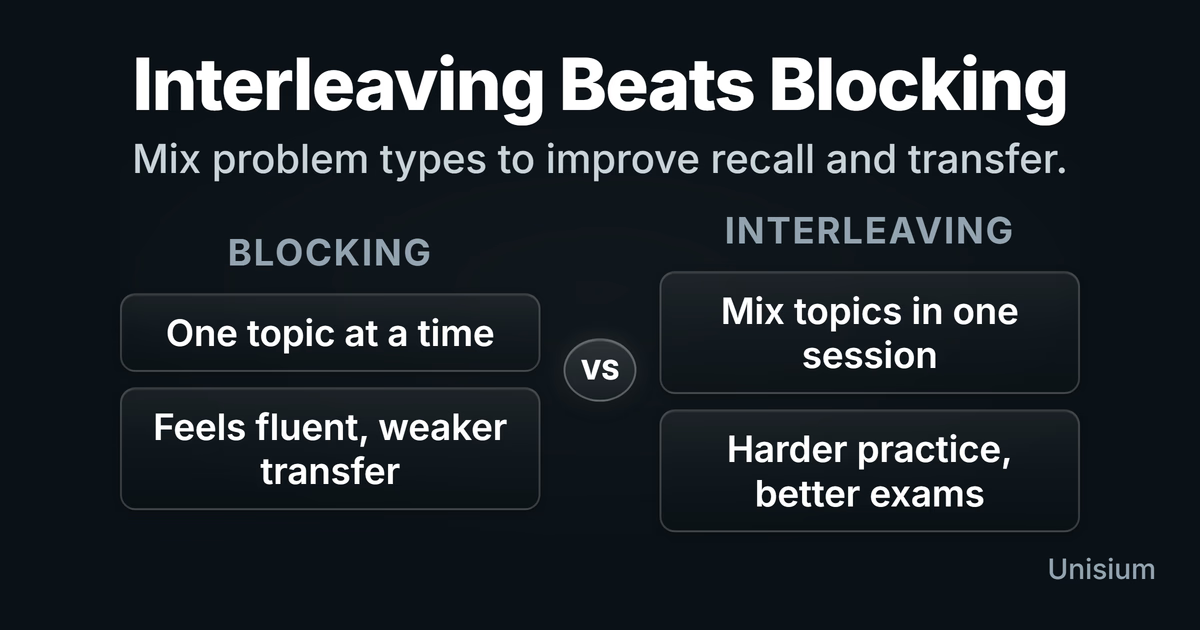
Interleaving means mixing different concepts or problem types within the same study window instead of doing them in isolated blocks (blocking). It feels harder and looks worse during practice—but leads to better test performance, classification of problems, and long-term retention.
Bottom line: Interleaving improves the quality of your elaboration, retrieval, self-explanation, and problem solving by forcing you to identify which principle applies and when.
Use interleaving after a short blocked on-ramp, especially for similar math and physics problem types where the hard part is choosing the right method, not executing a known one.
This interleaving loop is one of the core loops inside the Unisium Study System.
Interleaving beats blocking once you have a short on-ramp. Mix similar problem types and concepts within a session to strengthen recall, improve problem classification, and transfer knowledge to new questions.
On this page: TL;DR · What it is · Why it works · How to do it · When to use/not use · Schedules & templates · FAQ
TL;DR
- Interleaving = mix concepts/problem types within a session.
- It feels harder and practice scores look worse, but exam performance improves.
- Core benefits: better problem classification, stronger retrieval, natural spacing, and richer contrast between ideas.
- Use it especially when problems are similar and easy to confuse (e.g., physics forces vs. energy; derivatives rules; algorithmic patterns).
- Practical rule: If a set feels smooth and repetitive, interleave. If you’re brand-new and overwhelmed, block briefly, then interleave.
What Is Interleaving?
Interleaving is a session-level structure: instead of 60 minutes on Topic A → 60 on Topic B (blocking), you rotate A/B/C every few problems (serial) or shuffle a mixed set (random). This forces selection: before you can execute, you must identify the problem type and the principle + conditions that apply.
Interleaving vs. Blocking (Quick view)
| Aspect | Blocking | Interleaving |
|---|---|---|
| Practice feel | Fluent, repetitive | Effortful, disfluent |
| Short-term score | Higher | Lower |
| Exam/transfer | Weaker | Stronger |
| Skill trained | Execution of one pattern | Classification + selection across patterns |
| Cognitive effects | Shallow familiarity | Spacing + contrast + retrieval |
Why Interleaving Works
Problem Classification (Discrimination)
Similar problems require noticing differences: Is this momentum or energy? Chain rule or product rule? Interleaving trains the decision step you’ll face on exams.
Natural Spacing
Mixing topics inserts time between repeats of the same concept—creating desirable difficulty and stronger reconsolidation. You’re building spacing naturally as part of the session.
Contrast and Similarity
Juxtaposing A vs. B exposes what makes each distinct, helping you encode conditions of use—the real key to transfer.
Countering Fluency Illusions
Blocked sets inflate confidence (“I’ve got it”) by leaning on short-term memory. Interleaving forces long-term retrieval, making gaps in understanding visible during practice. This is the same fluency illusion that makes many ineffective strategies feel productive.
Contextual interference: Interleaving creates a desirable difficulty that strengthens discrimination practice compared to blocked practice.
Core Principle
You learn what you practice. Interleaving practices identification + selection, not just execution.
How to Interleave in Practice
Step 1: Build a Mixed Set (10–20 items)
Math/Physics: Pull 3–5 problems each from 3 topics (e.g., Newton’s Laws, Energy, Momentum).
Programming: Alternate small tasks (array ops, recursion trace, hashmap design) or kata variants.
Medicine/ECG, Bio: Shuffle diagnoses with similar presentations.
Humanities: Mix primary-source analysis, theory application, concept comparisons.
Step 2: Set Clear Decision Prompts
Before solving, answer aloud or in brief:
- What type is this? (name the principle)
- What conditions apply? (when valid / when not)
- Why not the alternative? (contrast with neighbor)
Step 3: Keep the Rotation Tight
- Serial interleave: A1, B1, C1, A2, B2, C2 …
- Random interleave: shuffle the stack each pass. If you get 3 in a row of the same type, reshuffle.
Step 4: Close With Retrieval (no notes)
2–3 quick items per topic, from memory: Name → Conditions → Example. Tomorrow, do a spaced mini-set (6–8).
When to Interleave—and When to Block
Interleave when:
- Problem types are similar and easily confused.
- You feel fluent in blocked sets (too easy).
- You’ve reached a plateau and need fresh challenge.
- You’re preparing for cumulative or mixed exams. See Quick Comparison for how interleaving stacks against blocking.
Block (briefly) when:
- Skill is brand-new and you’re overwhelmed.
- You must learn the basic schema/notation first.
- Motor/cognitive load is too high to classify and execute at once.
Rule of thumb: Start blocked for on-ramp only (minutes to a couple sessions). Switch to interleaving as soon as execution stabilizes.
Templates and Sample Schedules
A) 60-Minute STEM Session (Serial Interleave)
- 05 min Warm-up: skim formula sheet; state conditions (no solving)
- 40 min Mixed set (A/B/C rotation, 2 problems each per pass)
- Before each: Type? Conditions? Why not X?
- 10 min Retrieval no-notes: Name → Conditions → One example per topic
- 05 min Log mistakes → tag by misclassification vs execution
B) Exam Week (Mixed Past Papers)
Build a 20-item set from past exams covering all major topics.
Do 10 today, 10 tomorrow. Shuffle daily.
Track errors by wrong principle chosen vs procedure slip.
C) Flashcards (Anki)
Convert each problem type into type cards (When does [principle] apply? Contrast with [neighbor]).
Tag by topic; review mixed decks daily; lean on spaced intervals.
Interleaving by Domain
Math & Physics
Mix look-alikes: product vs chain rule; forces vs energy; kinematics vs dynamics; series tests.
Always state conditions (e.g., conservation laws).
Programming
Rotate pattern families: recursion vs iteration, hashmap vs tree, greedy vs DP hints.
Use tiny tasks (≤5–8 min each) to keep rotation alive.
Medicine / Diagnostics
Cluster confusables; force “why this not that” before reading the answer.
Humanities
Interleave theory → application → counterexample mini-tasks; compare authors’ claims side-by-side.
Common Pitfalls
Too big a switch: jumping from brand-new to heavy interleave → overload. Start blocked briefly.
Interleaving without contrast: if topics are unrelated, you lose the classification benefit. Pick similar neighbors.
Skipping retrieval: interleaving ≠ retrieval. Always finish with no-notes recall.
Over-long rotations: 30 minutes on “A” isn’t interleaving. Rotate every 1–3 items.
Quick Comparison: Interleaving vs. Blocking
| Goal | Blocking | Interleaving |
|---|---|---|
| Learn basic mechanics | Good (short-term) | Fine after on-ramp |
| Classify problem types | Weak | Strong |
| Long-term retention | Moderate | Strong |
| Exam transfer | Inconsistent | Stronger |
Start Now (5-Minute Kickoff)
- Pick 3 topics you often confuse.
- Assemble 9 problems (3 per topic).
- Rotate A/B/C, answering Type/Conditions/Why-not-X before solving.
- Tomorrow: 6-item no-notes mini-set. Track where you misclassify.
How This Fits in the Unisium Study System
The Unisium Study System turns this strategy into concrete cards and scheduled practice: sessions automatically mix different problem types and principles, forcing you to identify which principle applies before you start solving.
Related Guides
- Elaborative Encoding — Build the connections that make classification stick.
- Self-Explanation — Explain why each step follows from a principle’s conditions.
- Retrieval Practice — Lock it in with spacing and recall.
- Problem Solving — Solve systematically once identification is solid.
- Five-Step Strategy — Physics-specific problem-solving framework.
← Prev: Highlighting and Underlining | Next → Retrieval Practice
Interleaving is domain-general. Interleaving trains discrimination. When tasks look similar but require different rules, mixing them forces you to choose the right principle before you execute. Blocking teaches execution in a known lane; interleaving teaches selection—the part students usually fail on exams. That selection skill is domain-independent, so the benefits travel wherever categorization matters.
FAQ
Is interleaving always better than blocking?
No. Use a short blocked on-ramp for brand-new skills, then switch. If it feels smooth, you waited too long.
How similar should topics be?
Similar enough to confuse. Interleaving shines when discrimination matters.
Can I interleave across courses?
Yes, if there’s overlap (e.g., calculus + physics). If unrelated, the decision step weakens—benefits drop.
What if my scores drop during practice?
Expected. Interleaving trades practice fluency for exam performance. Track misclassification shrinking over days.
How do I know it’s working?
Your no-notes recalls and first-try topic selection improve. Exam items feel recognizable by structure, not surface features.
Is interleaving the same as spacing?
No. Interleaving mixes topics within a session; spacing spreads reviews over days. Use both together for maximum effect.
How many topics should I interleave at once?
Usually 2–4. Enough contrast to force classification without overwhelming switching costs.
Ready to apply this strategy?
Unisium turns these evidence-based techniques into guided study sessions for math and physics. Places are limited during early access. Check current availability to start a trial; joining the mailing list is optional.
See plans and availability Read More GuidesAlready have access? Sign in