The Feynman Technique: A Gateway to Deep Understanding
Is the Feynman Technique effective for learning physics and math? Yes—it forces you to translate formal definitions into your own words, exposing gaps you didn’t know existed. When you explain a concept simply, you turn recognition into usable understanding that survives problem sets and exams.
The Feynman Technique is often presented as a way to “learn anything fast.” While it doesn’t replace the hard work of problem solving, it is an excellent diagnostic tool. It reveals exactly where your understanding breaks down so you can target your study.
When you strip away the jargon and try to explain a principle in plain English, you can’t hide behind memorized phrases. You either understand the mechanism, or you don’t. This process of simplification and translation—combining self-explanation with elaborative encoding—is a core part of the Unisium Study System.
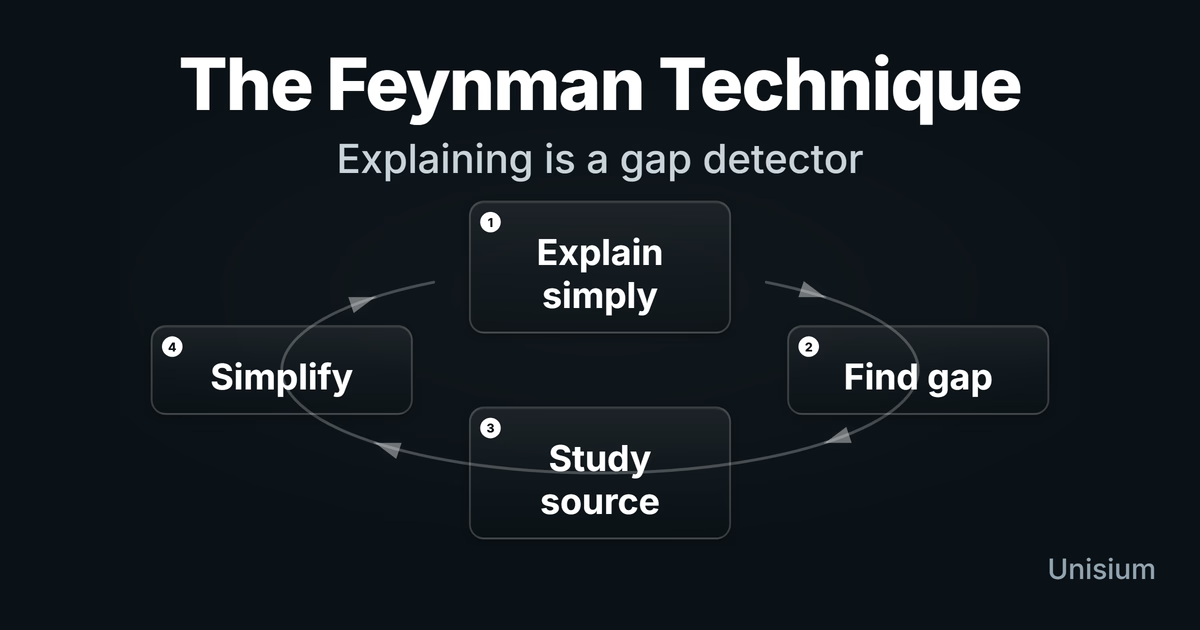
On this page: Why It Works · The Trap · How To Do It · Common Mistakes · Start Now · FAQ · How This Fits in Unisium
Why It Works
The Feynman Technique works because it uses generative processing. Instead of passively consuming information, you are actively generating an explanation. This engages two powerful learning mechanisms:
1. Self-Explanation When you explain a concept, you are forced to make causal connections explicit. You can’t just say “momentum is conserved”; you have to explain why (no external forces). This aligns directly with self-explanation. As noted in Learning Myths, a perfect explanation can feel like learning even when you can’t reproduce it. Generating your own explanation is what exposes that gap.
2. Retrieval (Testing Effect) When you explain from memory, you are testing yourself. That retrieval attempt strengthens recall and makes the idea easier to use under exam pressure. Getting stuck or reaching for jargon is also useful—it’s the built-in gap detector that tells you what to review next. See the testing effect for why retrieval beats re-reading.
Skeptical take: “I don’t have time to teach imaginary students.” You don’t need an audience. The value comes from the cognitive effort of translation, not the performance.
Want the complete framework behind this guide? Read Masterful Learning.
The Trap: Performing Instead of Learning
The Feynman Technique fails when it becomes a performance. If you focus on making your explanation sound smooth rather than accurate, you fall into the same trap as Blurting: fragile fluency.
To salvage it, you must be your own harshest critic. If you gloss over a condition (e.g., “assuming constant mass”) to make the explanation simpler, you have failed. You must explain the mechanism, not just a simplified story. This distinguishes it from Summarizing, which often just shortens the text without deepening understanding.
How to Do the Feynman Technique (Step by Step)
Step 1: Choose Your Concept
Write the name of the concept at the top of a blank sheet of paper. Be specific. Instead of “Physics,” choose “Conservation of Angular Momentum.”
Step 2: Teach It to a Child (or a Novice)
Write out an explanation of the concept in plain English. While formal names have power and are essential for exams, they often hide gaps in understanding. Here, you must unpack them. If you use a technical term, define it immediately using simple words. Use analogies and drawings to illustrate the mechanism.
Guardrail: Simple language is the goal, but constraints are non-negotiable. If you drop conditions (like “closed system” or “constant mass”), you didn’t simplify—you changed the claim.
Example: Instead of “Torque is the cross product of radius and force,” try “Torque is a twisting force. It depends on how hard you push and how far from the pivot you push, like using a long wrench to loosen a tight bolt.”
Step 3: Identify Gaps and Review
When you get stuck, or your explanation gets wavy and confusing, stop. That is your gap. Go back to your source material (textbook, notes) and re-learn that specific part until you can explain it simply.
Step 4: Simplify and Organize
Once you have a working explanation, refine it. Remove clutter. Create a simple analogy that captures the essence. The goal is a concise, accurate mental model that you can easily retrieve later.
Common Mistakes (and the Fix)
| Mistake | Fix |
|---|---|
| Using Jargon | Names have power, but don’t hide behind them. Define every term you use. |
| Skipping the “Gap” Step | The learning happens when you go back to the source to fix your gap. Don’t skip it. |
| Being Too Vague | ”Energy is good” is simple but useless. Your explanation must be physically accurate. |
| Ignoring Math | Use this template: “This equation says rate of change of X equals cause Y, under conditions C.” |
Start Now (5 minutes)
Stuck on a concept? Try this:- Pick the concept that is confusing you most right now.
- Set a Pomodoro timer for 5 minutes.
- Write an explanation as if you were teaching a classmate who missed the lecture.
- Circle the parts where you used a buzzword because you didn’t truly understand the mechanism.
FAQ
Is the Feynman Technique enough for physics?
No. It builds conceptual understanding, but you still need problem solving to apply that understanding to quantitative problems. Use Feynman to understand the why, then practice the how.
Should I do this for every topic?
No. It is time-consuming. Use it for “high-value” principles that are central to the course, or for concepts you find particularly confusing.
Can I do this mentally?
You can, but writing it down is better. Writing forces linearity and precision. It’s harder to gloss over gaps on paper than in your head.
How do I turn this into retrieval practice?
Once you have a good explanation, turn it into a prompt. Example: “Explain conservation of momentum in two sentences without using the words ‘conserved’ or ‘isolated’.”
How This Fits in Unisium
The Feynman Technique is a specific application of self-explanation and elaborative encoding, which are core pillars of Masterful Learning.
- Replace Passive Review: Instead of passively reviewing your lecture notes, use Feynman to diagnose what you can and cannot explain.
- Pair with Diagrams: Once your explanation is clear, draw a concept map to lock in the relationships visually.
- Combine with Retrieval: Once you have a good explanation, turn it into a retrieval practice prompt (e.g., “Explain conservation of momentum in one sentence without using the word ‘conserved’”).
- Support Problem Solving: Use your simplified mental model to check if your calculated answers make sense.
Ready to use it? Check access and join the Unisium waitlist or go deeper in Masterful Learning.
Next Steps
- Do instead: Self-Explanation
- Big picture: Ineffective Study Techniques
Masterful Learning
The book behind these guides: a study system for physics, math, & programming built on retrieval, connection, explanation, and problem solving.
Ready to apply this strategy?
Unisium turns these evidence-based techniques into guided study sessions for math and physics. Places are limited during early access. Check current availability to start a trial; joining the mailing list is optional.
See plans and availability Read More GuidesAlready have access? Sign in