Is Blurting Effective for Learning Math & Physics? Rarely
Blurting (or brain dumping) is a retrieval strategy where you write everything you know about a topic from memory and then audit it against a source of truth. For math and physics, it is mostly a diagnostic because it reveals what you can recite but rarely builds the step-generation you need for problem solving. Use it only as a quick stress test, then immediately verify with a fresh problem or a strict cross-exam of your explanation.
For more on effective retrieval, see Retrieval Practice and Problem Solving.
Short answer: blurting is rarely effective for learning math and physics if your goal is better problem solving. It is useful as a quick recall stress test, but it does not replace solving fresh problems under constraints.
On this page: Is Blurting Effective? · Why It Fails · Can It Be Salvaged? · The Protocol · FAQ · How This Fits in Unisium
Is Blurting Effective?
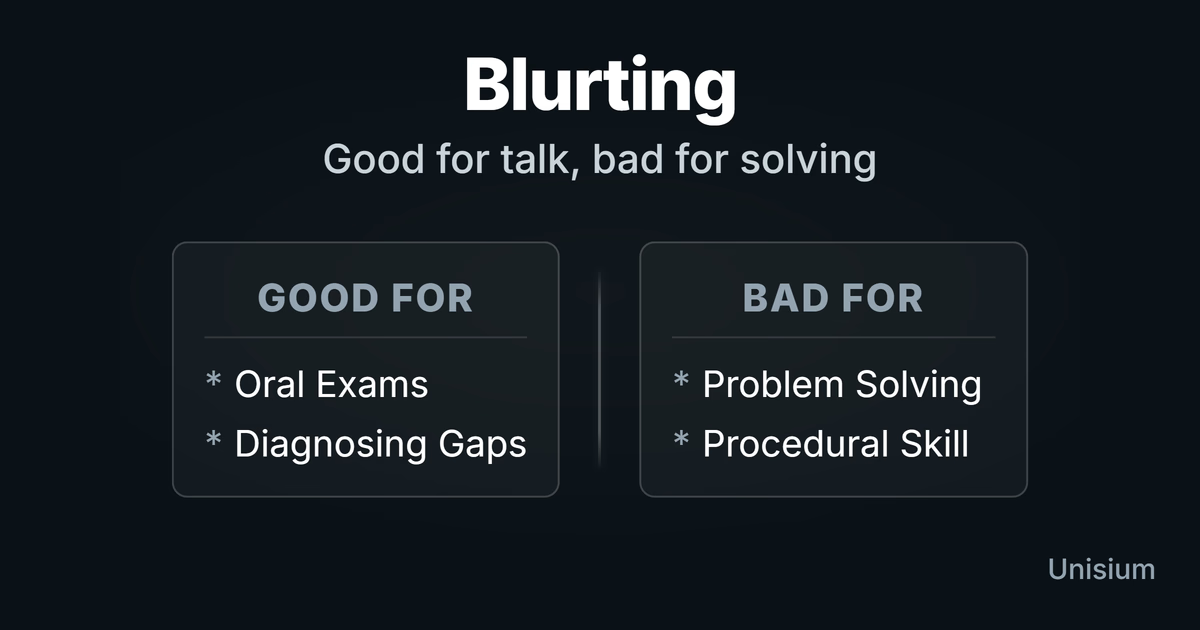
Is blurting effective for learning math and physics? Rarely. Blurting is mainly a diagnostic: it reveals what you can recite, but it usually doesn’t train the step-generation needed for problem solving.
Blurting is often marketed as a “brain dump”—but dumping is not the same as generating solution steps under constraints. Math and physics exams usually test problem solving, not recitation. You can successfully “blurt” the derivation of the Wave Equation and still fail to apply it to a boundary value problem you haven’t seen before.
Blurting trains verbal coherence. Problem solving trains transfer. If you confuse the two, you will build a “fragile fluency”—you sound like you know it, but you cannot do it.
How Does Blurting Work?
Blurting (brain dumping) is simple: you try to retrieve everything you know from memory, then audit it against a source of truth. In math/physics, that retrieval is usually verbal/definition-level, not step-generation.
Cycle: Study → Blurt → Audit → Restudy (gaps) → then solve a fresh problem.
Why It Fails for Problem Solving
The Illusion of Competence
When you blurt, you are often just reconstructing a linear chain of logic you memorized. Real problems are non-linear. They require you to select the right tool, adapt it to constraints, and execute it. Blurting does not practice these selection and adaptation steps, unlike Retrieval Practice applied to problems.
High Fluency, Low Verification
The danger of blurting is that it feels productive. You fill a page with equations. But unless you have a rigorous feedback loop (an “audit” plus solving one fresh problem), you might be reinforcing subtle errors. If you don’t follow blurting with Problem Solving, you risk high confidence with low competence.
Can It Be Salvaged?
While not a primary study method, blurting can be salvaged if you treat it as a diagnostic, not a learning event. It shares a niche with the Feynman Technique: both are output-focused but prone to “fragile fluency” unless audited.
1. Oral Exam Prep
If your course involves an oral component (common in European universities), blurting is essential. Oral exams reward the ability to retrieve and link concepts verbally under pressure, similar to Self-Explanation.
- Goal: Smooth, coherent explanation.
- Method: Record yourself explaining a principle for 60-120 seconds.
2. AI as an Adversary
You can use AI to turn blurting into a feedback loop. Instead of asking AI to explain something to you, explain it to the AI. Don’t ask it to teach; ask it to challenge and to flag missing conditions.
- Prompt: “I am going to explain [Concept]. Act as a strict physics professor. Find the first invalid inference in my explanation and ask me a question to expose it.”
- Benefit: This forces you to be precise. Speech-to-text makes this frictionless.
- Guardrail: Use it to generate questions and pressure-test conditions; verify against a textbook/solution key. AI can hallucinate, so treat it as a sparring partner, not an oracle.
3. The “Think-Pair-Share”
In a study group or classroom, blurting works as a social retrieval prompt. It turns a solitary activity into a peer-audit where you hunt for missing conditions and errors in a peer’s work.
- Step 1: Everyone blurts for 90 seconds.
- Step 2: Swap papers.
- Step 3: Find 2 missing conditions and 1 error in your partner’s work. This turns a solitary activity into a rigorous audit.
The Protocol: Diagnostic Only
If you use blurting, treat it as a stress test, not a study session. Use it like Pretesting to identify what you don’t know before you start deep work.
- Select a Target: A specific derivation or principle (e.g., “Gauss’s Law”).
- The Blurt (Timed): 5 minutes, no notes. Write the equation, the conditions, and the physical meaning.
- The Audit (Mandatory): Switch to a red pen. Compare your output to the textbook. Mark every missing condition (e.g., “valid only for high symmetry”).
- The Real Work: Close the blurt. Go solve a problem that uses that principle.
Blurting Study Method (What It Is Good For)
Blurting is best used as a timed retrieval stress test to expose gaps quickly. If you don’t audit and then solve a fresh problem, it’s mostly performance theater.
FAQ
Is blurting effective?
Rarely for math/physics problem solving. It can help you notice missing definitions and conditions, but it doesn’t train selecting tools and generating steps.
How does blurting work?
You write from memory, then audit against a textbook/solution key. Without the audit + one fresh problem, you mostly reinforce errors or confidence.
Blurting method studying: how should I do it?
Use it as a 5-minute diagnostic, then immediately (1) audit missing conditions and (2) solve one new problem that uses the same principle.
What is the best way to memorize in physics?
Not blurting alone. Use retrieval practice on principles plus self-explanation and problem solving so you memorize conditions → actions → goals, not just words.
Is the pre-exam “brain dump” the same thing?
No. Writing down formulas on your scratch paper right before an exam starts is a performance ritual to reduce anxiety and offload working memory. “Blurting” is a study technique done days or weeks in advance to build retrieval strength.
Can I use this for definitions?
Yes. For pure declarative knowledge (definitions, units, history), blurting is fine. But in physics, definitions are rarely asked in isolation; they are part of a problem.
Handwriting vs. Typing?
For math and physics, the constraint is notation. Typing LaTeX or using an equation editor is often too slow for a stream-of-consciousness dump. Handwriting reduces the friction between your brain and the page, allowing you to focus on retrieval.
How This Fits in Unisium
In the Unisium Study System, we prioritize methods that build transfer. We don’t just want you to recite formulas; we want you to apply them to novel situations.
- Elaborative Encoding: Builds the mental model first.
- Blurting (Optional): Checks if you can retrieve that model verbally.
Use blurting only as a bridge between understanding a concept and solving problems with it. It is a diagnostic tool, not the destination. The full pipeline is in Masterful Learning.
Next Steps
- Do instead: Problem Solving
- Big picture: Ineffective Study Techniques
Masterful Learning
The book behind these guides: a study system for physics, math, & programming built on retrieval, connection, explanation, and problem solving.
Ready to apply this strategy?
Unisium turns these evidence-based techniques into guided study sessions for math and physics. Places are limited during early access. Check current availability to start a trial; joining the mailing list is optional.
See plans and availability Read More GuidesAlready have access? Sign in