Names Have Power: Why Math and Physics Vocabulary Is Not Optional
Names in math and physics aren’t trivia—they’re retrieval cues that let you recognize a problem type, activate the right structure, and recall the conditions for using it. If you can’t name what you’re looking at (“harmonic oscillator”, “Gaussian surface”, “non-homogeneous linear ODE”), every problem stays a fresh mess of symbols. Learn the vocabulary by forcing yourself to state the name, the meaning, and the conditions, then use it in problems.
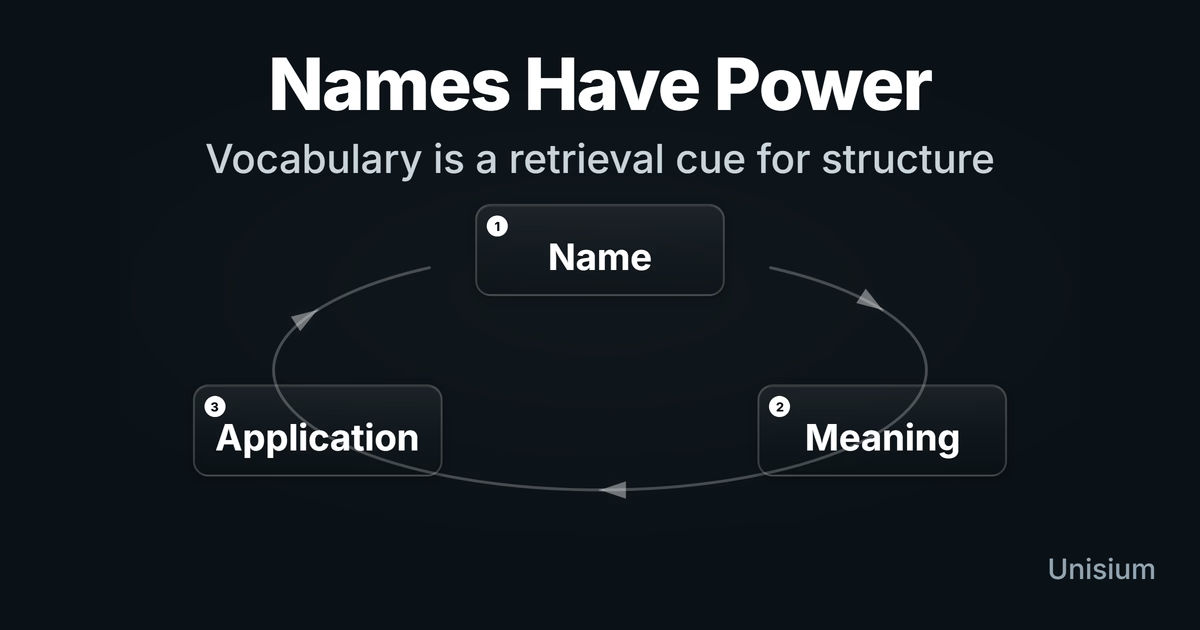
“Do I really need to remember all these names? Can’t I just learn the formulas and methods?”
If you’ve studied math or physics, you’ve probably had that thought—or heard someone say it.
This is for students who know formulas but still struggle to recognize what kind of structure a new problem belongs to.
It feels like vocabulary is extra load on top of the real work: solving problems, passing tests, getting through the course.
But that’s backwards.
If you never learn the names of things in a domain—the real, formal vocabulary—you are choosing to stay weak in that domain. Names are not a cosmetic layer on top of understanding; they’re one of the main ways humans build understanding in the first place.
When I say “math and physics vocabulary,” I mean the real terminology of the subject: the formal names of concepts, principles, structures, and conditions.
You can see that from evolution, cognitive science, religion, and fantasy. And once you see it, it’s obvious why Unisium leans into formal language instead of hiding it.
1. Humans are a naming species
Humans are weirdly obsessed with names.
We don’t just shout generic calls like “danger!” or “food!” We:
- Give individual names to people and places.
- Name tools, storms, ships, the local café, and our favorite bike.
- Carve the world into categories and subcategories, then label them.
From an evolutionary perspective, naming specific people, places, and objects probably had huge coordination benefits: you can refer to absent events and entities, make plans about them, and share those plans with others.
Names are a form of compression. Instead of transmitting a full mental picture, you send a short code that your group knows how to expand:
- “Meet at Old Njál’s stone by the ford when the sun touches the fjord.”
- “Ask Eira about the red mushrooms beyond Mýrkviðr.”
- “We break camp when Njörðr’s wind turns against the fjord.”
Math and physics are hyper-evolved versions of this same move.
“Newton’s second law”, “harmonic oscillator”, “linear map”, “eigenvalue”, “Gaussian surface” — each is a tiny verbal handle on a lot of shared structure. If you don’t know the handle, you’re outside the conversation.
2. Cognitive science: labels as high-powered cues
In cognitive psychology, verbal labels aren’t just tags. They change how memory and attention work.
Research shows that having a label for an object or category can improve memory, even when the label itself is arbitrary. The label becomes an extra associative cue you can use at retrieval. Other work indicates that verbal labeling during encoding can shift what people pay attention to and how they later recognize visual stimuli.
Then there’s schema activation: when you hear a word, your brain automatically lights up a whole network of related knowledge, expectations, and procedures. “Right-hand rule” doesn’t just sound familiar; it drags in cross products, magnetic fields, orientation of axes, and hand gestures.
So:
A name is a compact retrieval cue for a whole subgraph of your knowledge.
In STEM, that’s the entire game:
- “Conservation of energy” is a label for a pattern: if only conservative forces do work, total mechanical energy stays constant.
- “Normal force” is a label for “force a surface exerts perpendicular to itself to prevent interpenetration.”
- “Linear approximation” is a label for “use the tangent line near a point; ignore higher-order terms.”
If you truly own these labels, you can pull a tiny string (“this is basically an energy problem”) and a full problem-solving pattern unfolds.
If you don’t, every problem is just a fresh mess of symbols.
3. Religion and mysticism: names as power
The idea that names have power is ancient.
In the Hebrew Bible, God names parts of creation (“day”, “night”, “heaven”, “earth”), and Adam’s role over the animals is marked by his act of naming them. Naming signals authority and relationship.
In Jewish tradition:
- The tetragrammaton (YHWH) is treated as a unique divine name, approached with extreme caution.
- Abram becomes Abraham; Jacob becomes Israel — new names for new roles and covenants.
- Mystical strands explore hidden names of God as carriers of power and insight.
Other traditions mirror this: sacred mantras in Hinduism and Buddhism; the Logos in Hellenistic and Christian thought; Japanese kotodama (“the spirit of words”).
You see similar ideas in Norse myth, where runes, galdr (sung spells), and heavily meaningful god-names tie language directly to magic and power.
You don’t have to buy the theology to see the pattern:
To name something—correctly and precisely—is to stand in a different relation to it.
In math and physics, if you can’t name what you’re dealing with, you are effectively at the outer courtyard of the temple, peeking in.
4. Fantasy (and anime) and the “true name” trope
Modern fantasy leans hard into the “true name” idea:
- In folktales like Rumpelstiltskin, knowing the creature’s name breaks his power.
- In The Odyssey, Odysseus hides his name from the Cyclops, then stupidly shouts it on the way out, enabling revenge.
- In Ursula Le Guin’s Earthsea, wizards learn the “true names” of things and people to command them.
- In Patrick Rothfuss’ The Name of the Wind, Naming is a form of magic where truly knowing the Name of the wind (or anything else) lets you command it directly.
- In Christopher Paolini’s Inheritance Cycle, every person and thing has a “true name” in the Ancient Language; knowing it gives you root-level control.
Plenty of anime and games reuse this pattern: if you learn someone’s real name, you gain special leverage over them.
As a metaphor for learning, it’s almost too perfect:
Once you know an entity’s true name, it stops being a vague threat and becomes something you can manipulate deliberately.
First-year student: sees a page of math, feels anxiety. More advanced student: “Okay, this is a non-homogeneous linear ODE with constant coefficients” or “this is just an energy–momentum conservation problem in disguise.”
That’s a true-name moment. The space of options collapses. You know which tools normally work and which don’t.
In real life, there’s no magic; it’s just better pattern-matching. But the trigger is still the name.
5. Language changes what you notice (colors and numbers)
Linguistic relativity (Sapir–Whorf) is often oversold in its strong form (“language completely determines thought”), but the moderate version—that language influences what you automatically notice—is well supported.
The classic color example:
- Russian has separate basic color terms for light blue (goluboy) and dark blue (siniy).
- English just has “blue”.
- Experiments show that Russian speakers can discriminate light/dark blues faster when the pair crosses the goluboy/siniy boundary, and that this advantage disappears when people are forced to do a verbal interference task.
The categories in your language become perceptual shortcuts.
Now look at numbers.
Some cultures—including the Pirahã in the Amazon—have no stable words for exact numbers like “three” or “seven”. Experiments suggest they can still perceive quantity, but they struggle with tasks that require keeping exact counts in memory across time and space.
The interpretation many researchers favor is:
Exact number words act as a cognitive technology — a naming system that lets you track precise quantities over time, not just approximate “few, some, many.”
Once the names exist and you internalize them, you start “seeing” exact cardinalities and relationships that were practically invisible before.
In STEM, formal vocabulary does the same thing:
- If you don’t have a crisp concept of “orthogonal”, you keep saying “at 90 degrees” and miss the deeper pattern that unifies geometry, projections, probability, and linear algebra.
- If you don’t have “centripetal vs centrifugal” nailed down, rotating systems stay muddy.
- If you don’t have “linear vs nonlinear” as a named dichotomy, you don’t develop a feel for which tools and approximations scale.
No terminology → fewer ready-made slots in your mind → more cognitive load on every problem.
6. Principles: the highest-yield names in math and physics
Not all names are equal.
Knowing the term “pendulum” is useful. Knowing the term “simple harmonic oscillator” (and what qualifies as one) is dangerous in the best way.
Principles are the highest-leverage concepts in math and physics (see Principle Structures) because each principle is a bundle:
- A name
- A structure / equation (or set of equations)
- A set of conditions of validity
For example:
-
Conservation of momentum
- Name: “conservation of momentum”
- Structure: total momentum of a closed system remains constant
- Conditions: isolated system; external net impulse ≈ 0
-
Linear superposition
- Name: “principle of superposition”
- Structure: solutions add; responses are linear in the cause
- Conditions: linear systems (equations or operators), not arbitrary nonlinear ones
These are true names in the fantasy sense: once you really own them, entire classes of problems collapse into the same pattern. You see past surface details to the underlying principle.
But there’s a cost:
- Principles are abstract.
- They don’t attach to a single obvious picture.
- They’re easy to half-memorize and almost impossible to wield without practice.
That’s exactly why systematically learning their names, structures, and conditions is such a power move. It’s also what most “fast tips” apps avoid, because it’s harder to package into a swipe-able experience.
7. How to learn the language: the questioning loop
It’s not enough to see the names in a textbook, or to watch someone else say them in a video.
You have to run them through a meaning-making loop:
-
Question
- “What is this thing, really?”
- “When does this principle apply and when does it fail?”
- “How is this different from that other thing with a similar name?”
-
Hypothesis
- You form a guess in your own words:
- “I think ‘normal force’ is just the surface’s reaction perpendicular to contact.”
- “I think conservation of energy holds whenever friction is negligible or can be modeled as conservative.”
- You form a guess in your own words:
-
Test against an authority
- You compare your guess against:
- A carefully written explanation (textbook, guide, solution).
- Worked examples and problem solutions.
- A teacher, tutor, or trusted reference.
- You check: “Where does my story match? Where does it break?”
- You compare your guess against:
-
Refine and reconnect
- You adjust the concept: fix edge cases, tighten conditions, sharpen distinctions.
- You link it to related names: “Oh, this is just Newton’s 2nd law in disguise,” “This is another conservation-of-something problem.”
This loop is how names stop being noises and start becoming handles on reality.
(For more on how to build this loop into your study habits, see Elaborative Encoding.)
Crucially, there has to be input injection—lectures, books, videos, worked examples—but the input is almost meaningless if you don’t run this loop. Without questioning, hypothesizing, and testing, new terms just float past as decorative sound.
And this loop is exactly what most students skip. They skim definitions, memorize a few formulas, and hope recognition is enough.
It isn’t.
How This Fits in Unisium
Unisium is built around helping you master the vocabulary of math and physics by forcing you to use the right names in real problem contexts. That’s a core part of the Unisium Study System. (See Is Unisium Right for You? to see if this rigorous approach fits your goals.)
Unisium is deliberately designed to force that question → hypothesis → test → refine loop, especially around principles and their names.
-
Elaborative encoding studycards
- Prompt you with targeted questions like “In your own words, what does conservation of energy say in this situation?” or “What’s the difference between centripetal and centrifugal force here?”
- You must commit to a hypothesis in text — not just nod in your head.
- Then you see a high-quality reference answer and compare line by line, tightening your understanding of both the name and the conditions.
-
Self-explanation studycards
- Wrap the same loop around full problems and solutions.
- You’re asked to explain why a particular principle or method was used, using the actual math/physics vocabulary.
- You test your story against the model solution and refine your internal “name → structure → condition” mapping.
-
Principle-centric structure
- Unisium doesn’t just track generic “questions done”. It tracks progress at the level of principles, subdomains, and domains.
- Many studycards are explicitly about “Which principle applies?” or “State the principle and then apply it,” so naming is a first-class skill, not an afterthought.
-
Language in, language out
- You don’t just see the formal language. You type it, retrieve it, and use it to explain.
- Over time, those names become the natural mental handles you reach for when you see new problems.
This is not an accident. It’s the point.
Unisium is not for people who want a surface-level app where you half-memorize an algorithm, mostly click around, and feel good without changing how you think.
If you only want quick mechanical tricks for tomorrow’s quiz, lots of tools will happily feed you templated steps.
Unisium is built for a different kind of student:
- The one who wants the true names of the subject.
- The one who wants principles to feel as familiar as everyday words.
- The one who understands that real power in math and physics comes from being able to name, connect, and wield the right concepts under pressure.
Once you’ve run enough principled, language-heavy studycards through that meaning-making loop, something shifts.
A page of math stops looking like a wall of symbols and starts looking like a small, finite set of named structures you already know how to handle.
That’s what power feels like in these domains.
Unisium just makes it harder for you to avoid getting there.
FAQ
Do I need to memorize names, or can I just learn the method?
You need both. The name is often the fastest retrieval cue for the method and its conditions. If you can’t name it, you’ll struggle to select it under time pressure.
How do I learn vocabulary without turning it into flashcard trivia?
Tie every term to a structure: meaning → conditions → one example → one contrast. Then force yourself to use the term while self-explaining a worked example and while solving a new problem.
What’s the fastest way to build “problem recognition”?
Practice naming what you’re looking at. After each problem, write one sentence: “This is a ___ problem because ___, so I should check ___ conditions.” Then revisit a week later and try to classify it cold.
Next → Principle Structures | Elaborative Encoding | Is Unisium Right for You?
Ready to apply this strategy?
Unisium turns these evidence-based techniques into guided study sessions for math and physics. Places are limited during early access. Check current availability to start a trial; joining the mailing list is optional.
See plans and availability Read More GuidesAlready have access? Sign in