Uniform-Field Potential Difference: Track the Sign of Voltage
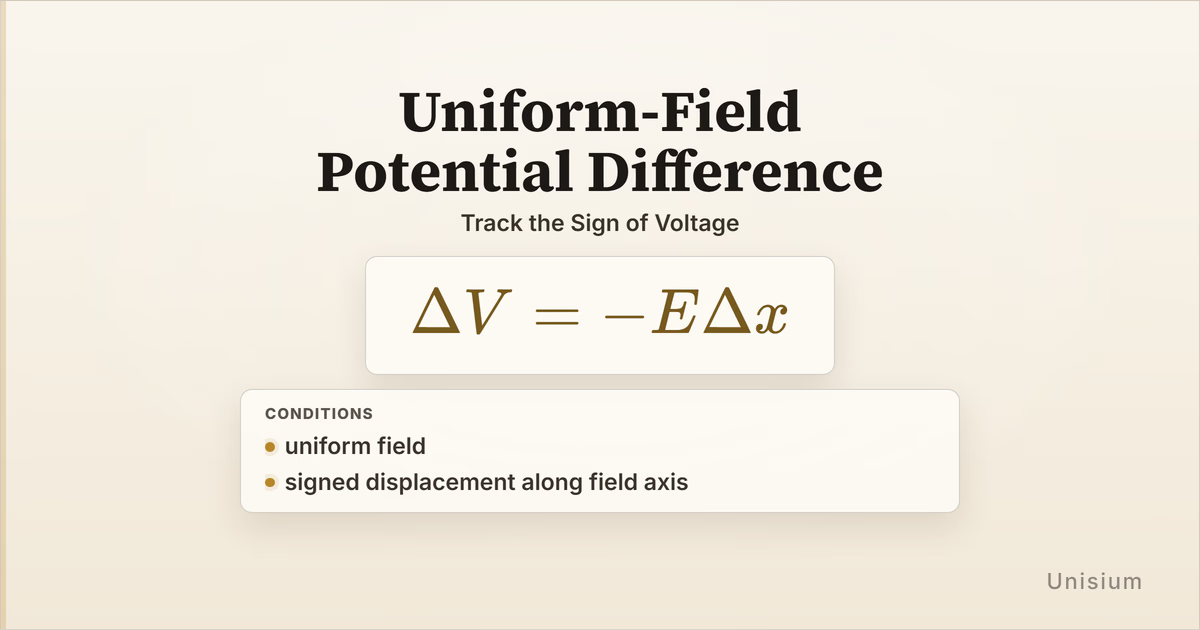
Uniform-Field Potential Difference says that voltage changes by minus field strength times signed displacement along the field axis. The model is , and it applies for a uniform field with displacement signed positive in the field direction. Use it when a problem gives a constant electric field and asks how potential changes between two positions.
This guide sits after Electric Potential Of A Point Charge and before energy-change work such as Electric Potential Energy From Potential. The surrounding decision is the sign convention for : choosing the field-positive axis and endpoint order is setup, not a separate principle.
On this page: The Principle | Conditions | Misconceptions | Elaborative Encoding | Retrieval Practice | Worked Example | Solve a Problem | Related Principles | FAQ | Related Guides | How This Fits
The Principle
Statement
Uniform-Field Potential Difference connects a constant electric field to the change in electric potential along the field axis. If the displacement is measured in the positive field direction, potential decreases; if the displacement is measured against the field direction, potential increases. The minus sign is the physics of electric potential: the electric field points in the direction of decreasing potential.
Mathematical Form
Where:
- is the potential difference, usually , in V
- is the magnitude of the uniform electric field in V/m or N/C
- is the signed displacement along the field axis in m
The diagram shows the orientation-care issue. Once the positive axis is chosen along the uniform field, a positive means moving with the field, so is negative. Reversing the signed displacement reverses the sign of the potential difference.
Common endpoint form
When the coordinate axis is chosen positive in the direction of the uniform field, the same relation is often written as:
This is not a new principle. It is the same model with and expanded into final-minus-initial endpoint differences.
What this relation does and does not say
- It converts a uniform electric field and a signed displacement into a potential difference.
- It says potential decreases in the direction of the electric field.
- It does not compute the field from source charges; for that, use a field principle such as Electric Field From Point Charge when the condition fits.
- It does not handle nonuniform fields directly; the line-integral relation is the later general form.
Conditions of Applicability
Condition: uniform field; signed displacement along field axis
Practical modeling notes
- Uniform field means is constant over the displacement being modeled.
- Signed displacement means this compact form treats positive as displacement in the direction of the electric field and negative as displacement against it.
- Along field axis means the displacement component used in the equation is parallel or antiparallel to the field, not an arbitrary path length.
- If you choose a coordinate axis opposite the field direction, first convert the displacement into this field-positive sign convention or use a signed field component instead.
- If a problem gives two plate positions, decide which endpoint is initial and which is final before assigning .
When it does not apply directly
- Nonuniform electric field: if the field changes with position, use a line-integral model rather than multiplying one constant by the whole displacement.
- Displacement not resolved along the field: first take the component along the field axis; perpendicular displacement does not change potential in a uniform field.
- Unknown field from source geometry: first compute or identify the field before using this relation.
Want the complete framework behind this guide? Read Masterful Learning.
Common Misconceptions
Misconception 1: Moving with the field raises voltage
The truth: Moving in the direction of the electric field lowers electric potential, because when is positive along the field.
Why this matters: The sign of the voltage change is the main information this relation protects.
Misconception 2: Delta x is just distance
The truth: is signed displacement along the chosen field axis. Distance is never negative, but displacement can be.
Why this matters: Replacing with a positive distance erases whether the motion is with or against the field.
Misconception 3: The formula works for any electric field
The truth: This compact product form needs a uniform field over the displacement being modeled.
Elaborative Encoding
Use these questions to build understanding before memorizing the formula. See Elaborative Encoding for the broader method.
Within the Principle
- Why does the minus sign mean potential decreases in the direction of the electric field?
- How can times become volts?
For the Principle
- What wording in a problem tells you that the field is uniform rather than position-dependent?
- What must be decided before the sign of is meaningful?
Between Principles
- How is this relation different from Electric Potential Energy From Potential, which uses a charge after the potential difference is known?
Generate an Example
- Describe a parallel-plate setup where the electric field points from plate A toward plate B, and moving from A to B gives a negative .
Retrieval Practice
Answer from memory, then reveal the result and check it. See Retrieval Practice for the full study method.
State the principle in words: _____In a uniform electric field, potential difference along the field axis equals minus field strength times signed displacement.
Write the canonical equation: _____
State the canonical condition: _____uniform field; signed displacement along field axis
Worked Example
Use this worked example to practice Self-Explanation.
Problem
A uniform electric field has magnitude and points in the positive direction. A particle moves from point A to point B, with signed displacement along the field axis. Find .
Step 1: Verbal Decoding
Target:
Given:
Constraints: uniform field; displacement is signed along the field axis; positive is chosen with the field
Step 2: Visual Decoding
Draw a horizontal axis pointing right, draw the electric field arrow to the right, place A to the left of B, and mark from A to B as positive. (The key visual fact is that the displacement is with the field.)
Step 3: Physics Modeling
Step 4: Mathematical Procedures
Step 5: Reflection
- Dimensional analysis: times gives , so the unit matches potential difference.
- Interpretation: Moving with the field gives a negative potential difference, so B is at lower potential than A.
- Limiting case: If the displacement were zero, the equation would give zero potential difference.
Before moving on: self-explain the model
Try explaining why this compact form measures positive in the field direction, why the minus sign stays in the equation, and why no charge value is needed.
Physics model with explanation
Principle: We use Uniform-Field Potential Difference because the problem gives a constant electric field and a displacement along the field axis.
Conditions: The field is uniform, and the displacement is already signed positive in the field direction.
Relevance: The target is voltage change, so the direct model is .
Description: A positive displacement along the field means the final point lies farther in the direction of decreasing potential.
Goal: We solve for and keep the negative sign because the motion is with the field.
Solve a Problem
Apply what you have learned with Problem Solving.
Problem
A uniform electric field has magnitude and points in the positive direction. Point B is to the left of point A along the same axis, so the signed displacement from A to B is . Find .
Hint: Keep the displacement signed; do not replace it with a positive distance.
Show Solution
Step 1: Verbal Decoding
Target:
Given:
Constraints: uniform field; displacement is signed along the field axis; positive is chosen with the field
Step 2: Visual Decoding
Draw a horizontal axis pointing right, draw the electric field arrow to the right, place B to the left of A, and mark the A-to-B displacement as negative. (The key visual fact is that the displacement is against the field.)
Step 3: Physics Modeling
Step 4: Mathematical Procedures
Step 5: Reflection
- Dimensional analysis: times gives .
- Interpretation: Moving against the field raises potential, so is greater than .
- Verification: Substituting a negative into gives a positive voltage change.
Related Principles
| Principle | Relationship to Uniform-Field Potential Difference |
|---|---|
| Electric Potential Of A Point Charge | Computes potential from point-charge source geometry instead of from a uniform field. |
| Electric Potential Energy From Potential | Uses the resulting potential difference with a charge to find energy change. |
| Electric Field Force Relation | Uses electric field to find force on a charge; this guide uses electric field to find voltage change. |
See Principle Structures for organizing these relationships visually.
FAQ
What is Uniform-Field Potential Difference?
Uniform-Field Potential Difference is the relation . It says that, in a uniform electric field, potential changes by minus the field strength times signed displacement along the field axis.
Why is there a minus sign in the formula?
The minus sign means electric potential decreases in the direction of the electric field. If the signed displacement points with the field, is negative; if it points against the field, is positive.
Is Delta x a distance or a displacement?
is a signed displacement along the field axis. A positive distance alone is not enough, because the equation needs to know whether the motion is with or against the field.
Does this formula need the charge of the particle?
No. Potential difference is energy change per unit charge, so this relation does not need the test charge. If you later want energy change for a specific charge, use .
What if the electric field is not uniform?
Then this compact product form does not apply directly. You need a more general relation that accumulates field along a path, such as the electric-potential line integral.
Related Guides
- Electromagnetism Principle Map - See where this voltage relation sits in the EM structure.
- Electric Potential Energy From Potential - Use potential difference to find energy change for a charge.
- Self-Explanation - Practice explaining why the model fits the setup.
- Problem Solving - Use the five-step routine on new physics problems.
How This Fits in Unisium
Unisium treats this as a principle because it is a reusable relation with a sharp condition and a common sign trap. The learning path is to encode the field-direction meaning, retrieve the equation and condition, self-explain worked examples, and then solve new problems where the signed displacement is not handed to you in the same way.
Ready to master Uniform-Field Potential Difference? Check access and join the Unisium waitlist or explore the full framework in Masterful Learning.

Masterful Learning
The book behind these guides: a study system for physics, math, & programming built on retrieval, connection, explanation, and problem solving.
Ready to apply this strategy?
Unisium turns these evidence-based techniques into guided study sessions for math and physics. Places are limited during early access. Check current availability to start a trial; joining the mailing list is optional.
See plans and availability Read More GuidesAlready have access? Sign in