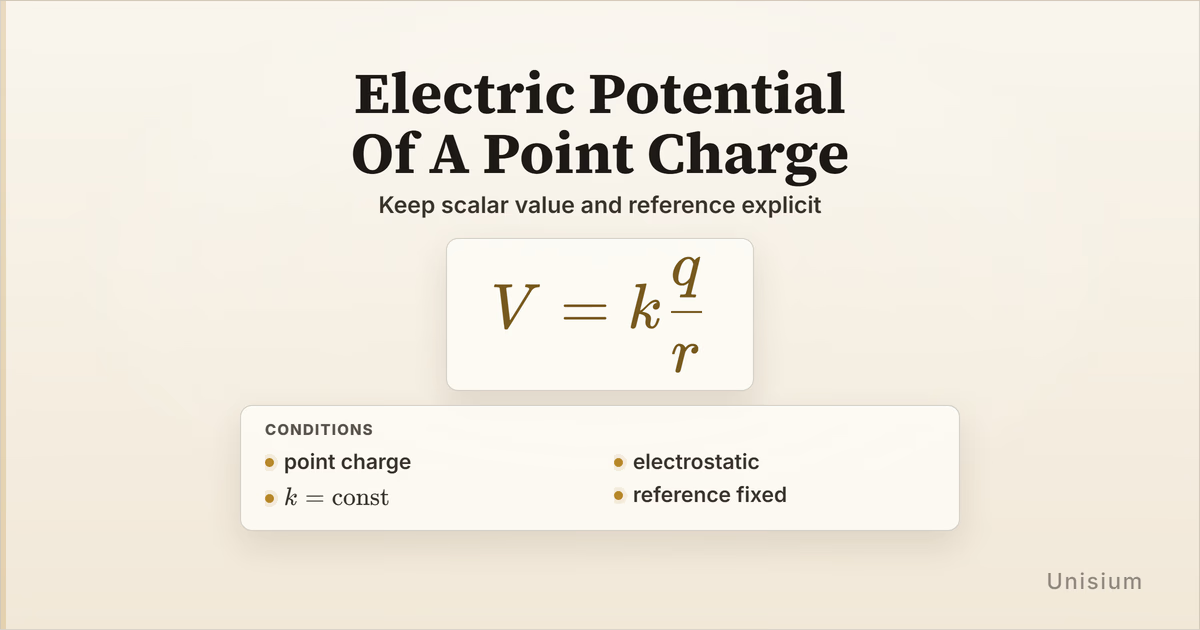
Electric Potential Of A Point Charge: Keep Scalar Value And Reference Explicit
Electric potential of a point charge gives the scalar electric potential created by one point charge at distance r. A common electrostatic form is , used when the source can be treated as a point charge, is constant, and the reference is fixed. Use it when you need scalar potential itself or a clean setup for later energy relations, and do not confuse it with the inverse-square electric field relation.
Electric potential from a point charge is a scalar, not a direction field. The sign of the source charge makes the potential positive or negative relative to the chosen zero level, but there is no arrow attached to the potential itself.
That boundary matters early in electromagnetism. Students often mix three different jobs: using source-to-field-point geometry to get the distance , fixing the reference level for potential, and then switching too quickly to electric field or force language even though this guide is about scalar potential at one point.
On this page: The Principle · Conditions · Misconceptions · Elaborative Encoding · Retrieval Practice · Worked Example · Solve a Problem · Related Principles · FAQ · Related Guides · How This Fits
The Principle
Statement
Electric potential of a point charge gives the scalar electric potential created by one point charge at a chosen field point. With a fixed reference, the potential is proportional to the source charge and inversely proportional to the distance from the source. Unlike electric field, this quantity is scalar: the sign of sets whether the potential is positive or negative relative to the reference, but it does not create a direction arrow.
Mathematical Form
Where:
- is electric potential in V
- is the proportionality constant for the medium in
- is the source charge in C
- is the distance from the source charge to the field point in m
The visual model above fixes the two setup ingredients this relation needs: one source charge and one source-to-field-point distance . The extra condition is not a direction choice but a reference choice, because scalar potential only has meaning relative to a fixed zero level.
Common reference convention
In many introductory electrostatics problems, the fixed reference is , which is why the point-charge relation often appears exactly as written above. The key condition is not infinity by itself; it is that one reference is chosen and kept fixed while you interpret the scalar value.
What this relation does and does not say
- It gives the scalar electric potential at one field point from one point charge.
- The sign of sets the sign of relative to the chosen reference.
- It does not by itself give electric field direction or force on a second charge.
- In multi-source problems, this one-charge result is only one scalar contribution before a larger potential model is assembled.
Conditions of Applicability
Condition: point charge; electrostatic; ; reference fixed
Practical modeling notes
- Point charge means the source is physically tiny compared with the relevant distance scale or is modeled so that only source-to-field-point separation matters.
- Electrostatic means the source charge distribution is treated as fixed in time; you are not modeling changing fields, induction, or radiation effects.
- means one medium-dependent proportionality constant is used across the whole setup.
- Reference fixed means the scalar potential is measured relative to one chosen zero level; changing the reference shifts every absolute potential value by the same amount.
When it does not apply directly
- Extended or continuous charge distributions: if the source cannot be treated as a point charge, you need charge-distribution modeling or integration.
- Time-varying or multi-medium situations: if changing electromagnetic effects or interfaces matter, one electrostatic point-charge relation is not enough.
- Problems asking for field or force instead of potential: if the target is a vector field or force, this scalar relation is not the direct final model step.
Want the complete framework behind this guide? Read Masterful Learning.
Common Misconceptions
Misconception 1: Scalar potential must always be positive
The truth: Scalar means “no direction,” not “nonnegative.” A negative source charge gives negative electric potential relative to the chosen reference.
Why this matters: If you treat every scalar as a magnitude, you lose the sign information that later matters in energy and potential-difference reasoning.
Misconception 2: Point-charge potential falls off as
The truth: Point-charge potential follows an inverse-first-power relation, . The inverse-square dependence belongs to the electric field magnitude, not to scalar potential.
Why this matters: Mixing those distance dependences leads to major size errors and blurs the difference between scalar potential and vector field.
Misconception 3: The reference choice is optional bookkeeping you can ignore
The truth: Absolute potential values depend on the chosen zero level. You can compare or use them consistently only after one reference is fixed.
Why this matters: If the reference drifts mid-problem, the scalar value stops meaning what you think it means.
Elaborative Encoding
Use these questions to build understanding before you memorize the formula. See Elaborative Encoding for the broader method.
Within the Principle
- If the source charge changes sign while the distance stays fixed, what happens to the sign of the potential?
- Why does doubling the distance halve the point-charge potential instead of reducing it to one quarter?
For the Principle
- What clue in a problem tells you that the target is scalar potential rather than electric field or force?
- Why must the reference level be fixed before an absolute potential value is interpreted?
Between Principles
- How is this relation different from Electric Field From Point Charge, which uses the same source geometry but a vector inverse-square field?
Generate an Example
- Describe a setup where the point-charge potential is negative even though the source-to-field-point distance is positive.
Retrieval Practice
Answer from memory, then reveal the result and check it. See Retrieval Practice for the full study method.
State the principle in words: _____A point charge creates an electric potential that is proportional to the source charge and inversely proportional to the distance from the source, measured relative to a fixed reference.
Write the canonical equation: _____
State the canonical condition: _____
Worked Example
Use this worked example to practice Self-Explanation.
Problem
A point charge of is fixed in air. Taking electric potential to be zero at infinity, what electric potential does it create at a point from the charge? Use .
Step 1: Verbal Decoding
Target:
Given:
Constraints: point charge; electrostatic; single medium; reference fixed at infinity
Step 2: Visual Decoding
Draw the source charge and the field point on one line, then label the separation as . Mark that the scalar potential is being evaluated at the field point relative to the chosen zero reference.
(The key visual fact is that one distance sets the size, while the sign of the source charge sets the sign of the scalar potential.)
Step 3: Physics Modeling
Step 4: Mathematical Procedures
Step 5: Reflection
- Dimensional analysis: times reduces to , so the units match electric potential.
- Interpretation: The negative source charge makes the scalar potential negative relative to the zero-at-infinity reference.
- Parameter dependence: If the field point were twice as far away, the potential would be half as large in magnitude because this relation scales as .
Before moving on: self-explain the model
Try explaining why the sign of the result comes from the source charge rather than from a direction choice, and why fixing the zero reference is part of the model rather than optional extra wording.
Physics model with explanation
Principle: We use electric potential of a point charge because one source charge creates the scalar potential at one chosen field point.
Conditions: The source is treated as a point charge, the situation is electrostatic, one constant is used, and the reference is fixed by taking potential to be zero at infinity.
Relevance: This is the right principle when the target is scalar potential itself rather than electric field or force.
Description: The geometry contributes one source-to-field-point distance , while the source charge contributes the sign. Because potential is scalar, the sign tells you positive versus negative relative to the chosen reference, not a direction in space.
Goal: We want the numerical potential at the field point, so one direct substitution into is enough once the reference has been stated.
Solve a Problem
Apply what you have learned with Problem Solving.
Problem
A point charge of is fixed in air. Taking electric potential to be zero at infinity, what electric potential does it create at a point from the charge? Use .
Hint: Keep the reference choice explicit and remember that the denominator is , not .
Show Solution
Step 1: Verbal Decoding
Target:
Given:
Constraints: point charge; electrostatic; single medium; reference fixed at infinity
Step 2: Visual Decoding
Draw the source charge and the field point separated by , and note that the scalar potential is measured relative to the same zero-at-infinity reference.
(The key visual fact is that the positive source keeps the scalar potential positive relative to that fixed reference.)
Step 3: Physics Modeling
Step 4: Mathematical Procedures
Step 5: Reflection
- Interpretation: The positive source charge makes the scalar potential positive relative to the chosen zero reference.
- Parameter dependence: If the field point moved to twice the distance, the potential would fall to half of this value.
- Connection to concept: This is a scalar potential value at one point, not a force or field-direction answer.
Related Principles
See Electromagnetism: The Principle Map for placement in the subdomain and the wider guides library for adjacent study paths.
| Principle | Relationship to electric potential of a point charge |
|---|---|
| Electric Field From Point Charge | Both use the same source-to-field-point geometry, but this guide gives scalar potential while the field relation gives a vector inverse-square field. |
| Coulomb Force | Coulomb force models interaction between two charges, while this guide gives the scalar potential created by one source charge at a point. |
| Electric Potential Energy From Potential | Multiplying a scalar potential by a charge leads to a later energy relation, so this guide is one bridge into electric-potential-energy modeling. |
See Principle Structures for a broader view of how nearby relations connect.
FAQ
What is electric potential of a point charge?
It is the scalar electric potential created by one point charge at a chosen field point. In a common electrostatic setup with a fixed reference, it is written .
When does the point-charge potential formula apply?
It applies when the source can be treated as a point charge, the situation is electrostatic, one constant describes the medium, and the reference level for potential is fixed.
Why can the potential be negative?
Because electric potential is scalar, not always nonnegative. A negative source charge gives negative potential relative to the chosen reference.
Is this the same as electric field from a point charge?
No. Electric potential is a scalar that falls as , while the electric field is a vector that falls as and carries direction.
Why does the reference choice matter?
Absolute potential values depend on where you choose zero. If you do not keep the same reference throughout the problem, the scalar value stops being consistent.
Related Guides
- Principle Structures — Place point-charge potential inside a wider map of related physics principles.
- Electric Field From Point Charge — Compare scalar potential with the nearby vector field relation.
- Retrieval Practice — Make quickly available from memory.
- Problem Solving — Use fixed-reference potential cleanly in new electromagnetism setups.
How This Fits in Unisium
In Unisium, this principle sits in the early electromagnetism sequence where students need to keep scalar potential separate from vector field and force language. The progression is to retrieve the point-charge potential relation, keep the fixed-reference condition explicit, and then explain worked examples where sign, distance, and reference each do one clear job. Check access and join the Unisium waitlist or see the wider framework in Masterful Learning.

Masterful Learning
The book behind these guides: a study system for physics, math, & programming built on retrieval, connection, explanation, and problem solving.
Ready to apply this strategy?
Unisium turns these evidence-based techniques into guided study sessions for math and physics. Places are limited during early access. Check current availability to start a trial; joining the mailing list is optional.
See plans and availability Read More GuidesAlready have access? Sign in