Electric Field From Point Charge: Start With Magnitude, Keep Radial Direction Explicit
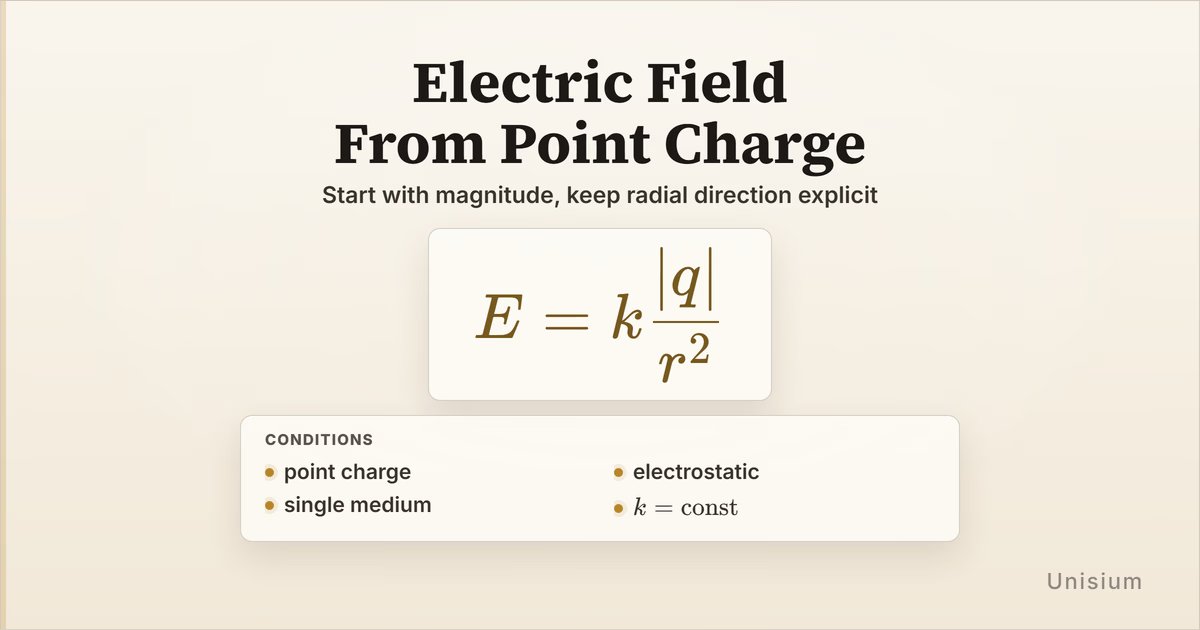
Electric Field From Point Charge says that one point charge creates an inverse-square electric field around itself. A common first form is , which gives field magnitude at distance from the source charge. Use it for a point charge in electrostatics with one medium and constant , then keep the radial direction explicit when you need the full field vector.
Electric Field From Point Charge is one principle with multiple accepted forms. The scalar magnitude form isolates how source charge size and distance set field strength, while the vector form carries the same inverse-square dependence together with the radial direction from the source to the field point.
That boundary matters early in electromagnetism. Many mistakes come from mixing two separate jobs: using the inverse-square law to get field magnitude, and then using source-charge sign plus geometry to decide whether the field points with or against the chosen radial direction.
On this page: The Principle · Conditions · Misconceptions · Elaborative Encoding · Retrieval Practice · Worked Example · Solve a Problem · Related Principles · FAQ · Related Guides · How This Fits
The Principle
Statement
Electric Field From Point Charge gives the electric field created by one point charge at a chosen field point. In the common scalar magnitude form, the field magnitude is proportional to the source-charge magnitude and inversely proportional to the square of the distance from the source. In the vector form, the same relation also keeps the radial direction explicit, so the field points away from a positive source charge and toward a negative source charge.
Mathematical Form
Accepted Forms
Direction-aware vector form:
This guide starts with the scalar form because it keeps the inverse-square magnitude relation visible. Use the vector form when source-charge sign and radial direction must stay inside the modeled step.
Where:
- is the electric field magnitude in
- is the proportionality constant for the medium in
- is the source charge in C
- is the distance from the source charge to the field point in m
- is the unit vector pointing from the source charge to the field point
The diagram labels the source charge as . The formula above uses for the same source-charge quantity.
The visual model above fixes the two geometry ingredients the relation needs: the separation from source to field point and the radial reference direction . For a positive source charge, the field points with ; for a negative source charge, the field points opposite at the same field point.
What this form does and does not say
- It gives the field created by one point charge at one field point.
- The scalar magnitude form gives field magnitude only.
- Source-charge sign and radial geometry decide the full vector direction.
- If more than one source contributes, this one-charge field is only one ingredient of the net field.
Conditions of Applicability
Condition: point charge; electrostatic; single medium;
Practical modeling notes
- Point charge means the source is physically tiny compared with the relevant distance scale or is modeled so that only source-to-field-point separation matters.
- Electrostatic means the source charge distribution is treated as fixed in time; you are not modeling changing fields, magnetic induction, or radiation effects.
- Single medium means the field point and source are treated within one medium, so the same proportionality constant applies throughout the relation.
- means one medium-dependent value of is used across the whole setup.
When it does not apply directly
- Extended or continuous charge distributions: if the source cannot be treated as a point charge, you need charge-distribution modeling or integration.
- Multiple source charges: this relation can still supply each individual field contribution, but the net field needs vector addition through superposition.
- Time-varying or multi-medium situations: if the setup crosses media or changing electromagnetic effects matter, one electrostatic point-charge relation is not enough.
Want the complete framework behind this guide? Read Masterful Learning.
Common Misconceptions
Misconception 1: A negative source charge makes the field magnitude negative
The truth: The scalar magnitude form uses , so the field magnitude is nonnegative. The sign of matters for the field direction in the vector form, not for making the magnitude itself negative.
Why this matters: If sign leaks into the magnitude step, you blur the difference between “how strong is the field?” and “which way does it point?” That confusion causes errors once direction becomes part of the answer.
Misconception 2: The distance is whatever distance looks convenient in the sketch
The truth: In this model, is the separation from the source charge to the field point where the field is being evaluated.
Why this matters: The relation is inverse-square, so even a small distance mistake changes the field magnitude sharply.
Misconception 3: This one-charge relation already gives the net field in a many-charge setup
The truth: It gives one source’s contribution. If several charges create the field, you must combine their contributions with vector addition.
Why this matters: Many electromagnetism problems fail at the boundary between one-source modeling and net-field modeling. Keeping that boundary explicit makes later Electric Field-Force Relation work cleaner too.
Elaborative Encoding
Use these questions to build understanding before you memorize the formula. See Elaborative Encoding for the broader method.
Within the Principle
- If the distance from the source charge doubles while the source charge stays fixed, what happens to the field magnitude?
- What information does carry that the scalar magnitude form does not?
For the Principle
- What clues in a problem tell you that the point-charge approximation is reasonable for the source?
- When should you stop with this one-source relation and move to a net-field model instead?
Between Principles
- How is this relation structurally different from Coulomb Force, which models interaction between two charges rather than the field created by one source charge?
Generate an Example
- Describe a setup where the magnitude form is valid, but a complete final answer still needs separate radial-direction reasoning.
Retrieval Practice
Answer from memory, then reveal the result and check it. See Retrieval Practice for the full study method.
State the principle in words: _____A point charge creates an electric field whose magnitude is proportional to the charge magnitude and inversely proportional to the square of the distance from the source; the vector form keeps the radial direction explicit.
Write the canonical equation: _____
State the canonical condition: _____
Worked Example
Use this worked example to practice Self-Explanation.
Problem
A point charge of is fixed at the origin. What electric field vector does it create at a point to the right of the charge in air? Use .
Step 1: Verbal Decoding
Target:
Given:
Constraints: point charge; electrostatic; single medium; constant ; one-dimensional horizontal geometry
Step 2: Visual Decoding
Draw a horizontal axis with the source charge at the origin and the field point to the right. Mark the source-to-field-point separation as and set the radial direction from the source to the field point as .
(The key visual fact is that a positive source makes the field point away from the source, so the final vector will align with .)
Step 3: Physics Modeling
Step 4: Mathematical Procedures
Step 5: Reflection
- Dimensional analysis: times reduces to , so the units match electric field.
- Magnitude check: A few hundred thousand newtons per coulomb is reasonable for a microcoulomb source at a distance of only a few tenths of a meter.
- Interpretation: The positive source sets the field direction away from the charge, so at a point to the right the field points in .
Before moving on: self-explain the model
Try explaining why the geometry lets you instantiate the vector form directly here, which part of the setup fixes as the radial direction, and why the same distance would give the opposite field direction for a negative source charge.
Physics model with explanation
Principle: We use Electric Field From Point Charge because one source charge creates the field and the target is the field at one specified point.
Conditions: The source is treated as a point charge, the situation is electrostatic, the medium is uniform, and one constant is used throughout the calculation.
Relevance: This is the right principle when a problem gives one source charge and asks for the field it creates at a chosen distance.
Description: The inverse-square relation sets the field magnitude, and the geometry fixes the radial direction. Because the source charge is positive and the field point is to the right, the vector model instantiates cleanly with .
Goal: We want the field vector at the field point. The calculation keeps direction inside the modeled step instead of attaching it only after a scalar magnitude calculation.
Solve a Problem
Apply what you have learned with Problem Solving.
Problem
A point charge of is fixed at the origin. What electric field vector does it create at a point to the left of the charge in air? Use .
Hint: Fix the radial direction from the source to the field point first, then let the sign of the source charge determine whether the field stays with or against that direction.
Show Solution
Step 1: Verbal Decoding
Target:
Given:
Constraints: point charge; electrostatic; single medium; constant ; one-dimensional horizontal geometry
Step 2: Visual Decoding
Draw a horizontal axis with the field point to the left of the source charge. Mark the radial direction from source to field point as , then note that a negative source makes the field point opposite that radial direction.
(The key visual fact is that the geometry sets to the left, but the negative source reverses the field vector relative to .)
Step 3: Physics Modeling
Step 4: Mathematical Procedures
Step 5: Reflection
- Verification: The two negative factors in the instantiated vector model cancel, leaving a rightward field vector.
- Interpretation: A field point to the left of a negative source sees the field point back toward the source, so the vector is rightward.
- Parameter dependence: If the distance doubled, the field magnitude would drop to one quarter of this value.
Related Principles
See Electromagnetism: The Principle Map for placement in the subdomain and the wider guides library for adjacent study paths.
| Principle | Relationship to Electric Field From Point Charge |
|---|---|
| Coulomb Force | Both use the same inverse-square structure, but Coulomb force models pairwise interaction while this guide models the field created by one source charge at a point. |
| Electric Field-Force Relation | Once this guide gives the local electric field, turns that field into force on a charge placed at the field point. |
| Electric Field Superposition | In multi-source problems, each point-charge field is one contribution to the net field, which is found by vector addition. |
See Principle Structures for a broader view of how nearby relations connect.
FAQ
What is electric field from a point charge?
It is the inverse-square field created by one point charge at a chosen field point. A common first form is , which gives field magnitude before you attach radial direction.
When does the point-charge electric field formula apply?
It applies when the source can be treated as a point charge, the situation is electrostatic, the setup stays in one medium, and one constant describes that medium.
Why does the common magnitude form use the absolute value of the charge?
Because the scalar form isolates field magnitude. The sign of the source charge still matters physically, but it matters for the direction in the vector form rather than for making the magnitude negative.
How do I decide the field direction?
First choose the radial direction from the source charge to the field point. Then use the source-charge sign: positive charges give field with , while negative charges give field opposite .
What changes when more than one charge contributes to the field?
This one-charge relation still gives each separate contribution, but the net field must be found by adding those contributions as vectors instead of treating one source law as the whole answer.
Related Guides
- Coulomb Force — Compare pairwise force between charges with the field created by one source charge.
- Electric Field-Force Relation — Turn a known field into force on a charge placed at the field point.
- Electromagnetism: The Principle Map — Place this one-source field law in the electromagnetism progression.
- Problem Solving — Use the relation inside structured worked examples and solo practice.
How This Fits in Unisium
In Unisium, this principle sits between pairwise source-charge interaction and multi-source field reasoning: first retrieve the inverse-square one-source field law, then explain why source sign changes radial direction, then practice when this guide is enough and when a problem needs superposition or a later force relation. Check access and join the Unisium waitlist or see the wider framework in Masterful Learning.

Masterful Learning
The book behind these guides: a study system for physics, math, & programming built on retrieval, connection, explanation, and problem solving.
Ready to apply this strategy?
Unisium turns these evidence-based techniques into guided study sessions for math and physics. Places are limited during early access. Check current availability to start a trial; joining the mailing list is optional.
See plans and availability Read More GuidesAlready have access? Sign in